
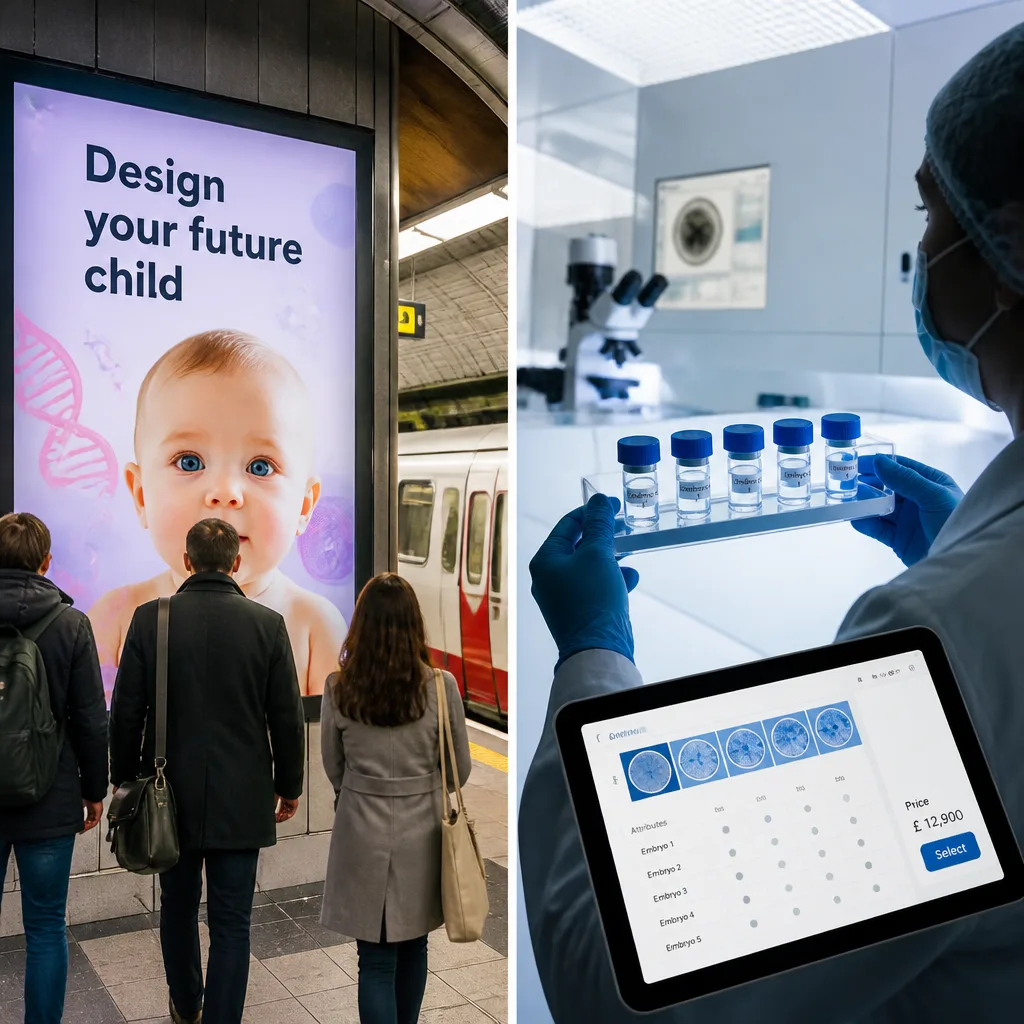
Silicon Valley companies are offering advanced embryo‑screening services that claim to forecast everything from disease risk to likely height and even aspects of intelligence, setting off a heated debate about ethics, regulation and what constitutes appropriate reproductive care.
What the new services offer
Fertility startups in the United States have begun advertising polygenic embryo screening directly to consumers. Some firms present bold marketing messages to commuters and online audiences; one campaign that ran in New York’s subway system featured the slogan
“Have your best baby.”
Firms such as Nucleus and Orchid promote tests that assess embryos created through in‑vitro fertilisation (IVF) for a range of genetic indicators. Services on the market claim to estimate future susceptibility to certain common diseases, and in some cases predict traits such as height, hair and eye colour and even measures of cognitive ability. Prices can be substantial: one company’s screening offering has been advertised at up to $50,000.
How widely could this be used?
For now, embryo screening is limited to children conceived by IVF, which remains a minority route to parenthood. In the United States in 2024, about 100,000 babies were born after IVF — roughly 2.8% of the total births that year. But investors and some clinicians believe that growing public interest, combined with increasing funding for fertility research, could accelerate adoption of genetic testing linked to IVF.
Support, scepticism and opposition
Company founders argue that their products meet a consumer demand. Kian Sadeghi of Nucleus said the subway ads signalled a mainstream ambition: “This is a mass‑market product. What’s a better way of showing that it’s a mass‑market product than the subway?”
Yet several groups — including many geneticists, medical professionals and ethicists — question the science and the ethics behind polygenic embryo screening. There are concerns about the accuracy and predictive value of current tests for complex traits, the commercialisation of reproduction and potential social harms such as increased inequality or new forms of discrimination.
Others in the marketplace frame their services in starkly pragmatic terms. Noor Siddiqui of Orchid, a competitor, has contrasted the roles of sex and embryo testing, saying: “sex is for fun; embryo screening is for babies”.
Legal frameworks and national differences
Regulation varies widely. Several jurisdictions, including the UK, already place legal limits on selecting embryos for non‑medical reasons. Screening embryos for sex selection, and for polygenic traits such as height or intelligence, is illegal in many countries. By contrast, the regulatory environment in the US is comparatively permissive, and has permitted a faster roll‑out of commercial services.
What this could mean for patients and policy
Even if only a small proportion of births are currently linked to IVF, the increasing availability of embryo‑level genetic information poses questions for clinicians and regulators. Policymakers will need to weigh potential benefits — preventing serious inherited disease, for example — against risks including over‑promising on predictive accuracy and the ethical implications of selecting embryos for traits.
Public attitudes also matter. Surveys suggest strong interest among Americans in using polygenic screening if already undergoing IVF; nearly three‑quarters say they would consider it. That popularity, coupled with private investment, could drive further development of the sector unless regulators intervene.
- Investment pressure: Funding into fertility research may speed technological advances.
- Regulatory gap: Differences between countries create a patchwork of access and standards.
- Scientific limits: Experts warn current predictions for complex traits remain uncertain.
| Statistic | Figure |
|---|---|
| US babies born after IVF (2024) | 100,000 (2.8% of births) |
| Maximum advertised cost for some embryo screening services | $50,000 |
The debate over embryo screening spans more than medical science: it touches on societal values about parenthood, fairness and the limits of consumer choice in medicine. As the market evolves, health services, regulators and the public will be asked to decide which uses of genomic technology are acceptable and which should be restricted. For now, the industry’s next steps and the regulatory responses they provoke will determine whether these services remain niche offerings or become a routine part of reproductive care.