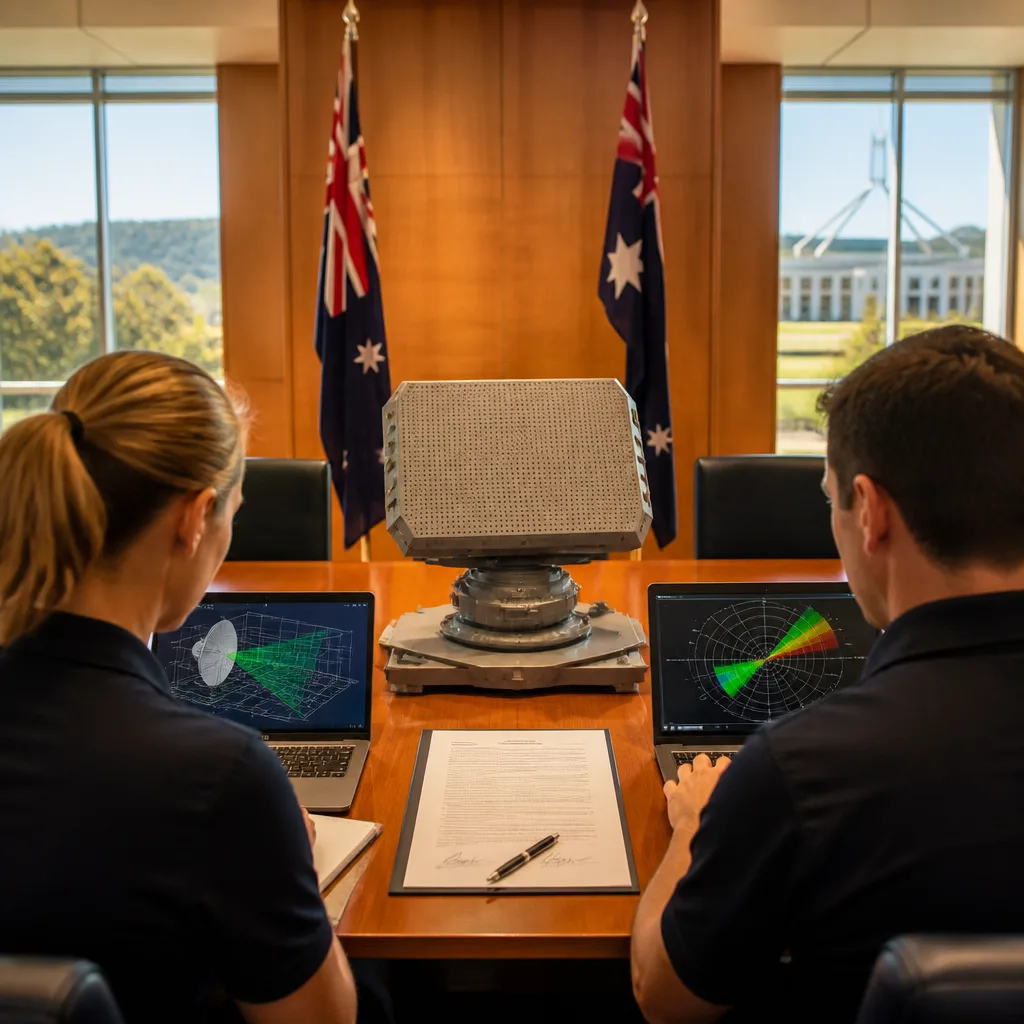
The United Kingdom and Australia have signed a statement of intent to examine whether Australian-designed active electronically scanned array (AESA) radar systems can be adopted for use by the British Armed Forces.
What has been agreed
The agreement, struck in Canberra, brings together the UK Ministry of Defence, the Australian Department of Defence, British defence firm QinetiQ and Canberra-based CEA Technologies. Under the proposed arrangement, CEA would supply its domestically developed AESA radar hardware while QinetiQ would lead integration, testing and technical assurance work to assess suitability for UK military platforms.
Why AESA matters
AESA radars use multiple electronically steered beams to detect, track and discriminate targets without mechanically moving the antenna. That architecture supports faster target updates, can track multiple threats at once and is widely used for air and missile defence as well as surveillance roles. The technology is central to modern sensor architectures and, if adopted, would influence how the UK configures its layered air and maritime surveillance systems.
Operational pedigree and immediate aims
CEA Technologies’ systems are already in operational use with the Australian Defence Force, notably on Anzac-class frigates and as part of land-based air defence installations. The statement of intent focuses on technical workstreams to evaluate how those sensors could be hardened, integrated and assured for UK platforms and doctrines.
- Supplier role: CEA Technologies to provide radar hardware.
- Systems integration: QinetiQ to manage integration, testing and technical assurance.
- Government partners: UK MoD and Australian Department of Defence to coordinate policy, access and potential procurement paths.
Those discussions are expected to cover the technical feasibility of installation, interoperability with UK command-and-control systems, sustainment arrangements and potential supply-chain implications.
Context: a wider defence and industrial tour
The radar agreement was signed during a broader visit by the UK Minister for Defence Readiness and Industry, who spent a week in Australia and New Zealand focused on defence production, supply chains and maritime cooperation. During the trip, officials discussed access to critical minerals and deeper coordination between the two nations’ defence industries.
As part of the same visit the minister planned to inspect the Henderson shipyard in Western Australia, a significant site for the maritime work related to the trilateral AUKUS submarine programme. He was also scheduled to travel to New Zealand for further talks on maritime capability and to visit sites including Devonport Naval Base, Rocket Lab and an uncrewed aircraft maker.
Implications and next steps
The statement of intent is a preliminary step: it commits the parties to explore integration options rather than to procure equipment. The move does, however, illustrate a growing willingness to consider closer industrial and operational ties with likeminded defence suppliers in the Indo-Pacific.
From a UK planning perspective, the inclusion of a systems integrator such as QinetiQ is significant. It signals an intent to evaluate not merely the radar hardware, but the full integration pathway — software, mission systems, testing regimes and technical assurance — that would be required before any fielding decision. For policymakers, questions will follow on logistics, long-term maintenance, export controls and how such sensors would fit alongside other UK and NATO systems.
| Organisation | Stated role |
|---|---|
| CEA Technologies | Provide AESA radar technology |
| QinetiQ | Integration, testing and technical assurance |
| UK Ministry of Defence | Policy and procurement coordination |
| Australian Department of Defence | Policy and operational coordination |
Any move to adopt foreign-developed sensors will also raise industrial-policy considerations at home, including how UK suppliers might be involved in upgrades or sustainment to secure jobs and sovereign capability. The statement of intent sets a framework for testing and evaluation; it does not yet change force structure or acquisitions.
For now, the agreement places radar technology and supply-chain cooperation squarely on the agenda of UK–Australia defence ties, and it will be watched closely by defence planners and contractors on both sides of the world.