
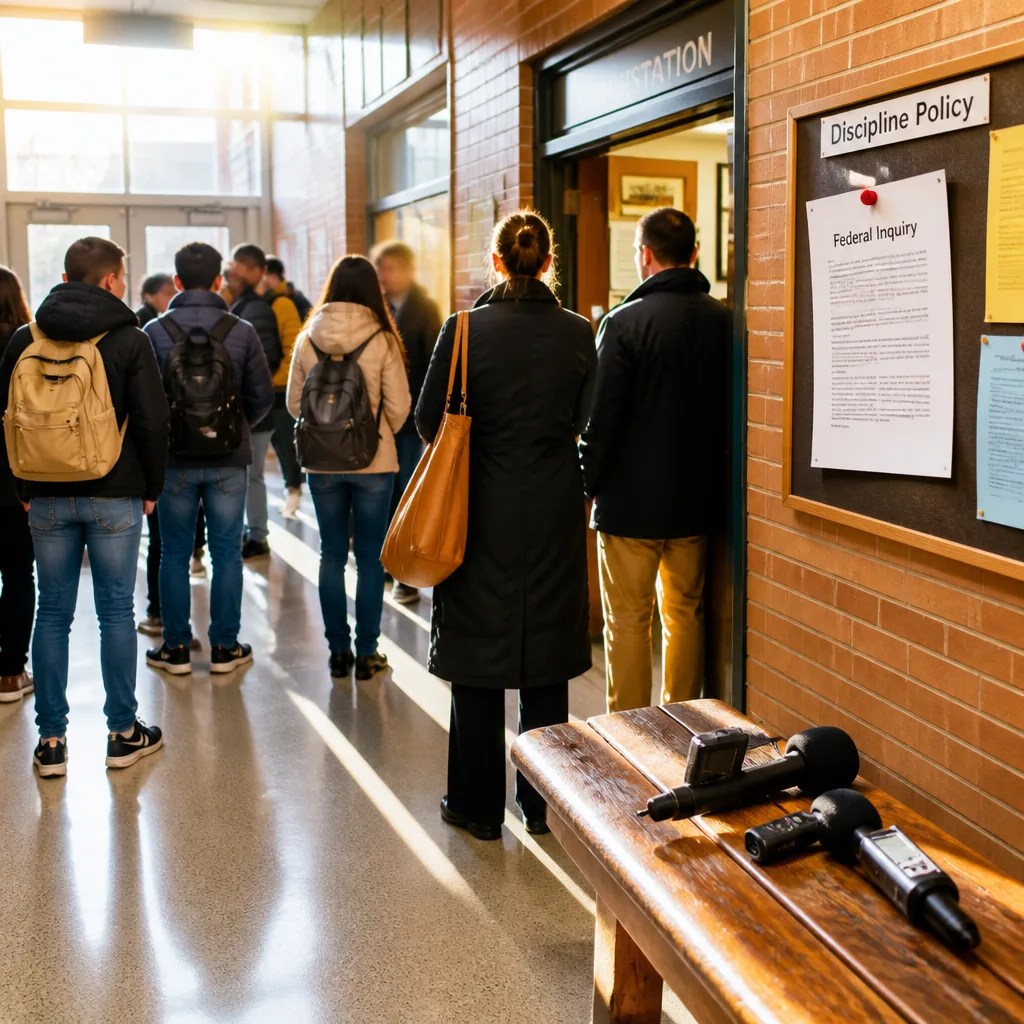
The U.S. Department of Education has announced an investigation into Fayetteville Public Schools in Arkansas after alleging teachers were directed to take pupils' racial identities into account when imposing discipline as part of a restorative justice approach. The department's action — and accompanying guidance from its Office for Civil Rights (OCR) warning schools not to factor race into disciplinary decisions — has reopened a fraught national debate over when discipline practices cross the line into unlawful discrimination.
Shock and confusion in district
District leaders said they were taken by surprise. Superintendent John Mulford told reporters the district received notice of the probe only about two hours before the Education Department publicly identified Fayetteville as a subject of investigation, leaving local officials uncertain about the precise allegations and the department's rationale.
"We're a little shocked at this point and completely in the dark as to what this is even about," Mulford said.
Mulford said Fayetteville has focused on refining the consistency of its disciplinary procedures, work he maintained aligns with federal civil‑rights law. He described the department's public naming of the district as unexpected and said officials were awaiting clarification from the federal agency.
What the department says and the guidance it issued
The Education Department's announcement framed the issue around a practice of asking staff to consider pupils' racial identities when deciding on discipline, purportedly to redress racial disproportionality in sanctions through restorative justice techniques. The OCR has warned that taking race into account when disciplining pupils could prompt civil‑rights investigations.
The development touches on long‑standing questions about how schools should respond when neutral‑looking policies produce unequal outcomes. Enforcement officials and civil‑rights advocates have historically focused on discipline data — who is suspended or expelled, how often and for how long — to detect patterns of disparate impact. The new guidance and the probe signal renewed federal attention to the boundary between permissible efforts to tackle disproportionality and practices that may themselves amount to unlawful race‑based treatment.
Why the controversy matters
At stake is how schools balance two competing priorities:
- Efforts to reduce racial disparities in discipline through restorative practices and other reforms;
- The legal requirement under federal civil‑rights statutes not to make disciplinary decisions on the basis of race.
Critics of past discipline policies argue that neutral rules have often produced deeply unequal results, disproportionately affecting pupils of colour. That reality prompted administrations and advocates to push for new approaches, including restorative justice, which emphasise repairing harm and keeping pupils in class rather than imposing exclusionary punishment.
But federal investigators have long grappled with whether and when a policy or practice, even if well‑intentioned, runs afoul of civil‑rights law because of its disparate effect or because it expressly uses race as a decision factor.
Broader implications for schools and policy
The OCR's latest guidance and the Fayetteville inquiry are likely to reverberate beyond one district. School leaders nationwide have been experimenting with interventions to address disproportionality in disciplinary outcomes. The department's stance places principals and local authorities in a difficult position: they must avoid any practice that could be construed as race‑conscious in discipline, while still responding to statistical disparities that suggest certain groups are being penalised more harshly.
For now, Fayetteville's leaders and the wider education community are left seeking clarity on how the Education Department intends to apply civil‑rights law to the complex realities of school discipline reform. The case underlines the persistent tensions between civil‑rights enforcement, local reform efforts and the drive to keep pupils engaged in learning.
| Element | Detail |
|---|---|
| Subject of investigation | Fayetteville Public Schools, Arkansas |
| Agency | U.S. Department of Education, Office for Civil Rights |
| Core issue | Whether considering pupils' race in discipline decisions constitutes unlawful discrimination |











