
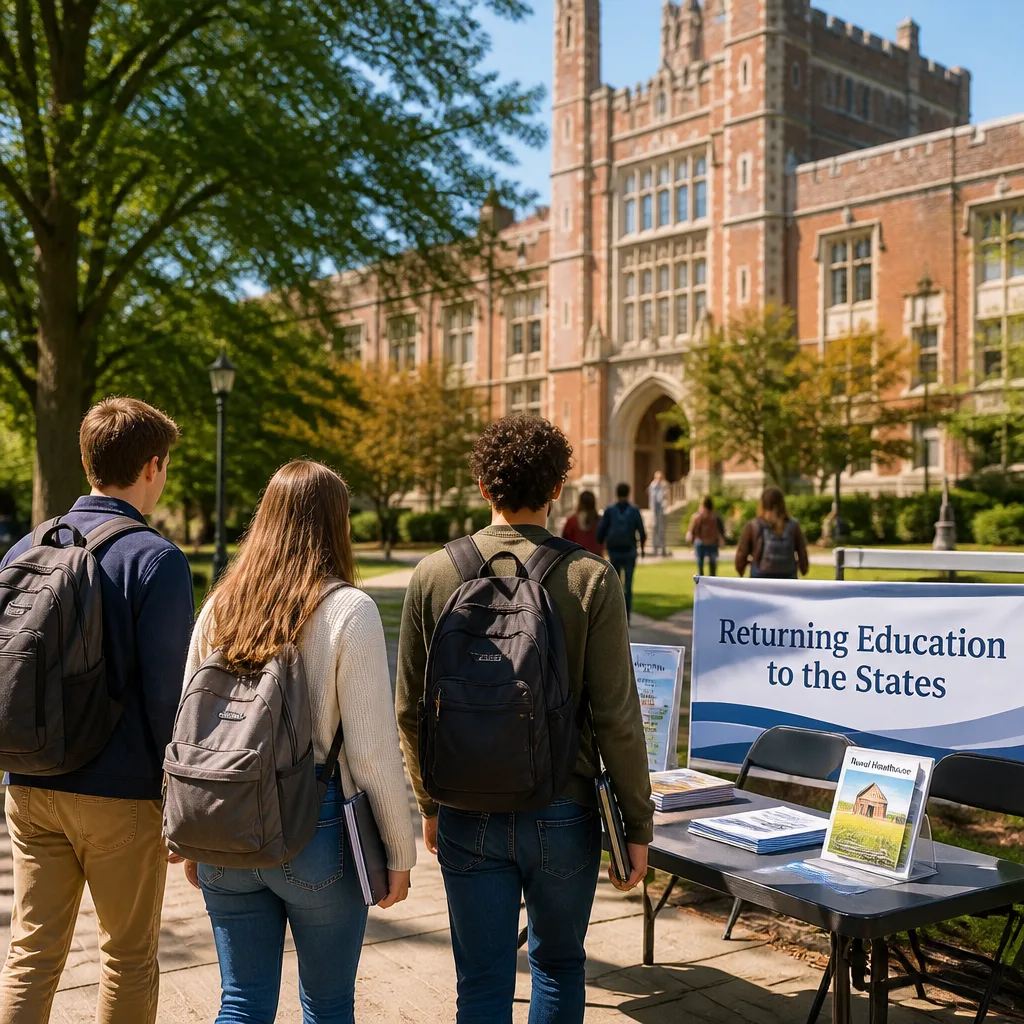
U.S. Secretary of Education Linda McMahon visited Washington University in St Louis on Wednesday as part of her ongoing national tour to engage educators and families across the country. The visit forms one stop in a series intended to explore how education intersects with local communities, and included a roundtable discussion on rural healthcare, meetings with university leadership and conversations about higher education’s role in civic and economic development.
Engagement across campus and community
According to material supplied by the university and the U.S. Department of Education, the visit included a roundtable on rural healthcare and a meeting with leaders of the university’s Gephardt Institute. University officials also said the Secretary met with Chancellor Andrew D. Martin to discuss how higher education contributes to community development and student success.
The Department of Education’s tour — billed as the Returning Education to the States Tour — is designed to gather local perspectives and showcase initiatives from across the country. Missouri was noted as the 42nd stop on the tour, and Washington University represented the 12th university the Secretary has visited so far, following campuses such as Auburn University, the University of Tennessee Knoxville and Montana State University.
"We are pleased that she was able to experience firsthand the commitment to life-changing research, excellence in teaching, and the development of future leaders all central to the WashU mission,"
This written remark was provided by the university’s executive director of strategic initiatives in a cutline shared with student media, and reflects the institution’s appreciation of the Secretary’s engagement on campus.
Timing and optics
Photographic metadata supplied with the university’s coverage places the Secretary on campus in the mid-afternoon, with images timestamped at 15:31 and 16:33. University communications emphasised a joint focus on "student success and the local community" in a statement attributed to the associate vice-chancellor for communications.
Washington University also indicated that the Secretary’s presence coincided with other campus events. Chancellor Martin, who met with the Secretary, missed a separate 16:00 forum where a series of brief faculty presentations discussed a commissioned report on the state of scholarship in the humanities and humanistic social sciences.
What the visit signals
- Policy reach: The tour underlines an effort by federal education leadership to connect national policy conversations with local institutional practice.
- Focus areas: Rural healthcare and community development were foregrounded during this visit, indicating those issues are priorities in the tour’s agenda.
- Higher education partnerships: Engagements with university leadership and research institutes point to an emphasis on the university sector’s role in regional development and student outcomes.
For the university, hosting a cabinet-level official offers an opportunity to highlight institutional priorities and partnerships, while for the Department of Education the campus visit provides ground-level perspective on how federal initiatives intersect with teaching, research and community activity.
| Detail | Information |
|---|---|
| Tour name | Returning Education to the States Tour |
| Missouri visit number | 42nd stop on tour |
| Universities visited so far | 12th university visited |
| Noted campus events | Roundtable on rural healthcare; meeting with Gephardt Institute; Chancellor meeting |
While the public material supplied by the university and student media gives a snapshot of the visit, the tour as a whole remains an unfolding effort to collect insights from across diverse educational settings. Observers of higher education policy will be watching how themes raised in these campus conversations — particularly around community engagement and student success — influence federal priorities and funding decisions in the months ahead.
As this engagement continues, institutions and communities visited by the Secretary may seek to translate these high-level discussions into concrete collaborations that support local healthcare needs, workforce pipelines and student retention strategies.











