
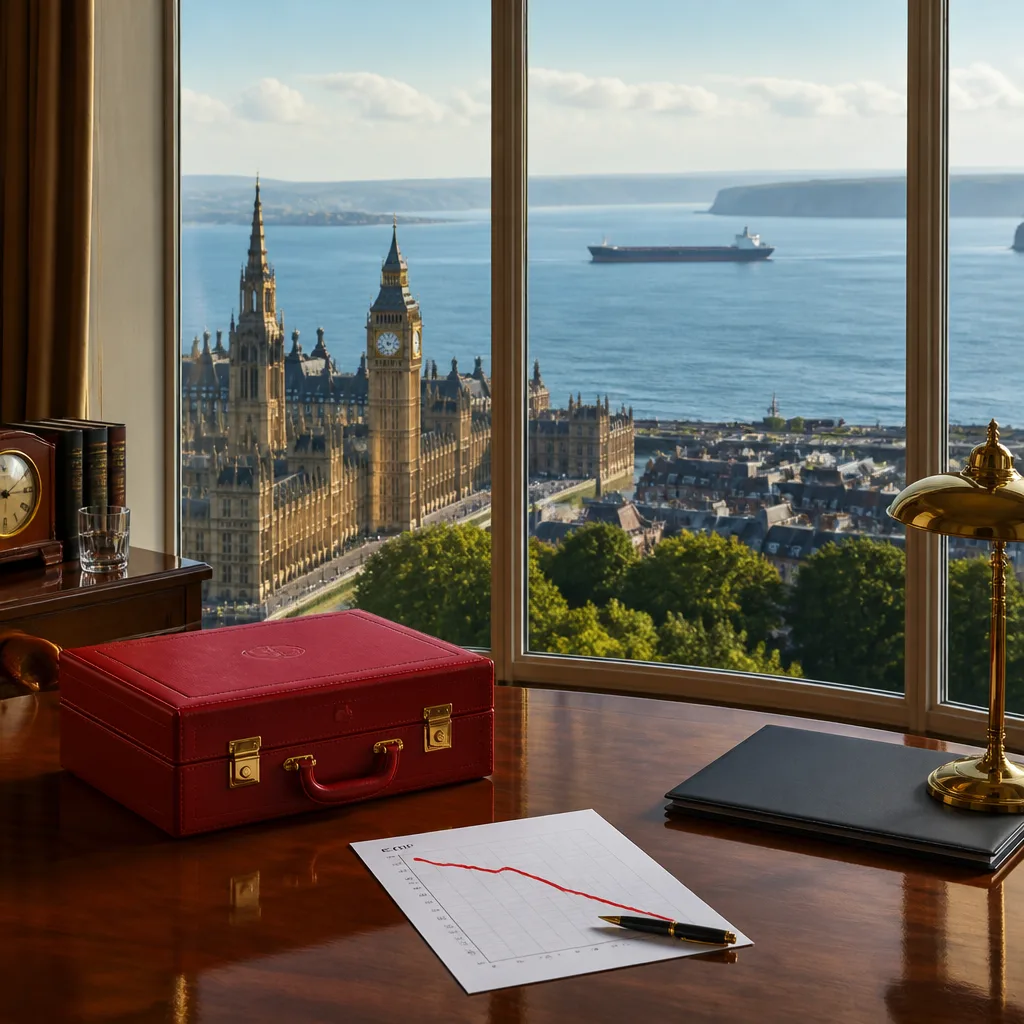
The UK could face near-stagnant growth next year if disruption in the Strait of Hormuz continues into 2026, Treasury modelling presented to Prime Minister Andy Burnham and Chancellor John Healey suggests.
Officials say the most adverse scenario examined — effectively a closed Strait of Hormuz for several months and no lasting US-Iran ceasefire until the new year — would trim GDP to as little as 0.3% in 2027. That projection sits well below the Office for Budget Responsibility's March forecast of 1.6% for the same year and follows a weaker-than-expected second half of this year after an initially strong start.
Modelling and immediate effects
Treasury sources said ministers were shown a range of situations as part of routine contingency planning. Under one described as a reasonable worst case, the economy would still grow in 2026 — but only by around 0.9%, marginally lower than the OBR's earlier 1.1% estimate.
The conflict has already pushed up global oil and fuel prices while disrupting supply chains, hitting some businesses and slowing progress after the economy began the year on a firm footing. Inflation, currently at 2.6%, would be expected to reach a peak of about 4.3% in the opening quarter of next year under the stress scenario.
| Measure | Office for Budget Responsibility (March) | Treasury reasonable worst-case |
|---|---|---|
| Growth 2026 | 1.1% | 0.9% |
| Growth 2027 | 1.6% | 0.3% |
| Inflation peak | — | 4.3% (Q1 2027) |
Political and policy implications
Ministers will face heightened pressure to use the Budget on 28 October to reduce the strain on households and firms if the geopolitical shock endures. Since taking office three weeks ago, the prime minister has introduced measures designed to ease the cost of living, including the removal of VAT from domestic electricity bills and bringing forward plans to end subscription traps.
But Downing Street figures have indicated that these steps may not be sufficient in isolation. The prime minister has asked the chancellor to examine further options ahead of the Budget, with Mr Healey signalling the announcement will concentrate heavily on household finances.
"It will be his 'main focus'."
That phrase, used by Treasury sources when describing the chancellor's stance, underlines the central political dilemma: balancing support measures against already tight public finances while preparing for a possible deterioration in growth and a temporary rise in inflation.
Near-term data and risks
Official statistics due on Thursday are expected to show modest growth for the April–June quarter, with economists forecasting around 0.4% expansion. But Treasury scenarios make clear how sensitive the outlook is to external shocks, especially sustained disruption to oil flows and global trade routes.
- Energy costs: higher oil and fuel prices have already fed into business and household budgets.
- Supply chains: continued disruption could further choke manufacturing and trade-sensitive sectors.
- Fiscal pressure: a weaker economy will intensify demand for targeted Budget measures to protect living standards.
Government officials stress that contingency planning is routine and that the scenarios presented are designed to help ministers weigh policy responses. But with the Budget a matter of weeks away and the international situation unresolved, ministers face a compressed window to assess whether and how to recalibrate support for families and firms in the face of a possible sharp slowdown.
How the administration reconciles short-term rescue measures with longer-term fiscal discipline will be the defining economic test of the coming months if the Iran conflict keeps pushing global prices and disrupting trade routes.















