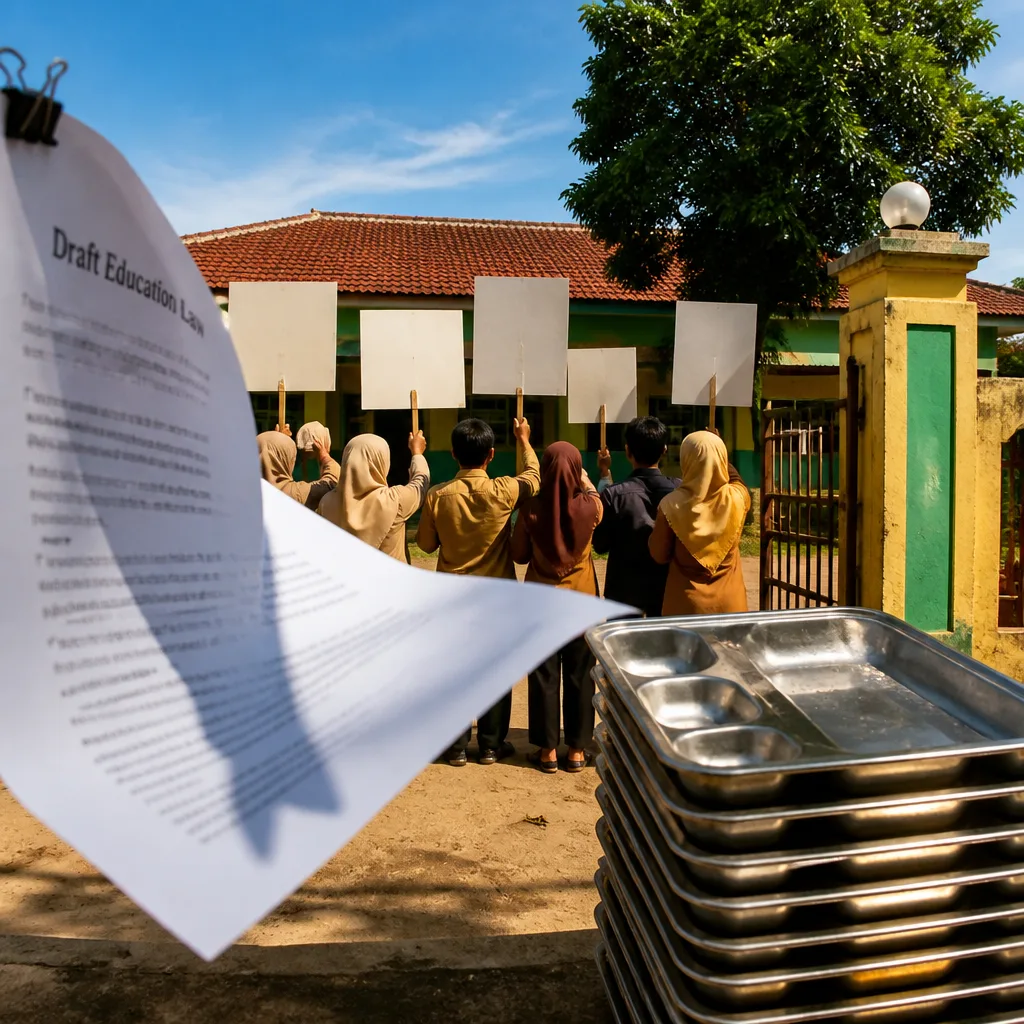
The revision of Indonesia’s National Education System law has alarmed teachers’ organisations, who say a broadly worded provision could allow the government to again use education funds to pay for a nationwide free nutritious meals programme.
What the draft says and why it matters
The contested clause in the draft bill, dated 8 July, states that the state and society, when organising education, should "provide health services, including those concerning mental health, at educational institutions in a manner that is integrated with the national health policies as well as the national education goals". Teachers’ representatives argue the language is open to interpretation and could be used to label health-related spending — including free school meals — as an education responsibility.
“We strongly suspect that the article could be translated into applying health policies at educational institutions,” said Satriwan Salim, national coordinator of the Indonesian Teachers Association (P2G).
P2G and other groups caution that if the bill is enacted without clear limits or wider public consultation, the revision could effectively reclassify the free meals programme as an education expense.
Budgetary scale and the court decision
Fiscal stakes are substantial. Under the constitution, at least 20% of the annual state budget must be allocated to education. This year the education allocation stood at Rp 769 trillion. From that sum, Rp 223 trillion was channelled to the free meals initiative — roughly one-third of the mandated education spending.
On 30 July the Constitutional Court ruled that President Prabowo Subianto’s free meals programme was not part of education and therefore should not be financed from the education budget. The court ordered the government to remove the programme from the education line when preparing the 2028 state budget, although it suggested the government may need to rework other spending plans for the intervening year.
| Item | Amount (Rp) |
|---|---|
| Education budget (total) | 769 trillion |
| Portion used for free meals | 223 trillion |
Concerns from teachers and wider implications
Teachers’ groups contend the draft’s health clause could be interpreted expansively to absorb programmes that have been contested in court. They fear the change would erode transparency over what the constitutionally protected education allocation is intended to fund, and could divert money from classrooms, teacher pay, infrastructure and learning resources.
P2G’s national coordinator told media the formulation could allow the free meals policy — presented by the government as a public health intervention — to be relabelled as an educational duty, enabling continued use of education funds for the programme.
- Teachers’ unions warn of limited public consultation on the bill and the risk of broad legal interpretation;
- The Constitutional Court has already directed the removal of the free meals programme from the education budget for 2028;
- Reclassification of health measures as education spending would affect how at least 20% of the state budget is spent each year.
At stake is not only one programme but the principle that a fixed share of the national budget is ring-fenced for education. Any legislative change that expands the concept of what counts as an educational expense could shift that protected funding to a broader set of social policies.
As the House of Representatives continues deliberation on the bill, teachers’ organisations are urging clearer language and stronger safeguards to ensure the education allocation is used for traditional schooling needs rather than wider health or social services reclassified to fall inside the education remit.
For now, the constitutional court’s decision sets a clear instruction for the 2028 budget, but the pending legal amendment has opened a new front in an already heated national debate about the boundaries between education policy and wider public health interventions.