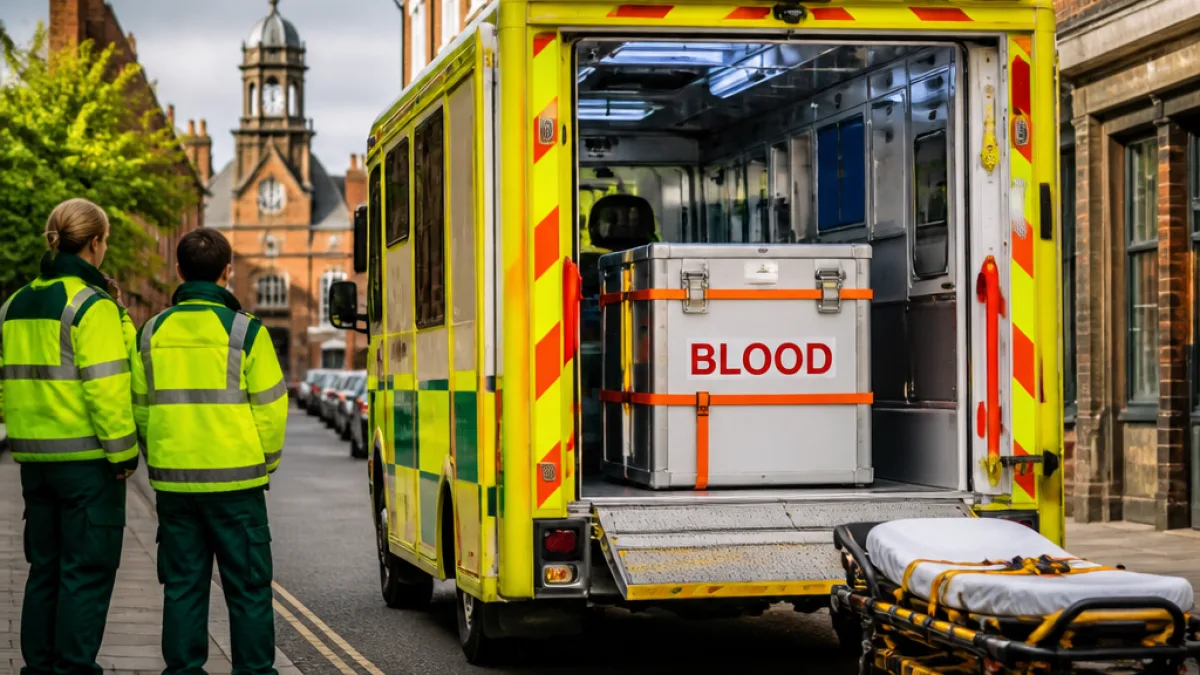
Ambulance crews linked to the city of Worcester and the Town of Shrewsbury have been given a new tool to treat critically ill and injured patients before they reach hospital: a supply of blood kept on specialist emergency units for use during transport.
How the service works
The capability, introduced on Sept. 1, follows approval from the state Department of Public Health to the health system operating the local 911 service. The measure allows certain pre-hospital vehicles to carry and administer transfusions to patients suffering substantial blood loss while en route to definitive care.
- Blood will be held on a designated emergency medical services (EMS) response unit rather than on every vehicle in the fleet.
- The stocked unit is dispatched to calls where clinicians suspect severe haemorrhage and a transfusion may be required.
- In addition to ground ambulances, the regional pre-hospital blood capability is available through air and specialist response teams.
"This is yet another lifesaving advance that Worcester EMS is proud to offer the citizens of Worcester, expanding on the state-of-the-art care we already provide with antibiotics, medication-enhanced intubation and mechanical ventilation," said Norman Soucie, chief of Worcester EMS at UMass Memorial Health.
What this means locally
For people in Shrewsbury, the change is intended to shorten the interval between severe blood loss and receiving blood products, a period that can be decisive for survival. Pre-hospital transfusion is now recognised in some emergency medicine circles as an important intervention for traumatic haemorrhage and other conditions causing major blood loss.
However, the new arrangement does not mean every responding ambulance will carry blood automatically. Instead, a designated vehicle with the blood supply will be deployed to appropriate calls. That distinction is important for setting expectations among the public about what crews can provide at scene.
Which units will provide blood?
The 911 system operated by UMass Memorial Health for Worcester and Shrewsbury will make blood available through several avenues, according to the service. These include:
| Service | Capability |
|---|---|
| Designated EMS response unit | Stocked with blood for dispatch to severe-haemorrhage calls |
| LifeFlight helicopters | Pre-hospital transfusions during aero-medical transport |
| Tactical EMS team | Available for high-risk and specialist responses |
| EMS physician response vehicle | Doctor-led rapid response with transfusion capability |
Context and limitations
Local emergency services have been expanding the scope of care they provide outside hospital for some time, introducing interventions such as advanced airway management and on-scene antibiotic administration. The addition of pre-hospital blood is presented by the operator as a continuation of that trend.
It is important to note the operational and logistical constraints surrounding blood provision. Storing and administering blood outside a hospital requires strict temperature control, robust protocols for matching and transfusion, and careful clinical judgement about when a pre-hospital transfusion is appropriate. The decision to send the stocked unit to a call will be driven by clinical indicators of the severity of haemorrhage and the likely benefit to the patient.
For residents of Shrewsbury, the development should be welcomed as an enhancement to emergency care, while not altering the fundamental need for rapid access to definitive hospital treatment. The service operator says the capability is the first of its kind in Central Massachusetts.
Further information about when and how the stocked unit is deployed can be obtained from the 911 service operated by UMass Memorial Health.