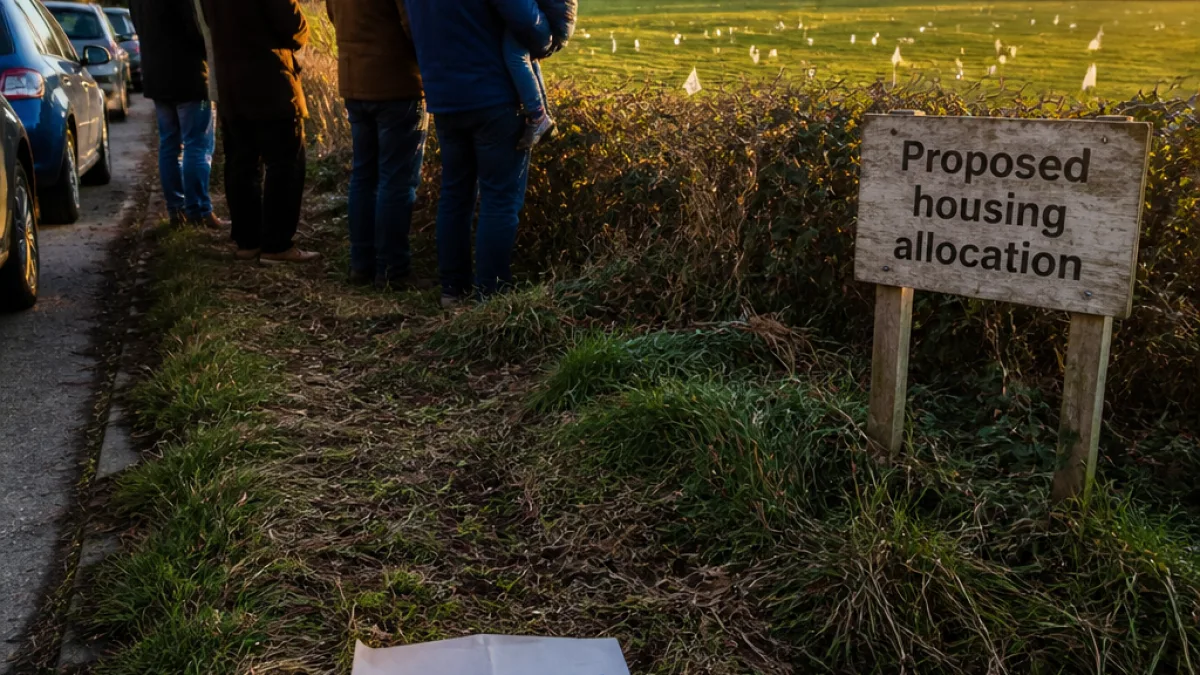
Campaigners accuse council of abandoning ‘brownfield first’ pledge
Residents on the north-eastern edge of Stoke-on-Trent have renewed their objections to the city council’s draft local plan after it retained several housing allocations on greenfield land from Packmoor to Milton. The draft sets out the city’s approach to meeting a government target of 952 homes a year, but critics say the proposals will still mean losing open countryside and worsening pressure on local highways and public services.
Council leaders say they favour a brownfield-first strategy, but attendees at a consultation event in Norton described the site choices as contradictory to that policy and harmful to the environment. Two previously large proposed developments near Norton have been sharply reduced since the plan’s first consultation, but that has done little to placate some residents.
Reduced allocations still spark fury
The most contentious proposals were originally two large greenfield sites to the north of the city. After last year’s consultation those combined plans were cut from a total of 3,097 homes to 520. The current draft allocates 250 homes to site BL10 (east of Bemersley Road) and 270 homes to site BL7 (north of Milton Works).
| Site | Former name | Homes now proposed |
|---|---|---|
| BL10 | North Green North | 250 |
| BL7 | North Green South | 270 |
| Chatterley Whitfield | (same) | 1,750 |
Other allocations in the area include the Packmoor site, which is the subject of a separate council masterplan, and the expansive Chatterley Whitfield allocation of 1,750 homes — a figure that remains a flashpoint for local opposition.
Residents say consultation cuts are token gestures
At the Norton consultation, several residents expressed disbelief that initial large-scale proposals ever reflected genuine intent. Norton resident Christine Tinsley told the meeting that the council’s proposals amounted to what she called “environmental vandalism,” arguing the council was not following the brownfield-first claim and that the estates would be car-dependent due to a lack of public transport.
“This is environmental vandalism. The council are going against their own policies. They say their approach is brownfield first, but they're proposing to build hundreds of homes on Green Belt land. And they say they're in favour of sustainability and reducing carbon emissions, but these new estates will be reliant on people driving cars because there's no public transport.”
Her neighbour, Claire Holdcroft, said she suspected the bigger initial numbers were a tactical move. “I don't think there was ever going to be 3,000 homes. They just proposed that originally so they could reduce it after the first consultation and claim that they've listened to people,” she said.
Local campaign groups mobilise
Tom Sherratt, named among local campaigners, is helping to coordinate opposition across the villages and suburbs affected. Organisers are urging residents in Norton, Norton Green, Milton and neighbouring areas to engage with the consultation process and sign up to local opposition efforts.
- Residents are concerned about the loss of greenfield land and impacts on local biodiversity.
- Transport and services such as schools and health facilities are believed to be under strain if developments proceed.
- Campaigners say reductions in proposed numbers after consultation are insufficient and suspect initial figures were inflated.
The council has maintained that it is attempting to balance required housing delivery with policy priorities. The debate now centres on whether the local plan’s allocations can be reconciled with residents’ demands for greener, better-connected growth and the council’s stated brownfield preference.
With the draft local plan still under consultation, the outcome will be pivotal for communities along the north-eastern fringe of Stoke-on-Trent, where the loss of open land and the prospect of substantial new housing remain divisive.