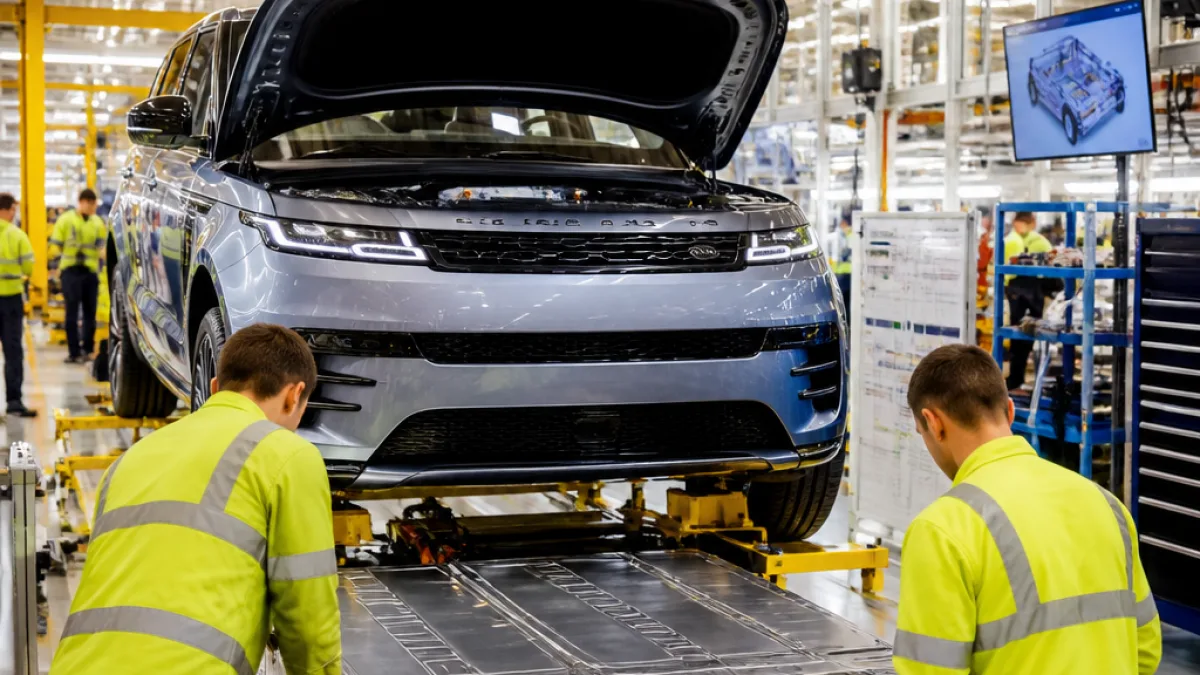
Jaguar Land Rover (JLR) has begun production of the Range Rover Electric at its Solihull facility, marking the first time in the marque’s 56-year history that a fully electric Range Rover is being manufactured.
Local workforce and investment
The launch, following a year-long delay, forms part of JLR’s five-year £15 billion Reimagine investment programme in electrification. The project has seen a significant local skills push: approximately 9,000 employees at Solihull have been retrained for work on electrified vehicles, with a further 1,500 people trained across the wider West Midlands region.
- Production location: Solihull plant
- Local upskilling: around 9,000 employees at Solihull retrained
- Regional training: around 1,500 trained across the wider West Midlands
Vehicle technicals and charging
The Range Rover Electric is equipped with a 118.5kWh battery and offers a WLTP range of up to 372 miles. JLR says the car can be rapid-charged from 10 to 80 per cent in about 22 minutes, figures that the company is using to position the new model as competitive in the upper end of the luxury electric market.
| Specification | Figure |
|---|---|
| Battery capacity | 118.5 kWh |
| WLTP range | Up to 372 miles |
| Rapid-charge time (10–80%) | Approximately 22 minutes |
Supply chain and regional manufacturing
Alongside Solihull’s vehicle assembly, JLR’s transformation includes work in the wider West Midlands. The Electric Propulsion Manufacturing Centre in Wolverhampton is producing battery packs and electric drive units in parallel with combustion engines, supporting the transition to battery electric vehicles (BEVs).
Corporate context and recent challenges
The Range Rover Electric is the first of a planned nine fully electric models JLR aims to launch across its Range Rover, Defender, Jaguar and Discovery brands by 2030. The launch is presented by the company as central to securing jobs and protecting the local economy.
“This is a pivotal for us at Range Rover, for JLR, I really believe that for us it's also for our partners for our retailers for our communities. This secures jobs this provides for the economy and we are really excited.”
The comment came from Martin Limpert, managing director of Range Rover, who described the model as the product of a decade of “considered engineering”.
JLR’s electrification push comes as the company continues to recover from a significant cyber-attack last September that forced a five-week production halt. That disruption contributed to a 20.9 per cent fall in annual turnover to £22.9 billion. More recently, JLR has reported a rebound in sales volumes, which were up by more than 60 per cent in its most recent quarter.
What this means for Solihull
For Solihull, the vehicle’s local production is both symbolic and practical: it anchors high-value manufacturing roles in the town and underlines the importance of the region to JLR’s future. The retraining of thousands of staff reflects a rapid shift in skills demanded by the automotive industry as it moves from internal combustion engines towards electrification.
While the immediate local impact is the preservation and creation of skilled manufacturing roles, the longer-term consequences will depend on market acceptance of the Range Rover Electric, the broader rollout of JLR’s BEV line-up and the stability of global supply chains. The company’s recovery from last year’s cyber-attack will also remain a material factor in its near-term prospects.
As production ramps up at Solihull, the plant will be a focal point for monitoring how traditional automotive towns in the West Midlands adapt to the electric era.