
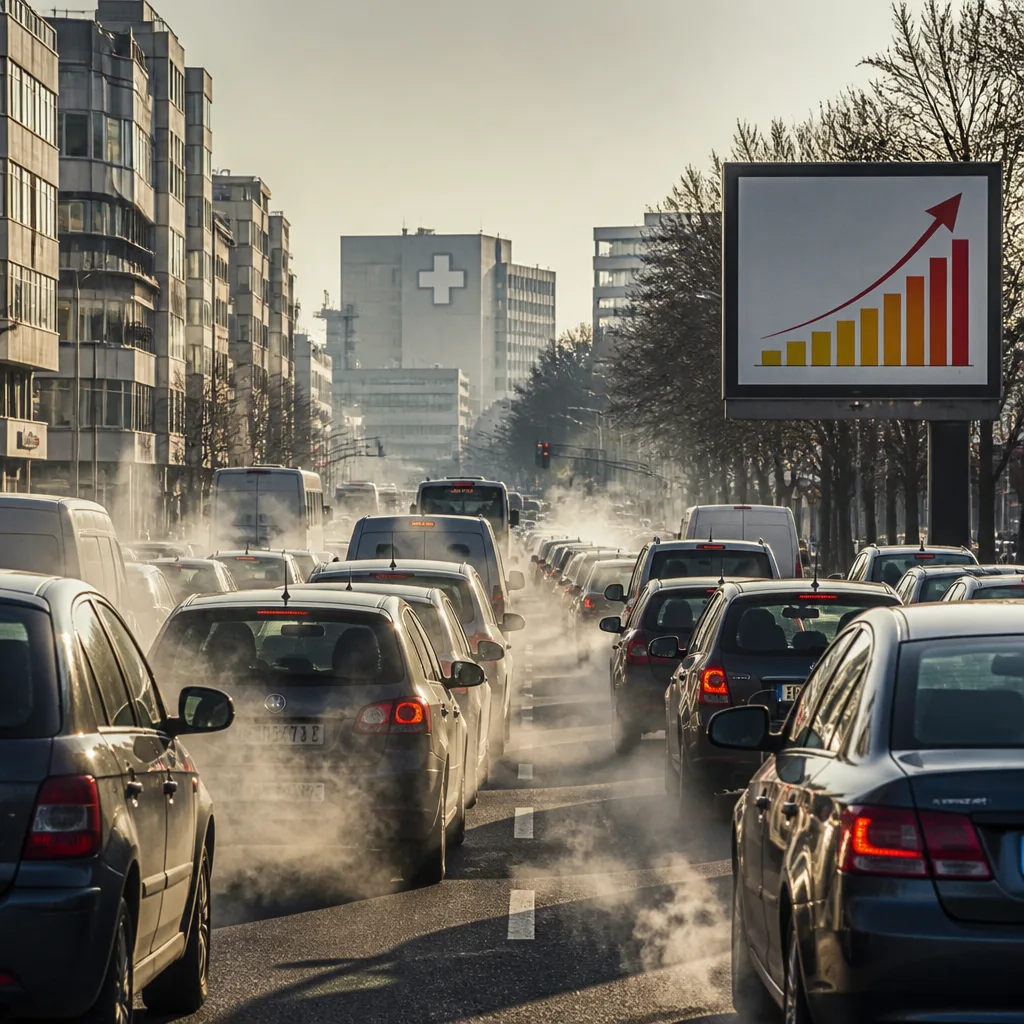
The European Commission’s December 2025 proposal to relax carbon dioxide standards for passenger cars and vans would, if adopted, substantially increase the number of internal combustion vehicles on the road and translate into higher air‑pollutant emissions linked to adverse health outcomes, according to new modelling published by a transport policy research group.
Projected rise in combustion vehicles and pollutant emissions
The analysis projects that under the revised standards the EU‑27 fleet could include up to 90 million internal combustion engine (ICE) vehicles — including hybrids and plug‑in hybrids — by 2050. That represents an increase of roughly 46 million ICE vehicles, or about 105%, compared with projections assuming the current, stricter rules remain in place.
Modelled cumulative "well‑to‑wheel" emissions for the period 2025–2050 rise across several pollutant categories if the weaker CO2 pathway is adopted. Relative to the existing standard, the brief estimates increases of:
- 24% in carbon monoxide emissions
- 22% in volatile organic compounds (VOCs)
- 3% in nitrogen oxides (NOx)
- 4% in particulate matter (PM)
Health consequences and uncertainties
The authors link the higher emissions to poorer public health outcomes, estimating an additional 6,800 premature deaths across the EU27 through 2050 and about 85,000 years of life lost compared with the path under the current CO2 standards. These figures arise from established epidemiological relationships between long‑term exposure to traffic‑related air pollution and mortality.
It is important to stress the findings are modelled projections rather than observed outcomes. They depend on assumptions about vehicle sales, fleet turnover, use patterns, emissions factors and the exposure–response relationships used to translate pollutant concentrations into health impacts. As with any scenario analysis, results should be interpreted as indicative of potential public‑health consequences rather than precise forecasts.
Regulatory context and policy implications
The briefing notes that the Commission’s proposal to relax CO2 standards contrasts with the contemporaneous treatment of pollutant limits. The Euro 7 regulation, which governs tailpipe pollutant emissions, largely carried forward the limits set under Euro 6 rather than tightening them. Industry stakeholders, the paper says, argued that a rapid shift to zero‑emission vehicles by 2035 would make stricter pollutant rules unnecessary; the revised CO2 proposal would instead allow manufacturers to continue selling ICE vehicles indefinitely.
The combined regulatory stance — softer CO2 reduction targets alongside unchanged pollutant limits — has prompted the modelling exercise to examine the health implications of a slower transition away from fossil‑fuelled vehicles. The results underline how transport policy choices intersect with air quality and population health.
| Metric (2025–2050) | Change under revised CO2 standards |
|---|---|
| Internal combustion vehicles by 2050 | +46 million (to 90 million) |
| Carbon monoxide emissions | +24% |
| Volatile organic compounds | +22% |
| Nitrogen oxides (NOx) | +3% |
| Particulate matter (PM) | +4% |
| Premature deaths | +6,800 |
| Years of life lost | 85,000 |
What this means for the UK and policy debate
Though the modelling covers the EU27, the findings are salient for UK public health and planning. Air pollution does not respect borders, and slower electrification of road transport in the EU could influence cross‑border emissions and market dynamics affecting vehicle availability, technology costs and fleet composition in the UK. The study reinforces the well‑established point that policy decisions on climate and transport shape near‑term pollutant exposures as well as long‑term greenhouse‑gas trajectories.
Policymakers must weigh competing claims: industry arguments that relaxing CO2 targets eases compliance burdens, against public‑health assessments pointing to avoidable mortality and morbidity. The modelling adds to a body of evidence showing that accelerated adoption of zero‑emission vehicles reduces both CO2 and many harmful pollutants, with attendant health benefits.
As with any single analysis, limitations exist: the figures depend on model assumptions and do not capture all pathways by which vehicle technology changes can affect exposure (for example, shifts in driving patterns, urban planning, or complementary measures such as low‑emission zones). Nevertheless, the projected scale of additional deaths and life‑years lost indicates decisions on vehicle standards will have measurable public‑health consequences.
Regulators and health officials will need to consider these trade‑offs as the legislative process continues in Brussels and as national governments assess the implications for domestic air quality and health protection.














