
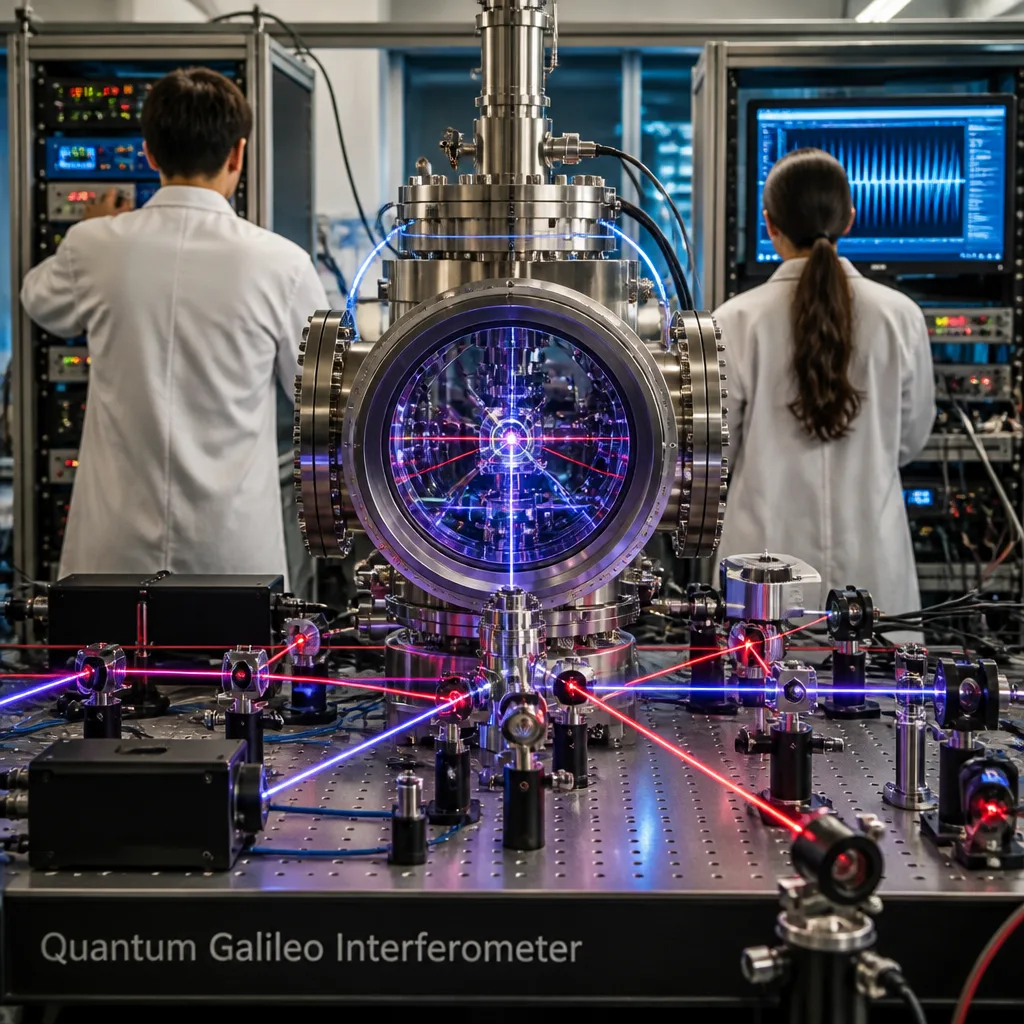
An international team of physicists has for the first time directly measured a predicted effect of gravity on the quantum phase of freely falling atoms, finding that a central tenet of Einstein’s theory of gravity remains consistent with quantum behaviour under the experiment’s conditions.
What the experiment did
Researchers from Ben‑Gurion University of the Negev, the University of Ulm and the University of Oxford, working with collaborators including Professor Sir Roger Penrose, used a device described as the Quantum Galileo Interferometer to split ultracold rubidium atoms into two quantum paths. One ensemble was held nominally stationary while the other was allowed to fall freely under gravity; the two paths were later recombined to measure the relative quantum phase accrued during their different trajectories.
The measured phase shift is the manifestation, at the quantum level, of the effect gravity is expected to have on the evolution of matter waves. The work is reported in Science Advances on 2 September.
“The result shows that a fundamental principle at the heart of Einstein’s theory of gravity remains consistent with the behaviour of matter in the quantum world.”
Significance and limits
The authors and accompanying press material are careful to note the boundaries of the result. The experiment probes the interface between two highly successful yet conceptually distinct frameworks — quantum mechanics and Einsteinian gravity — but it does not resolve the long‑standing theoretical question of how to unify the two. Nor does the measurement demonstrate that gravity itself is a quantum force.
Instead, the study establishes that, within the tested conditions, the equivalence principle — which underpins general relativity and states that the motion of freely falling bodies is locally independent of their composition — is consistent with quantum phase evolution of matter waves. The approach therefore provides a new, experimentally accessible window on where quantum and gravitational descriptions must be reconciled.
Method and future directions
The apparatus relied on standard elements of cold‑atom physics: a vacuum science chamber, a two‑dimensional magneto‑optical trap (2D MOT) to feed atoms into the chamber, an atom chip to manipulate the clouds and an arrangement of antennas, coils and optical fibres to control and read out the quantum states. By engineering two distinct paths for ensembles of ultracold rubidium, the team could detect minute differences in phase accumulated during free fall.
- Technique: Matter‑wave interferometry with ultracold rubidium atoms.
- Lead institutions: Ben‑Gurion University of the Negev, University of Ulm, University of Oxford.
- Publication: Science Advances, 2 September.
The authors highlight the potential for scaling the technique to heavier, more macroscopic quantum objects — for example, experiments with levitated nanodiamonds have been mooted as a next step. Heavier objects would in principle couple more strongly to gravitational fields and could therefore expose novel effects or tighter constraints on proposed quantum gravity models.
Context for UK science and global research
The participation of the University of Oxford and contributions from figures such as Sir Roger Penrose link the work to the UK research base, which has invested in cold‑atom and quantum technologies for both fundamental and applied aims. Matter‑wave interferometry is an active international field: the new result will be of interest to theorists and experimentalists seeking empirical handles on the compatibility — or otherwise — of quantum mechanics and general relativity.
Experts not involved in the study will look for replication, extensions to different species and mass scales, and experiments designed specifically to discriminate between alternative theoretical proposals. Until such broader lines of evidence accumulate, the new measurement stands as a carefully constrained and important test of a central prediction of Einsteinian gravity when applied to quantum systems.
While the result does not resolve the problem of quantum gravity, it demonstrates that precision quantum experiments can now probe regimes traditionally regarded as the exclusive domain of classical gravitation, and that these techniques will play an increasing role in the dialogue between theory and experiment.









