
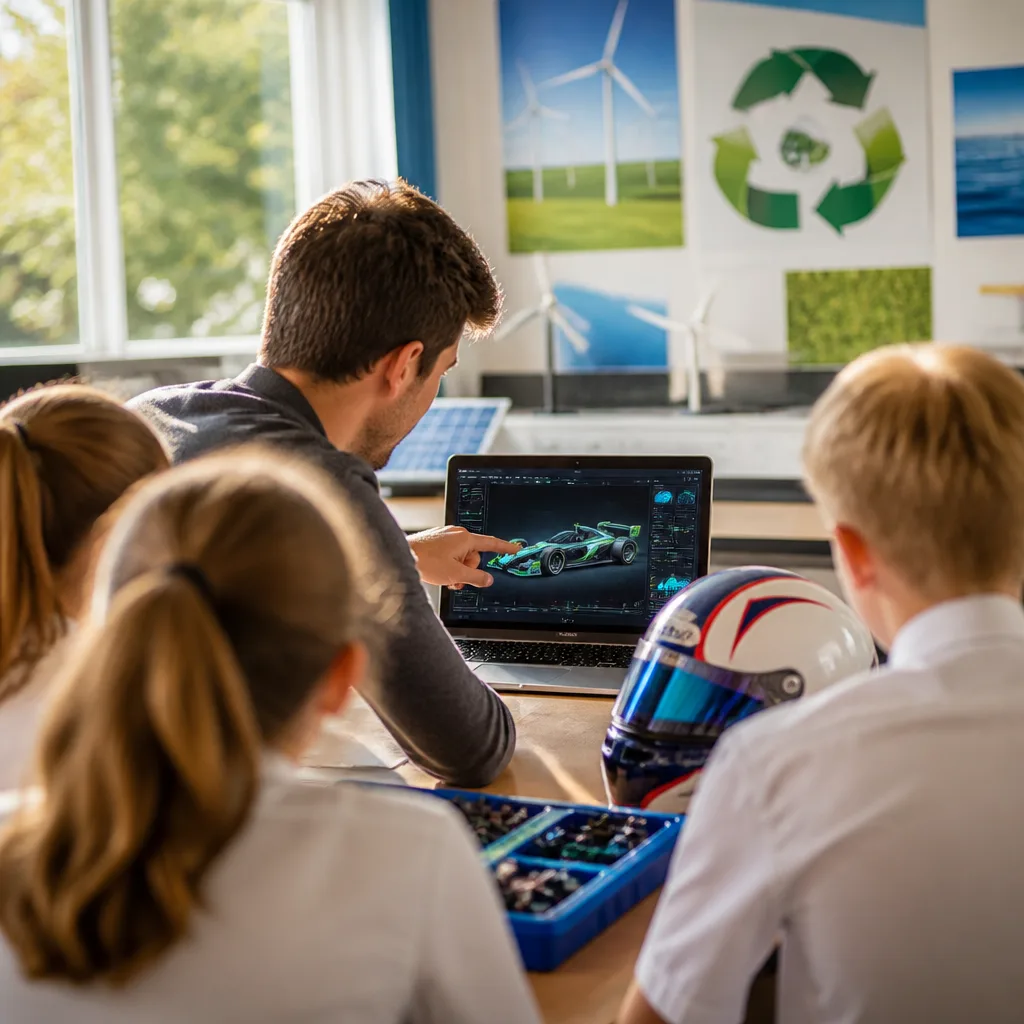
The Driving Force education programme — supported by the Public Investment Fund (PIF) and Formula E — has been relaunched as a single online platform designed to broaden access to STEM and sustainability learning for young people, parents and teachers worldwide.
From race paddocks to classrooms
The initiative, which began with a multi-channel offer of live workshops, teacher resources and on-demand learning, was first rolled out in April 2025 during the 2024/25 Formula E season. Organisers say the refreshed digital destination will give pupils a "backstage pass" to the technologies shaping electric racing and the future of mobility, while supplying practical classroom materials and family-facing guidance.
Since the programme’s inception, Driving Force has engaged an estimated 111,200 young people through teacher-led materials and live events delivered in the United States, Saudi Arabia and the United Kingdom. The new platform is intended to build on that footprint by providing a single point of access for interactive learning activities.
What the platform offers
According to the materials released by the partners, the revamped site will offer different experiences tailored to three main audiences:
- Pupils: interactive challenges, quizzes, games and rewards designed to make STEM engaging and easily shared;
- Parents: content to help families support children’s interest in STEM and careers connected to future mobility;
- Educators: ready-to-use lesson plans, activities and classroom resources linking engineering and sustainability to real-world technology.
The launch content will centre on the recently revealed GEN4 race car, which Formula E has scheduled to appear on track for the 2026/27 season. Organisers say using the GEN4 car as an educational focal point will help users understand the technology and sustainability principles that underpin the championship, as well as the career pathways that support those fields.
Evidence and ambition
Driving Force’s expansion follows research cited by the programme partners showing a gulf between parental hopes and student confidence. Engineering UK research referenced in the launch material finds that around eight in 10 parents believe their children are interested in a STEM career, yet only 32% of students report feeling they know enough (the programme materials do not elaborate further on that figure in the source content).
Organisers present the platform as a way of translating interest into sustained learning: by combining playful, game-like elements with classroom-ready resources and parental guidance, they aim to make STEM accessible beyond traditional routes into engineering and technology.
Implications for teachers and schools
For school leaders and teachers, the centralised platform promises time-saving resources that can be dropped into schemes of work. The availability of ready-made lesson plans and activities could ease the burden on teachers who are seeking to embed sustainability and electric-mobility topics into the curriculum, provided the materials align with national examination frameworks and local syllabuses.
Yet practical uptake will depend on factors the partners cannot directly control: teacher time, training and the extent to which schools prioritise funded or extracurricular STEM provision. The new platform’s success in the UK classroom will be measured by how readily teachers can adapt materials to their pupils’ needs and assessment demands.
| Item | Detail |
|---|---|
| Initial launch | April 2025 (during 2024/25 Formula E season) |
| Young people reached | 111,200 via teacher-led and live workshops |
| Early delivery countries | United States, Saudi Arabia, United Kingdom |
| GEN4 on track | 2026/27 season |
The Public Investment Fund’s involvement signals continued international investment in education tied to industrial technology, while Formula E’s role brings a high-profile sporting narrative into classrooms. For educators, the key test will be whether the materials enable teachers to turn interest into subject knowledge and realistic career awareness.
Parents and young people hoping to explore the platform should find a mixture of playful learning and more formal classroom support. How schools decide to use those resources—and whether ministries and inspection bodies treat them as curricular supplements or enrichment—will determine the programme’s longer-term educational impact.











