Penka Kasabova, born on 12 August 1901 in Stara Zagora, is credited with significant advances in preschool education in Bulgaria after training at the American Kindergarten in Sofia and studying in Chicago. Her work as a teacher-trainer and organiser of early years provision transformed attitudes to childhood education and helped establish new kindergartens and summer schemes across the country.
Early influences and training
Kasabova grew up in the family of teacher and bookseller Milyo Kasabov. One of her brothers was the poet Geo Milev. After completing secondary education she enrolled on Elizabeth Clarke’s pedagogical course at the American Kindergarten in Sofia, where her instructor recognised her promise. As Assoc. Prof. Raina Zaharieva, a long-standing lecturer at Sofia University, has observed, Clarke “saw in her a future artist because she was artistic and responsible.”
“This work is useful and sooner or later it will develop. Let's see if Pesha will be the one to push it forward!”
The words reportedly spoken by her father reflected an early family belief in the value of organised preschool work. In 1928 Elizabeth Clarke took Kasabova to her university in Chicago, where Kasabova studied for three years. On her return she was described as a “white swallow” of preschool education—an epithet suggesting both the novelty and the energy of her contribution.
Leadership and expansion of preschool provision
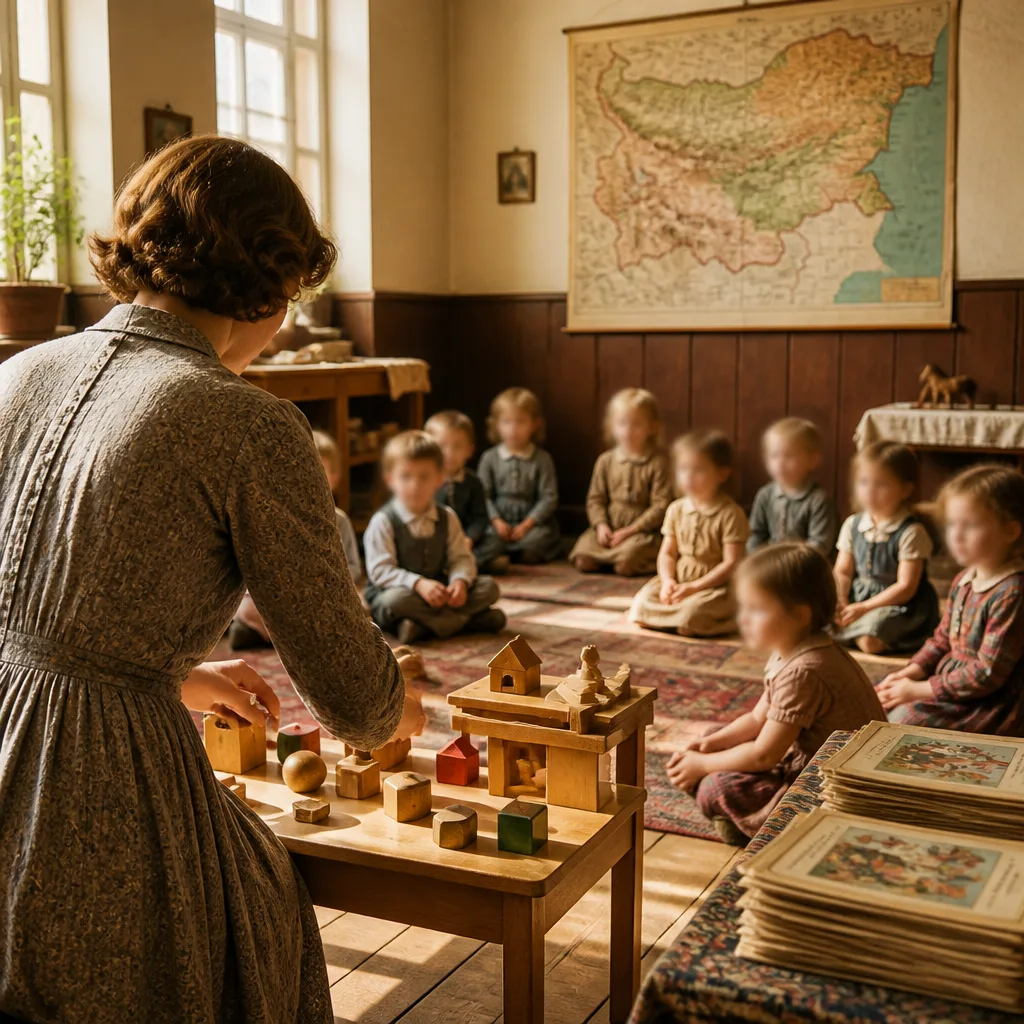
In 1932 Kasabova succeeded Elizabeth Clarke as head of the kindergarten and of the pedagogical institute affiliated with it. In that role she trained hundreds of teachers, many of whom embraced the profession as a vocation. Her influence encompassed practical classroom methods, parental attitudes and efforts to influence government policy on early years education.
Kasabova was active in establishing kindergartens beyond the capital, including summer kindergartens in villages. These schemes combined supervision with practical learning: while mothers worked during harvest, children were taught table manners, how to use utensils, and were given poems and songs to learn — small routines that reflected a focus on social as well as cognitive development.
- Completed Elizabeth Clarke’s pedagogical course at the American Kindergarten in Sofia
- Studied for three years at Clarke’s university in Chicago from 1928
- Succeeded Clarke in 1932 and led teacher training at the pedagogical institute
- Opened kindergartens nationwide, including village summer schemes
- Published and edited sections for preschool educators in the magazine "First Steps"
Publishing and professional development
Kasabova used the magazine First Steps to create dedicated sections for all those engaged in preschool education. The publication became a forum for teachers and parents, reinforcing the professional identity of early years practitioners and providing practical guidance for classroom work.
| Year | Milestone |
|---|---|
| Early 1920s | Completed training at American Kindergarten (Sofia) |
| 1928–c.1931 | Studied for three years in Chicago |
| 1932 | Became head of the kindergarten and pedagogical institute |
Associates and later scholars have emphasised Kasabova’s commitment to drawing out the individuality of each child, an aim that commentators note remains a challenge for contemporary education systems. Her practical initiatives — training teachers, opening local and seasonal provision, and producing a profession-focused journal — combined to professionalise preschool work in a way that left a lasting imprint.
While the available material sketches Kasabova’s achievements rather than cataloguing every detail of her career, the record presented by contemporaries and later researchers underlines the enduring significance of her contribution to early years education in Bulgaria.