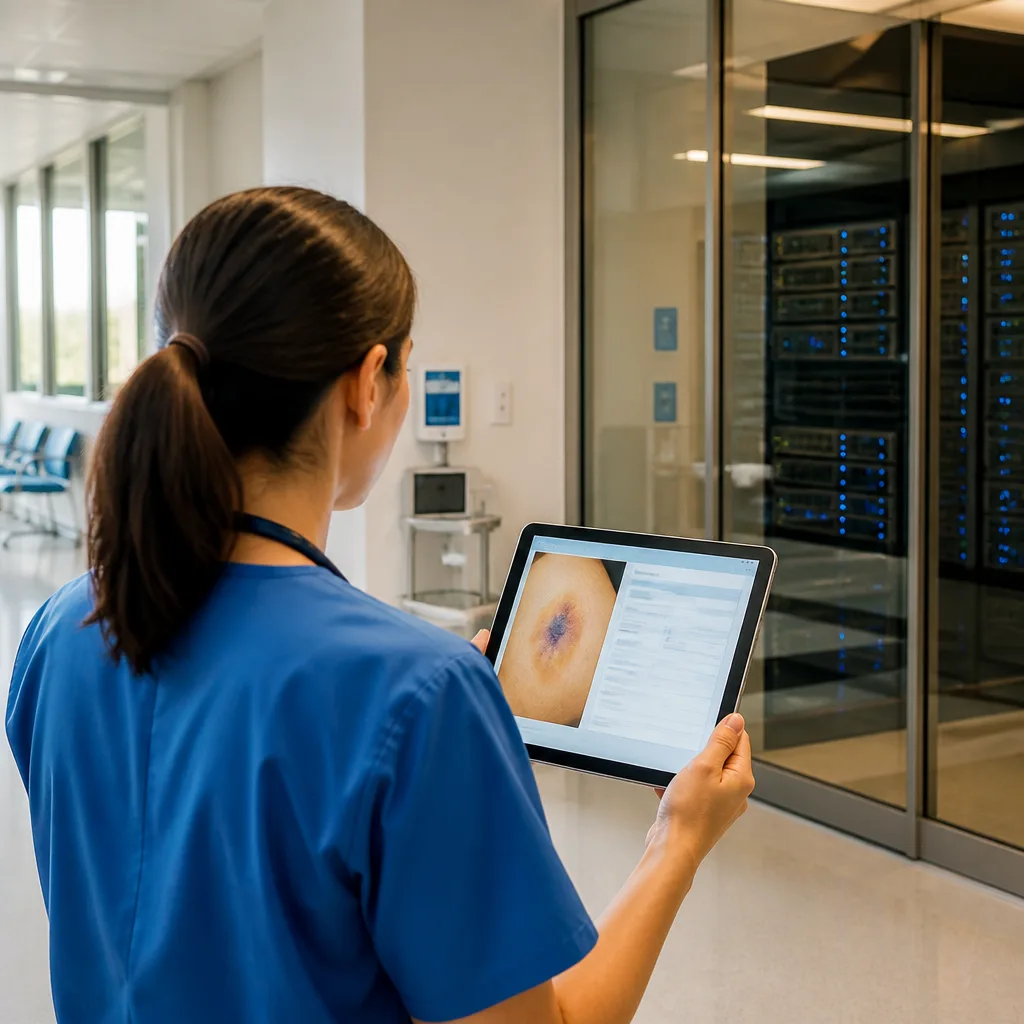
A team at George Mason University's Injury Analytics Lab (IAL) has secured a patent for an artificial intelligence system that pairs advanced imaging with clinical and demographic data from electronic health records to detect and assess bruises. The developers say the platform is intended to give clinicians, forensic professionals and researchers clearer information about skin injuries.
How the system works
The patented technology combines three elements: a repository of injury images used by computer vision systems, AI models trained to detect bruise lesions from those images, and linked clinical and demographic information drawn from patients' electronic health records. The lab likens the approach to plant-identification apps that augment image data with contextual information such as location.
According to the IAL, the platform is designed to support "real-world use" by providing clinicians and investigators with more complete data than images alone can supply. Development and maintenance of the platform and associated software are led by the lab's co-directors in health informatics and engineering.
"Documenting injuries accurately is essential for both medical treatment and seeking justice for victims of violence," said Associate Professor of Nursing and IAL Co-Director Katherine Scafide.
Potential uses and users
The lab states the system is targeted at three broad user groups: clinicians making treatment decisions, forensic professionals who must document injuries for legal processes, and researchers studying injury patterns. By combining image-based detection with background clinical information, the developers aim to reduce uncertainty that can arise when bruises are assessed from photographs alone.
- Clinical decision support — to help clinicians interpret skin injuries in a medical context.
- Forensic documentation — to improve accuracy and consistency when injuries are recorded for legal or investigative purposes.
- Research — to build datasets and improve understanding of injury patterns across populations.
What the patent covers and who led the work
The patent protects the lab's approach of integrating image analysis, advanced imaging techniques and linked health-record data within a single injury platform. The IAL reports that the initiative grew from collaboration among experts in nursing, health informatics and engineering over several years, and that the platform houses a substantial repository of injury images for computer vision systems.
Leadership of the project is shared among the lab's co-directors: Katherine Scafide (nursing), Janusz Wojtusiak (health informatics) and David Lat (engineering). Wojtusiak is identified as leading development of the platform and related software.
Context and consequences
The idea of combining images with contextual patient data addresses a recognised problem in injury assessment: photographs alone can be misleading, particularly across different skin tones and lighting conditions. Linking images with clinical information could improve interpretation — but also raises practical and ethical questions.
Key considerations that follow from this work include:
- Data governance and privacy — connecting image data to electronic health records increases the sensitivity of the dataset and will require robust safeguards and strict access controls.
- Bias and generalisability — the effectiveness of computer vision on diverse skin tones depends on the make-up of the image repository and the training process; the lab states it maintains a large image repository, but independent evaluation will be required.
- Clinical integration — for the platform to be useful it must fit into existing clinical workflows and meet regulatory standards for medical software used in care or forensic settings.
| Component | Function |
|---|---|
| Image repository | Provides training and reference data for computer vision |
| AI models | Detect and assess bruise lesions from photographs |
| EHR linkage | Supplies clinical and demographic context to improve interpretation |
The IAL frames the patent as a step towards practical tools that can aid both treatment and the pursuit of justice in cases of injury. Outside scrutiny will be important: clinicians, privacy experts and regulators will need to assess performance across patient groups, data security and how results are communicated to users. For now, the patent documents a technical approach that could change how bruises are assessed — but adoption will hinge on validation, governance and integration into real-world practice.