
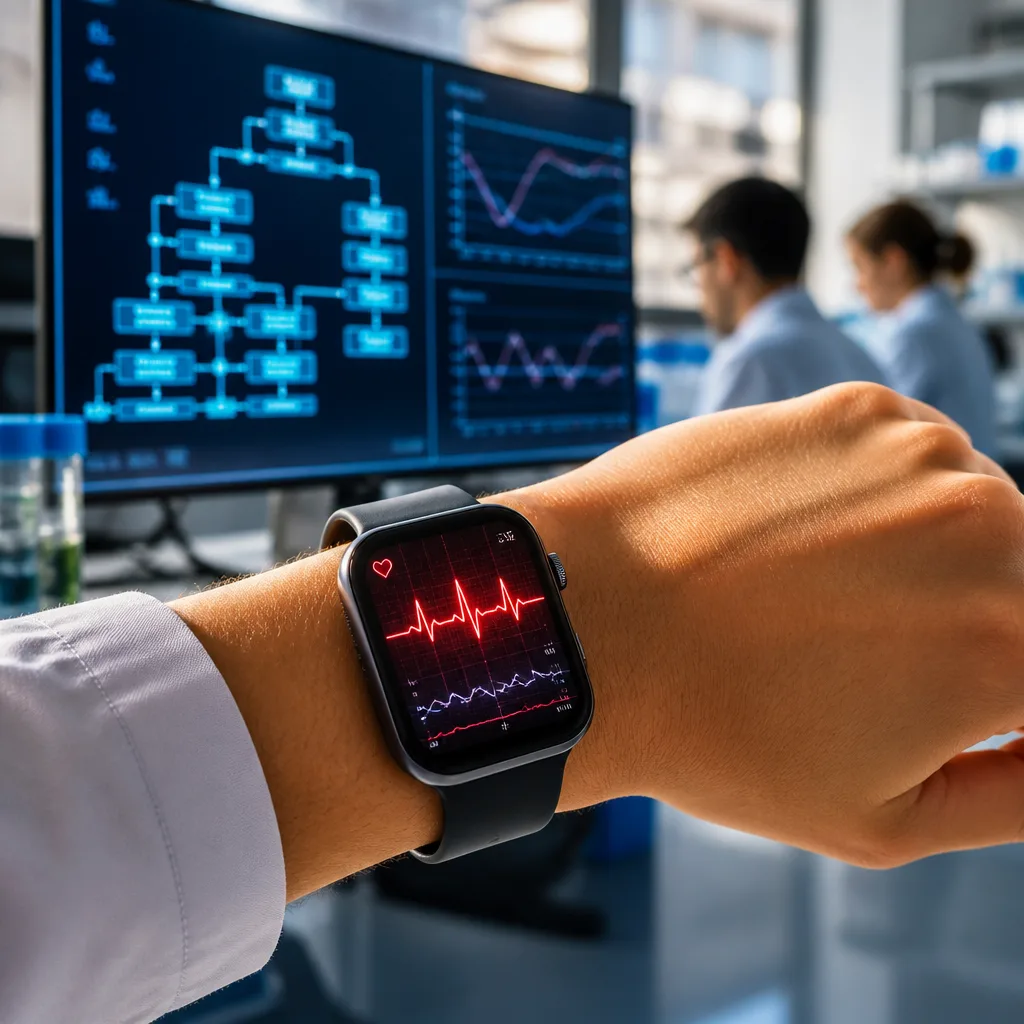
Samsung Research America has introduced two artificial intelligence systems designed to extract richer health information from wearable device data, signalling a further move by industry towards continuous, personalised monitoring rather than episodic care. The technologies, called xMAE and HiMAE, use self‑supervised learning to model relationships within and across biosignals such as heart rate, activity and sleep.
What the models do
The two approaches take different technical routes to represent patterns in time‑series data recorded by smartwatches and other wearables. xMAE — described by Samsung as a physiology‑aware masked cross‑modal reconstruction method — is intended to learn how multiple signals relate to one another across sequences. HiMAE, a hierarchical masked autoencoder, is built to capture structure at different time scales, from minute‑by‑minute variation through to patterns that emerge across days.
Both models are examples of so‑called health foundation models. In this paradigm, an algorithm is pretrained on large amounts of unlabeled biosignal data to learn underlying features; the pretrained system can then be adapted to several downstream tasks, such as detecting irregular heart rhythms or classifying sleep stages.
Why researchers and industry are interested
Proponents argue that learning directly from raw wearable signals could improve personalised monitoring by recognising subtle temporal relationships that simpler rules or hand‑engineered features miss. The approach also promises greater flexibility: once a foundation model has learned general representations, it can be fine‑tuned for different clinical or consumer uses without requiring large labelled datasets for every task.
- xMAE focuses on cross‑modal temporal reconstruction to capture relationships between biosignals.
- HiMAE aims to model hierarchical patterns across multiple time scales in wearable data.
- Both works were accepted for major machine learning conferences — xMAE to ICML and HiMAE to ICLR — underscoring technical interest in the field.
Potential benefits and limits
The promise is clear: if foundation models can reliably extract clinically meaningful signals from continuous biosensor streams, they could support earlier detection of deterioration, personalised lifestyle feedback and more targeted remote monitoring. Industry representatives at Samsung's recent Health Forum emphasised a vision of care that shifts from reactive treatment towards prevention and connected experiences.
However, the jump from algorithmic capability to safe, effective health interventions is substantial. The research announcements do not report clinical trials, prospective validation in representative populations, or demonstration of improved health outcomes. As with other machine learning systems, performance can vary across demographic groups, sensor types and real‑world conditions; models trained on limited or biased data risk underperforming for some users.
| Model | Primary aim | Conference |
|---|---|---|
| xMAE | Learn temporal relationships across biosignals | ICML |
| HiMAE | Capture hierarchical time‑scale patterns in wearable data | ICLR |
Crucially, foundation models in health introduce regulatory, privacy and interpretability questions. Clinicians and regulators will want evidence that outputs are reliable, explainable and robust before they are used to guide diagnosis or treatment. Data governance is another concern: many foundation approaches require large volumes of personal sensor data, which raises questions about consent, sharing, and potential commercial reuse.
Academic acceptance at leading machine learning conferences indicates the work is technically novel, but peer‑review of algorithm research does not substitute for clinical validation. Independent, prospective studies that evaluate accuracy, bias and impact on care pathways will be needed to judge whether these models can safely be deployed at scale.
For patients and consumers, the near‑term effect is likely to be more sophisticated wellness feedback embedded in wearable platforms. Whether that feedback improves health outcomes, reduces health inequalities, or introduces unforeseen harms will depend on rigorous testing and transparent reporting as the technology moves from laboratory demonstration towards commercial products.














