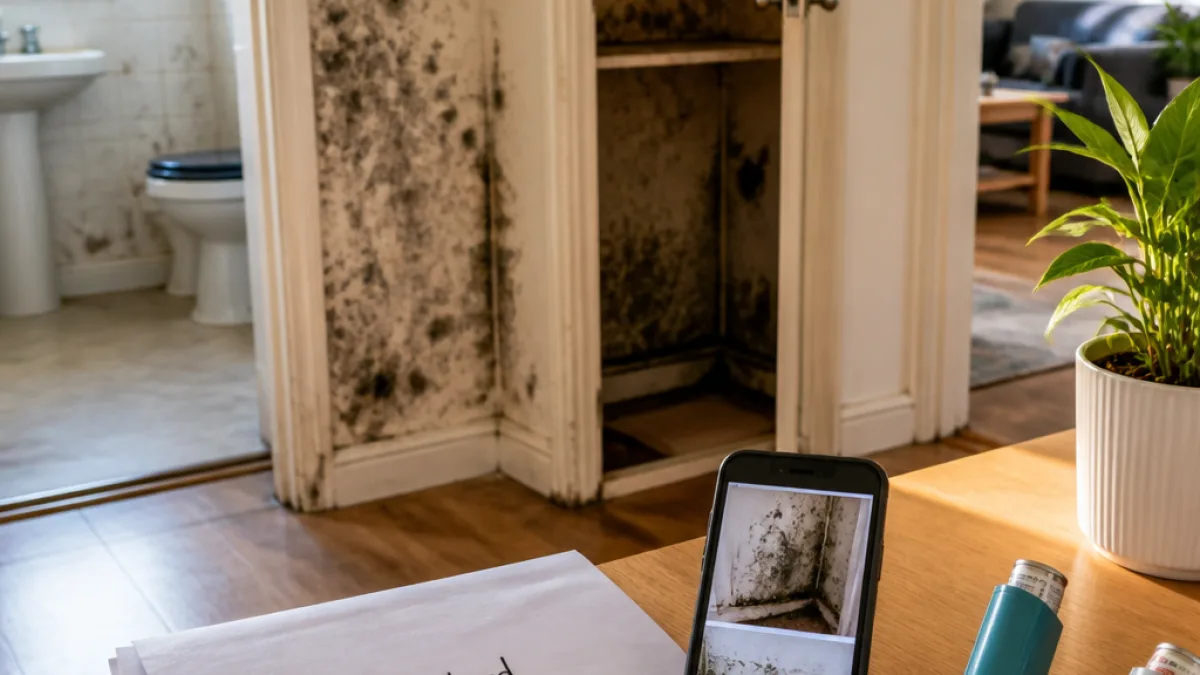
Hazardous mould found across apartment after landlord delays action
A tenant in Las Vegas who discovered black mould in several parts of her flat has issued a warning for other renters after a protracted struggle to secure meaningful help from her property manager.
The woman, identified in reports as Nicole Earle, first found suspicious dark growth under a bathroom sink in April. Her initial inspection with a phone revealed much more than a single patch: mould later appeared in both bathrooms, a hallway cupboard and in parts of the bedrooms, according to local television station KTNV.
When reports such as this reach across the Atlantic they serve as a reminder to tenants here in Mold that what may appear a minor fault can quickly become a serious health hazard — particularly where household members have existing respiratory conditions.
"I'm looking with my phone and I'm seeing this dark stuff and I don't know what it is,"
"My mom has end stage COPD, we've been living with it for a long time,"
Local reporting says the property manager at the Parkway at Silverado Ranch development did not initially provide effective help. A remediation company later confirmed the mould was hazardous, and the tenant was subsequently released from her lease without penalties, though she incurred significant out-of-pocket costs.
Why this matters for Mold residents
Mould exposure can be more than an aesthetic issue. For people with chronic obstructive pulmonary disease (COPD), asthma or other respiratory conditions, damp and fungal growth indoors may exacerbate symptoms and pose real health risks. The Las Vegas case highlights three practical points for renters:
- Document problems immediately: take photographs and save correspondence.
- Notify the landlord or managing agent in writing: this creates a record and starts the formal repair process.
- Allow the legally required repair window to pass: if no action follows, tenants should consider legal remedies.
Actions tenants should consider
National coverage of this case reiterates guidance frequently given by housing advice services: keep a clear paper trail, seek independent assessment where necessary, and explore legal options if a landlord fails to act.
Below is a concise checklist summarising the practical steps suggested by the reporting:
| Action | Why it matters |
|---|---|
| Photograph and log the issue | Provides evidence of the problem and its progression |
| Notify landlord in writing | Establishes an official request for repair |
| Seek independent inspection | Confirms whether mould is hazardous and what remediation is needed |
| Consider legal action if ignored | May be necessary to compel repairs or secure compensation |
Costs and consequences
In the Las Vegas instance the tenant was freed from her lease without penalty after the hazardous mould was confirmed, but not before paying substantial sums herself. That underscores another point: even where a landlord ultimately takes responsibility, tenants can face immediate financial and emotional costs — from replacing damaged belongings to securing temporary alternative accommodation.
For Mold renters, awareness and early action are vital. Damp and mould are common problems in UK housing stock and can be harder to resolve in older properties or poorly maintained buildings. Speaking to local housing advice services, your GP or community health teams can also help where health is affected.
Final thought
Stories like this act as a prompt: don’t assume a patch of mould is just a cosmetic flaw to be lived with. Document, notify, and if necessary, escalate. Landlords have responsibilities to provide safe, habitable homes; tenants have routes to seek remedy where those obligations are not met.