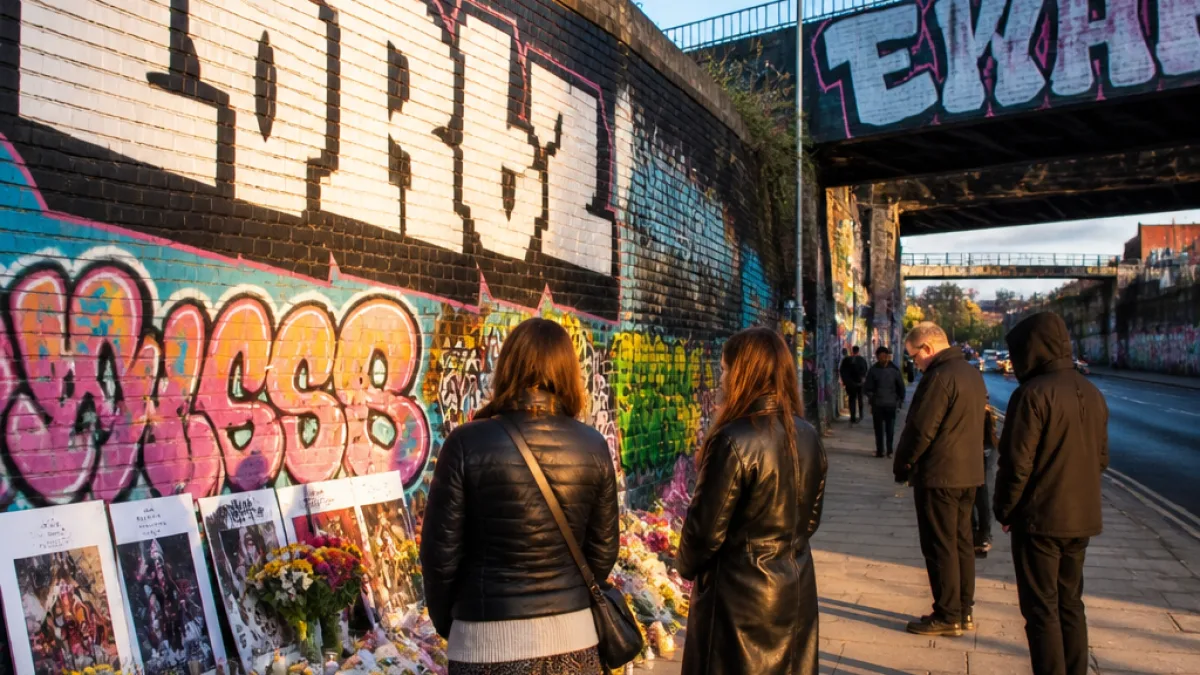
Helch, the elusive graffiti artist responsible for some of London’s most recognisable outdoor murals and rooftop tags, has died, prompting an outpouring of tributes from the art world and local communities.
Enigmatic presence on bridges and rooftops
Over the past eight years Helch built a reputation for painting giant block words across buildings, motorway bridges and rail viaducts. He first came to prominence in 2018 when his eponymous tag began appearing across a string of public spots in London and on bridges on the M4, M1 and M25.
His work ranged from the simple single letter “H” to stylised fonts and different colourways. Several pieces — including one on Brick Lane in Shoreditch — became local landmarks, photographed and shared widely online. A Getty Images picture of a Brick Lane tag from 20 May 2026 has circulated alongside the news of his death.
Gallery and artists pay tribute
BSMT, the Dalston gallery that staged a sell-out show of his work late last year, confirmed the news on Instagram. In a statement shared online the gallery said the news left them "broken hearted" and described the strange, compelling way Helch seemed to “step into our lives out of the ether”.
"Receiving news today of the untimely passing of Helch has left us broken hearted. It felt like he stepped into our lives out of the ether."
Alternative London, an established presence in the capital’s street art scene, described Helch as “a world class artist” and praised the adventurous nocturnal nature of his practice. The organisation also highlighted his charitable giving, noting he had donated part of his book sales to animal charities.
Identity and public debate
Helch maintained a strict anonymity that was central to his public persona. His identity has not been officially confirmed; a Daily Mail report has named him as Michael Purdy, 34, and linked him to the show at BSMT. The gallery described him as "a stranger to the gallery world" whose prints sold out rapidly after their release in 2022.
His anonymity fed debate about the status of street art in the capital: to some residents and curators his work was an act of pure urban creativity; to others the illegal nature of some placements raised questions about public space and property. That tension has been a feature of London’s evolving relationship with graffiti and legal mural commissions.
Local reaction from the streets
Speaking in Shoreditch, where some of Helch’s most visible work appeared, residents described how the tags had become part of the area’s visual identity.
- “You’d see it and know you were in East London,” one local told me. “It was part of the map here.”
- Gallery workers said his prints and canvases had introduced him to an audience beyond the streets.
- Some commuters and business owners expressed concern about illegal tagging but acknowledged Helch’s pieces were different in scale and intent.
What remains and what it means
With the news of his death, many of Helch’s works around the city will now be re-evaluated. Some pieces may be painted over as part of routine maintenance; others, particularly those photographed and archived by cultural organisations, will remain in public memory.
| Notable locations | References |
|---|---|
| Brick Lane, Shoreditch | Photograph dated 20 May 2026 |
| Motorway bridges | M4, M1 and M25 (first widely noted 2018) |
| BSMT Gallery, Dalston | Sell-out show late 2025; first print release 2022 |
Whether his pieces are preserved, removed or reproduced will be a matter for landowners, local councils and custodians of London’s built environment. For many who walked past his work, though, the immediate reaction is one of loss.
As galleries and peers reflect on Helch’s contribution, his practice — equal parts risk, scale and typographic clarity — leaves a clear trace on the city. The streets of East London, as Alternative London put it, will not look the same.
This paper will continue to follow any official statements from galleries, family members or local authorities as they are released.