New book shines light on Bradford’s Victoria Cross recipient
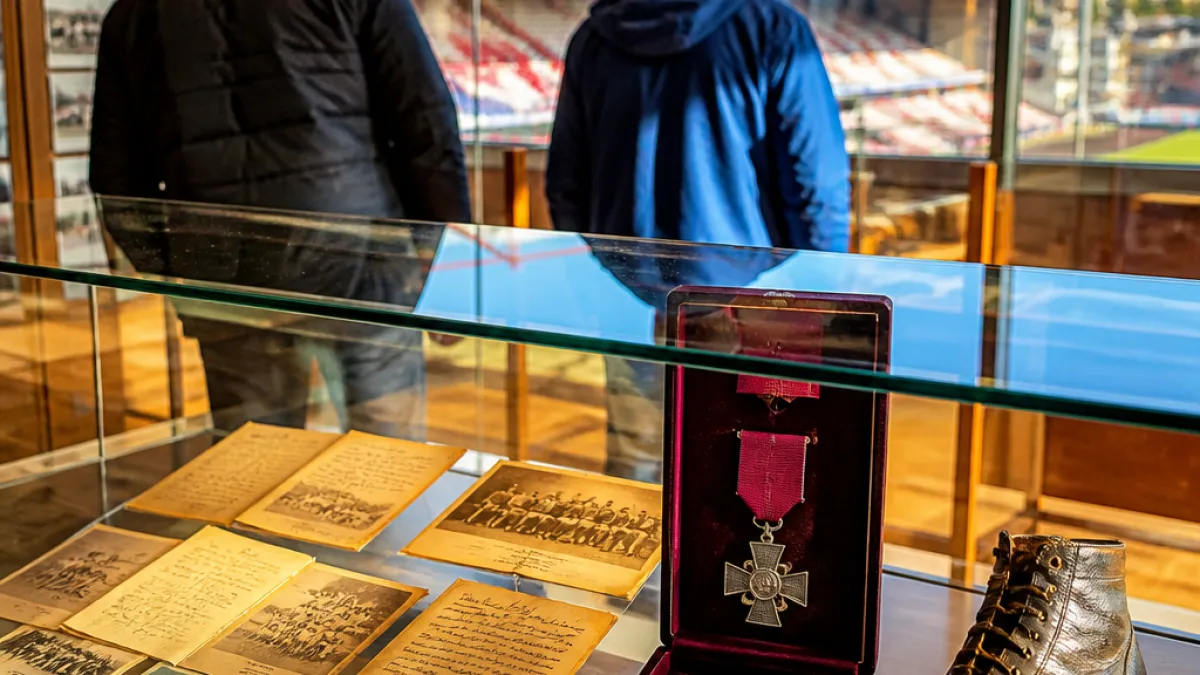
A newly published biography has brought renewed attention to Donald Simpson Bell, the Bradford Park Avenue footballer and schoolteacher who was the only English professional player to be awarded the Victoria Cross during the First World War. The book, written by Manchester-born author Iain McMullen, draws on previously unpublished letters, diaries and photographs from the Bell family archive to construct a fuller picture of his life.
Bell’s life spanned several roles in the north of England. Born and raised in the Harrogate area, he worked as a schoolteacher and played football at a high level, featuring for Newcastle United and Bishop Auckland before signing professionally with Bradford Park Avenue. When war broke out in 1914 he enlisted in the Army rather than joining the Footballers’ Battalion and served with the 9th Battalion, Yorkshire Regiment — the Green Howards — where he was commissioned as a second lieutenant.
The action at Horseshoe Trench
The biography details the circumstances that led to Bell’s Victoria Cross on 5 July 1916 during operations around La Boisselle and Contalmaison on the Somme. His battalion had been ordered to capture a German position known as Horseshoe Trench, a curved defensive line of some 1,400–1,500 metres on higher ground. Four days after the disastrous opening of the Battle of the Somme, a German machine-gun opened enfilade fire — firing along the length of the British line — threatening to halt the advance and cause heavy casualties.
According to the account in the book, Bell acted on his own initiative. Accompanied by Corporal Colwill and Private Batey, he advanced through a communication trench and then crossed open ground under intense fire to reach the machine-gun. Bell is said to have shot the machine-gunner with his revolver, used Mills bombs to destroy the gun and its crew, and thrown bombs into the adjacent trench. The official Victoria Cross citation concluded that his action "saved many lives" — a judgement that underpinned the award.
"saved many lives"
The author’s use of family papers provides additional context to Bell’s pre-war life and temperament — his sporting background is emphasised, with contemporaries noting speed, fitness and athleticism, qualities that the book links directly to his performance in close-quarter assault.
Local legacy and wider significance
The release of the biography will be of particular interest in Bradford where the city’s footballing and military histories intersect. Bell’s association with Bradford Park Avenue places him among a small cohort of sportsmen whose wartime service attracted the nation’s highest military decoration. The new material sheds light on the human dimensions behind the citation: the letters and photographs offer a more personal view of a man remembered both for his athleticism and his conduct under fire.
- Club career: Newcastle United, Bishop Auckland, Bradford Park Avenue
- Military unit: 9th Battalion, Yorkshire Regiment (Green Howards)
- Date of VC action: 5 July 1916, Horseshoe Trench, the Somme
As Bradford groups and regimental historians absorb the new material, the biography is likely to prompt renewed interest in commemorations and accessible local history projects. For residents, the book offers both a local human story and a reminder of the links between sport, community and military service in the early 20th century.
| Detail | Information |
|---|---|
| Name | Donald Simpson Bell |
| Club | Bradford Park Avenue (also Newcastle United, Bishop Auckland) |
| Regiment | 9th Battalion, Yorkshire Regiment (Green Howards) |
| Action | Horseshoe Trench, near La Boisselle and Contalmaison, 5 July 1916 |
| Award | Victoria Cross |
The biography is a reminder that Bradford’s past contains stories with national resonance. By placing new primary material in the public domain, the author has provided local historians and residents with fresh evidence to interpret a figure who bridged the playing field and the battlefield.