RAIB to examine track, embankment and weather after derailment north of Lewes
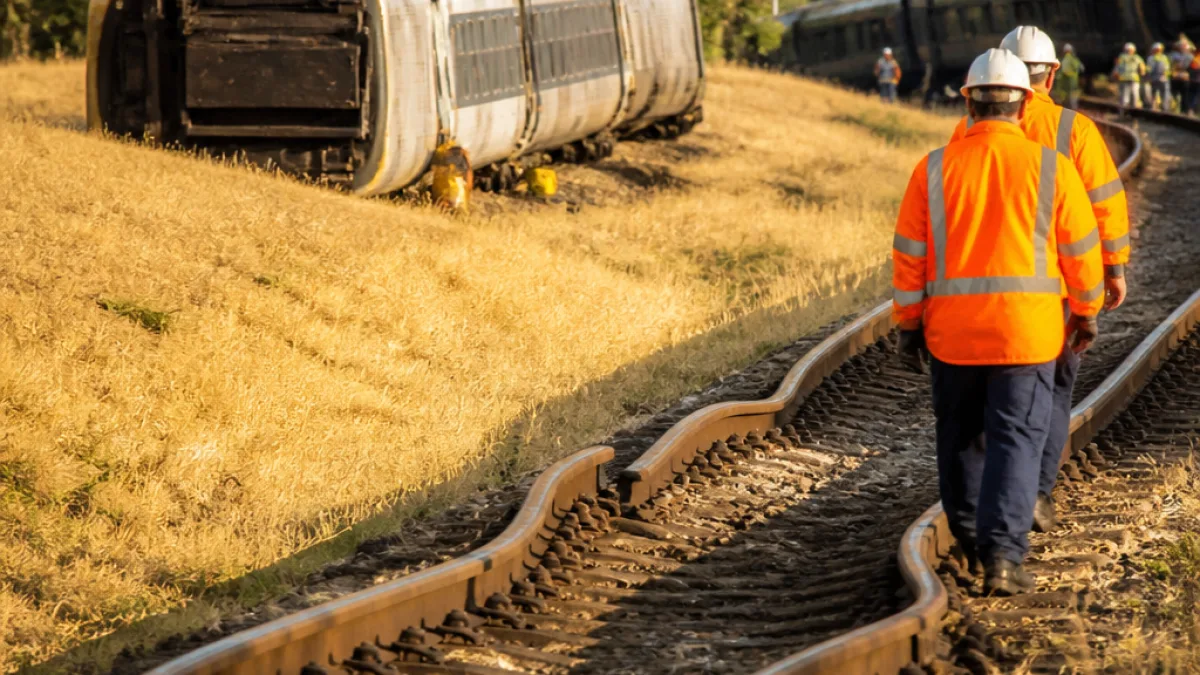
The Rail Accident Investigation Branch (RAIB) has identified a fault on the track north of Lewes as it carries out an inquiry into a derailment that left 30 people injured and saw three carriages come to rest on their sides on an embankment.
Investigators released a CCTV image showing a visibly bent rail at the scene and described the defect recorded on preceding trains as a “track geometry irregularity”. The RAIB said it would look at the weather conditions at the time of the incident, the state of the track and embankment, the condition of the train and the actions taken by operators to mitigate the risks posed by high temperatures.
The eight‑carriage Southern service was operating from London Victoria to Eastbourne on 13 August when the derailment occurred at around 3.54pm. The onboard data recorder indicates the train was travelling at about 65mph as it approached the point of derailment. Approximately 150 passengers were on board.
- 30 people were injured, of whom 20 required hospital treatment.
- Three carriages overturned and rested on their sides on the embankment; the front five carriages remained on the rails.
- The RAIB is analysing CCTV and onboard recorder data and will assess infrastructure and operational responses.
The RAIB highlighted the hot and dry spell that preceded the incident. Meteorological records show that day was the UK’s warmest of 2026 so far, with a high of 38.1C recorded in west London. The branch noted rails can reach much higher temperatures than the air, increasing the risk of buckling during prolonged heat.
“We will consider the weather conditions as well as the status of the track and embankment, the condition of the train and the effectiveness of any measures taken to address potential issues caused by hot weather.”
The RAIB said it had received several reports of ‘rough riding’ from passengers on services that passed the same location before the derailment, which is one of the factors investigators are examining. Evidence of previous maintenance activity in the area was also found.
Local consequences and questions for operators
The incident has prompted urgent calls for clarity from local representatives and passengers who use the route regularly. Operators and infrastructure managers have issued joint assurances that Britain’s railway remains among the safest in the world, while accepting the need to understand exactly what happened at Lewes.
Network Rail’s Sussex route director and GTR’s chief executive, the operator of Southern services, issued a joint statement emphasising the importance of the RAIB inquiry and saying it was essential to learn lessons from the event. The RAIB will examine whether inspections and heat‑mitigation measures in place before the derailment were adequate and correctly implemented.
Locally, commuters and residents will be looking for answers about maintenance standards on this stretch of line and whether embankment materials contributed to instability. The RAIB noted the embankment comprises clay and alluvial deposits — materials that can be sensitive to changes in moisture content and prone to movement under certain conditions.
| Detail | Figure |
|---|---|
| Date and time | 13 August, c. 15:54 |
| Speed as train approached derailment | About 65mph |
| Passengers on board | About 150 |
| Injured | 30 (20 hospitalised) |
Investigators will also seek to establish the relevance of reports of rough riding prior to the accident and whether recent inspections covered the exact section affected. Southern had warned passengers of a safety inspection between Lewes and Haywards Heath the night before the derailment and warned of potential delays; it is not yet clear if that inspection included the precise location where the derailment later occurred.
What residents need to know next
The RAIB’s examination is ongoing and will produce a detailed report once the evidence has been analysed. For now, commuters who travel through Lewes should expect continued attention to safety checks on local lines and any operational changes Network Rail or GTR decide to implement as immediate mitigations.
Local people directly affected by the incident remain the priority for emergency services and health providers. The broader questions over maintenance, inspection regimes and the resilience of railway infrastructure to extreme weather are likely to shape discussions between MPs, the infrastructure owner and the operator in the weeks ahead.
As the inquiry progresses, residents will want clear timelines and explanations from those responsible for the line about what happened and what will be done to reduce the risk of a similar event in future.