
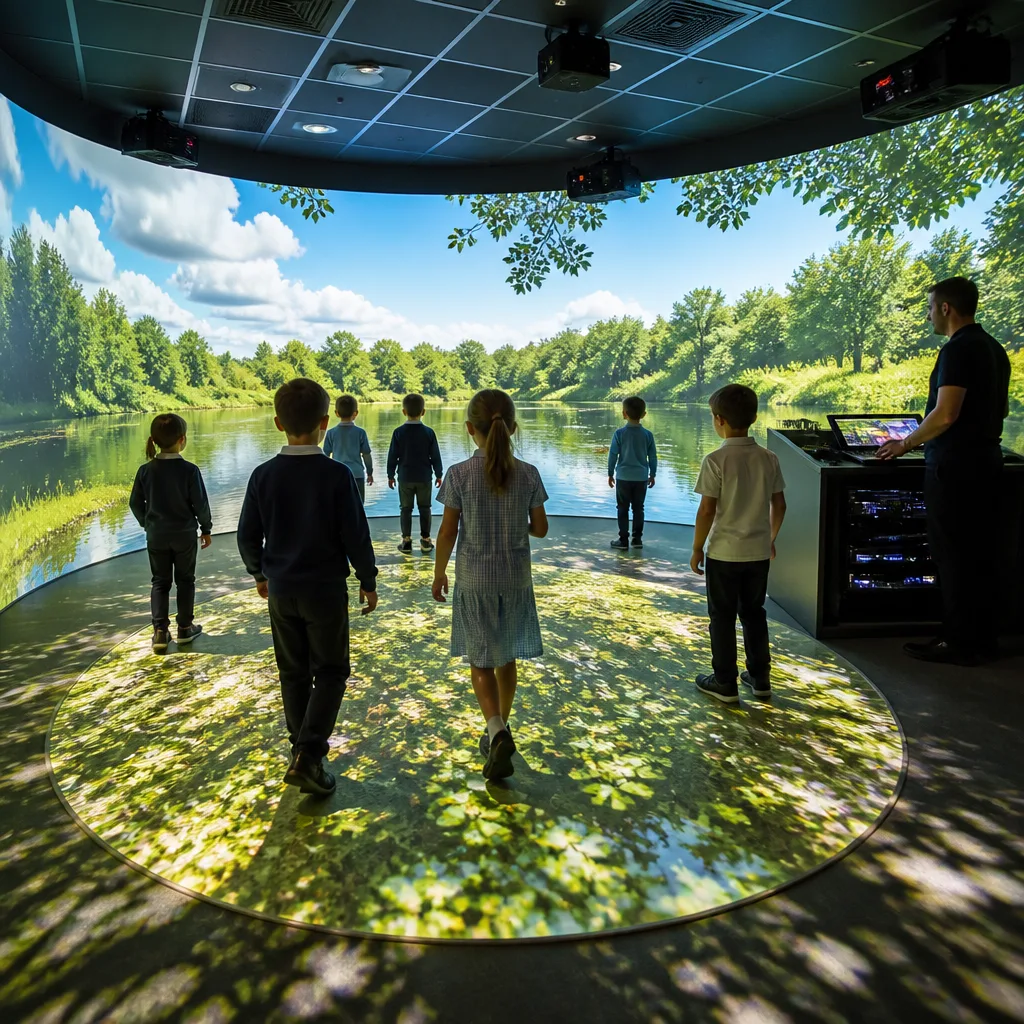
Schools in Israel are introducing immersive, room‑scale technology to help children recover from prolonged exposure to conflict, displacement and rocket fire, in a project built by local firm Totally Interactive in partnership with the Mashabim Community Stress Prevention Center. The initiative aims to support pupils’ emotional resilience and social readjustment as they return to classrooms after nearly three years of war.
Shared, not isolated, immersive experiences
The system projects interactive images and sounds into a physical space where small groups of pupils can move and participate together. Its proponents argue this approach differs from conventional virtual reality headsets by keeping children in a communal environment rather than isolating them individually.
The immersive rooms can present a variety of settings — from famous paintings to urban streets — to provide interactive exercises that teach stress recognition, empathy and coping strategies. The technology is being adapted to work with protocols developed by Mashabim, which aim to address the broad effects of sustained stress among children, including those who have not developed post‑traumatic stress disorder (PTSD).
Dr Nira Kaplansky, Mashabim’s head of innovation and development, says even otherwise healthy children have been affected by the Oct. 7 attack and the wars that followed.
Programme focus and intent
Officials stress the project is not intended as a clinical treatment for PTSD but as an early intervention to mitigate the pervasive impacts of ongoing stress. The immersive environments are designed to give pupils practical tools for managing emotional responses, improve social skills and support reintegration into school routines.
- Collaborators: Totally Interactive (technology) and Mashabim (resilience protocols).
- Target group: Children returning to school after prolonged conflict exposure, including those without formal PTSD diagnoses.
- Method: Room‑scale interactive projections used by small groups to learn about stress, empathy and coping.
Context and implications
After almost three years of sustained conflict, many children in affected areas show changes in behaviour and learning capacity even if they do not meet clinical thresholds for post‑traumatic stress. Mashabim’s work builds on established resilience frameworks and seeks to reach a wider group of pupils through familiar school settings. By situating the technology in classrooms and communal spaces, the programme aims to normalise coping skills training and reduce stigma associated with seeking help.
There are practical advantages to shared immersive rooms: schools can host multiple pupils simultaneously; teachers and counsellors can observe interactions directly; and the approach may be less intrusive than headset‑based virtual reality. However, the roll‑out will raise questions about evaluation, safeguarding and long‑term support. Robust monitoring will be needed to determine which pupils benefit, whether gains persist over time, and how to integrate the work with existing mental‑health services.
What officials say and next steps
Totally Interactive’s founder, Erez Noked, has been demonstrating the system in schools and community centres. Mashabim has created resilience protocols — including methods derived from the BASIC PH model associated with Professor Mooli Lahad — which are being adapted for the interactive rooms. The programme will continue to be refined based on classroom experience and professional feedback.
| Feature | Purpose |
|---|---|
| Room‑scale projections | Create shared physical environment for group exercises |
| Resilience protocols | Teach coping strategies and emotional recognition |
| Small‑group format | Encourage social learning and peer support |
The project sits at the intersection of technology, education and public health. Its early aim is pragmatic: to equip children with tools to manage stress and to make schools a stabilising presence after years of disruption. If the initiative demonstrates measurable benefits, it could influence how schools and community services elsewhere deploy immersive technology in resilience and wellbeing programmes.
For now, the emphasis from Mashabim and its partners is on adaptation and modest, evidence‑driven expansion — testing how interactive, communal experiences can complement traditional classroom and therapeutic approaches for children living through protracted conflict.









