
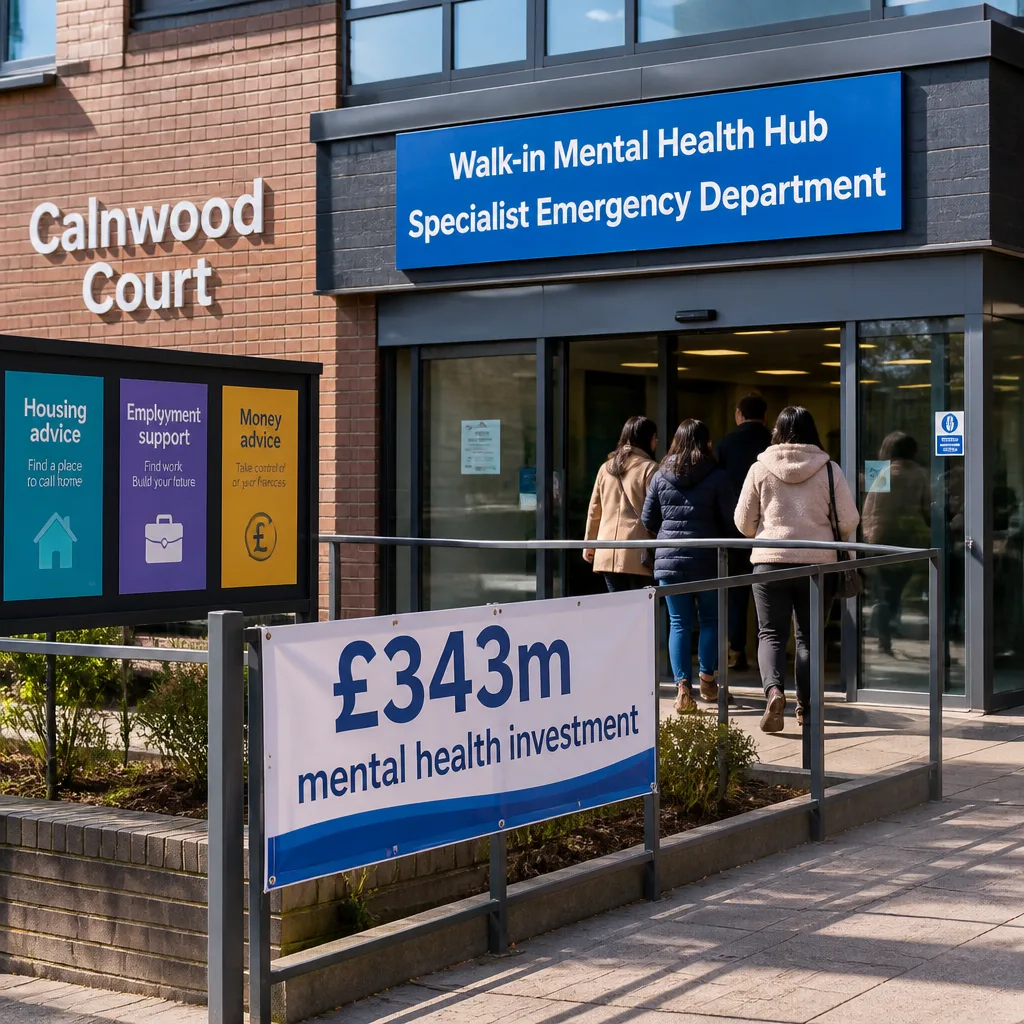
The Government has committed £343m to expand mental health support and has announced that Luton will receive a new walk‑in community facility alongside a dedicated mental health emergency department at Calnwood Court, ministerial plans show.
What has been announced
The funding forms part of a wider national investment intended to shorten waits for people seeking mental health help. In Luton the package will deliver two key elements: a walk‑in community hub where patients can be seen without a GP referral, and a specialist emergency department designed to provide urgent mental health care outside of mainstream A&E.
- Walk‑in access: patients can attend without needing a GP referral, intended to speed assessment and treatment.
- Specialist emergency department: the Calnwood Court facility aims to remove the need for people in crisis to wait in general A&E settings.
- Holistic support: the local services will bring together partner organisations providing housing, money advice and employment support to address non‑clinical drivers of poor mental health.
Why ministers say the changes are needed
Commenting in a local constituency column, Luton North’s Member of Parliament welcomed the initiatives as a response to what she described as a national crisis in mental health support. The measures are pitched at reducing lengthy waits for talking therapies and long waits in A&E, which campaigners and clinicians have repeatedly flagged as barriers to timely care.
“Patients will be seen much quicker without the need for a GP referral, and specialist emergency departments will remove the need for stressful visits to general A&E.”
This description underlines the intention to create alternatives to traditional referral pathways and emergency departments, and to provide earlier, more direct access for people in acute distress.
Services linked to social and economic support
The announced community hub is planned to coordinate with organisations specialising in housing, money advice and employment, reflecting an acknowledgement that social and financial pressures often intersect with mental health problems. The local MP stressed that these partnerships aim to provide practical help alongside clinical assessment and therapy.
Bringing multiple services together is consistent with a growing evidence base suggesting that integrated, multidisciplinary approaches can improve outcomes for people with complex needs. However, peer‑reviewed studies also caution that integration requires careful planning, sustained funding and clear pathways to avoid fragmented care or duplicated effort; the announcement does not yet set out operational detail.
Limits of the current information
At present the information published in the constituency column provides an overview of planned provision but lacks a detailed timetable, staffing plans or precise referral and triage protocols. There is no published data in the announcement on expected patient volumes, waiting‑time targets, or measures of clinical effectiveness.
These gaps matter for evaluation. Without specified performance metrics and transparent reporting, it will be difficult to judge whether the new facilities reduce pressures on A&E, shorten waits for therapy, or improve clinical outcomes for people at risk of self‑harm.
Local context and potential impact
The MP emphasised local need, pointing to the financial and social pressures many constituents face and suggesting the new services could provide earlier intervention and potentially avert crises. The planned model — combining clinical assessment with practical support — aims to identify and tackle underlying factors that can exacerbate mental ill health.
| Planned element | Stated purpose |
|---|---|
| Walk‑in community hub | Quicker access without GP referral |
| Specialist emergency department (Calnwood Court) | Urgent mental healthcare outside general A&E |
| Integrated support | Housing, money and employment advice linked to services |
As with any major reorganisation or new service, success will depend on implementation: where the facilities are located, how they are staffed, their hours of operation, and how they coordinate with existing primary care and crisis teams. Campaigners and clinicians will rightly expect published targets and ongoing evaluation to demonstrate that the investment translates into measurable improvements for patients.
Anyone seeking more information locally has been invited to contact the MP’s office, which offered an email address for constituents wishing to discuss access to services.
Note: the discussion above is based on the announcement published in a constituency column and summarises the planned elements and immediate implications. It does not include independent verification of operational details, which have not yet been published.














