
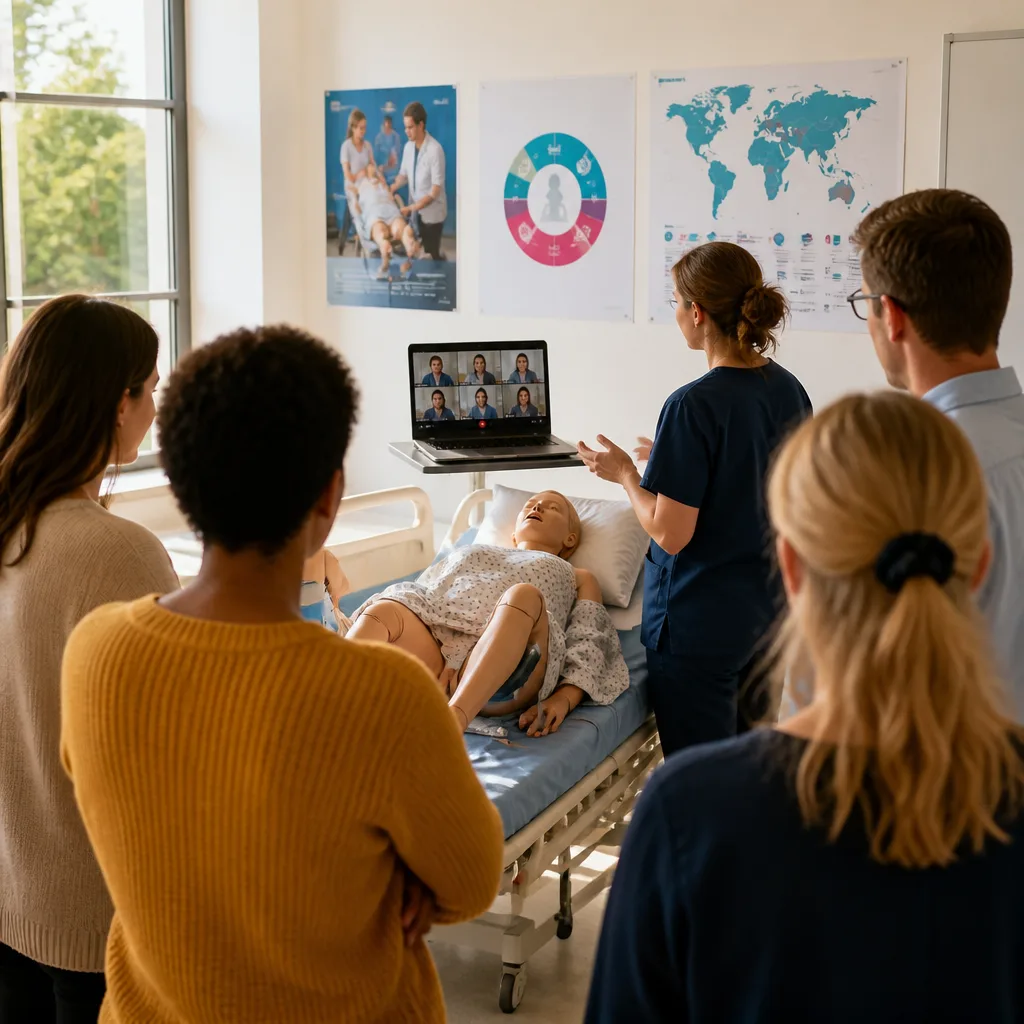
The University of Gothenburg is leading a new international research consortium that aims to create shared guidance for midwifery education by combining clinical simulation with approaches that centre women’s perspectives and participation in care. The initiative brings together global bodies and researchers to identify what elements of training can be standardised and what must be tailored to local cultures and health systems.
Bringing simulation and people-centred care together
Although both simulated clinical practice and woman-focused care already feature in international midwifery frameworks, there is currently no unified set of standards that explains how the two can be integrated across diverse educational and clinical environments. The consortium — the Global Research Consortium for Person-Centred Care and Simulation in Midwifery Education and Practice — will gather evidence from a variety of settings to develop such guidance.
Participants will examine whether and how training elements can be transferred between settings, and where adaptation is essential because of cultural, organisational or resource differences. The work builds on long-term research carried out by Gothenburg scholars in the Democratic Republic of the Congo, where combining simulation with a focus on women’s narratives and participation was shown to help student midwives practise both technical and relational skills.
“We saw in the Congo that learning clinical skills alone is not enough. Simulation also gives students the opportunity to practise listening and communication, build partnerships and involve women in decisions about their care,”
The consortium will partner with major international agencies and professional bodies to ensure that its findings are relevant to policy-makers, training institutions and regulatory organisations worldwide.
Partners, priorities and practical questions
Organisations involved include the World Health Organization, the United Nations Population Fund (UNFPA) and the International Confederation of Midwives, alongside the University of Gothenburg’s Institute of Health and Care Sciences and its Centre for Person-Centred Care. The consortium intends to pool research and practical experience from different continents to test and refine proposals for education standards.
- Clarify which simulation methods best support both clinical proficiency and communication skills.
- Define how person-centred principles can be taught and assessed in varied cultural settings.
- Identify adaptations needed where resources, clinical exposure or cultural norms differ.
The research team emphasises that educational content is influenced by context: what works in one country may not be directly transplantable to another without modification. Their fieldwork in the Democratic Republic of the Congo demonstrated the value of combining technical training with exercises that develop students’ ability to listen to women, to involve them in decision-making and to build respectful partnerships.
| Lead institution | Key international partners |
|---|---|
| University of Gothenburg | WHO, UNFPA, International Confederation of Midwives |
Researchers will ask not only what should be taught but how it should be assessed. Simulation offers a controlled environment for students to practise emergencies, routine procedures and communication challenges without risk to patients. The consortium plans to evaluate how simulation-based exercises can be combined with assessment methods that capture person-centred behaviours, such as shared decision-making and active listening.
Implications for education and care
If successful, the consortium’s work could lead to internationally recognised guidance that helps midwifery educators design curricula which produce practitioners competent in both clinical tasks and relational care. That, in turn, could influence accreditation standards, teacher training and investment in simulation facilities.
For low-resource and fragile settings, the consortium will need to specify low-cost, scalable approaches so that improvements in training do not exacerbate inequities. The consortium’s focus on distinguishing universal competencies from locally adapted practices will be key to ensuring relevance across high-, middle- and low-income health systems.
By uniting research, practice and policy expertise, the group aims to provide practical recommendations that education providers and health services can implement while respecting cultural diversity and resource constraints.











