Governments and public institutions are being urged to move beyond traditional awareness campaigns and adopt simulation-based learning to reduce massive financial losses from scams, according to the ASEAN Foundation.
From awareness to behavioural resilience
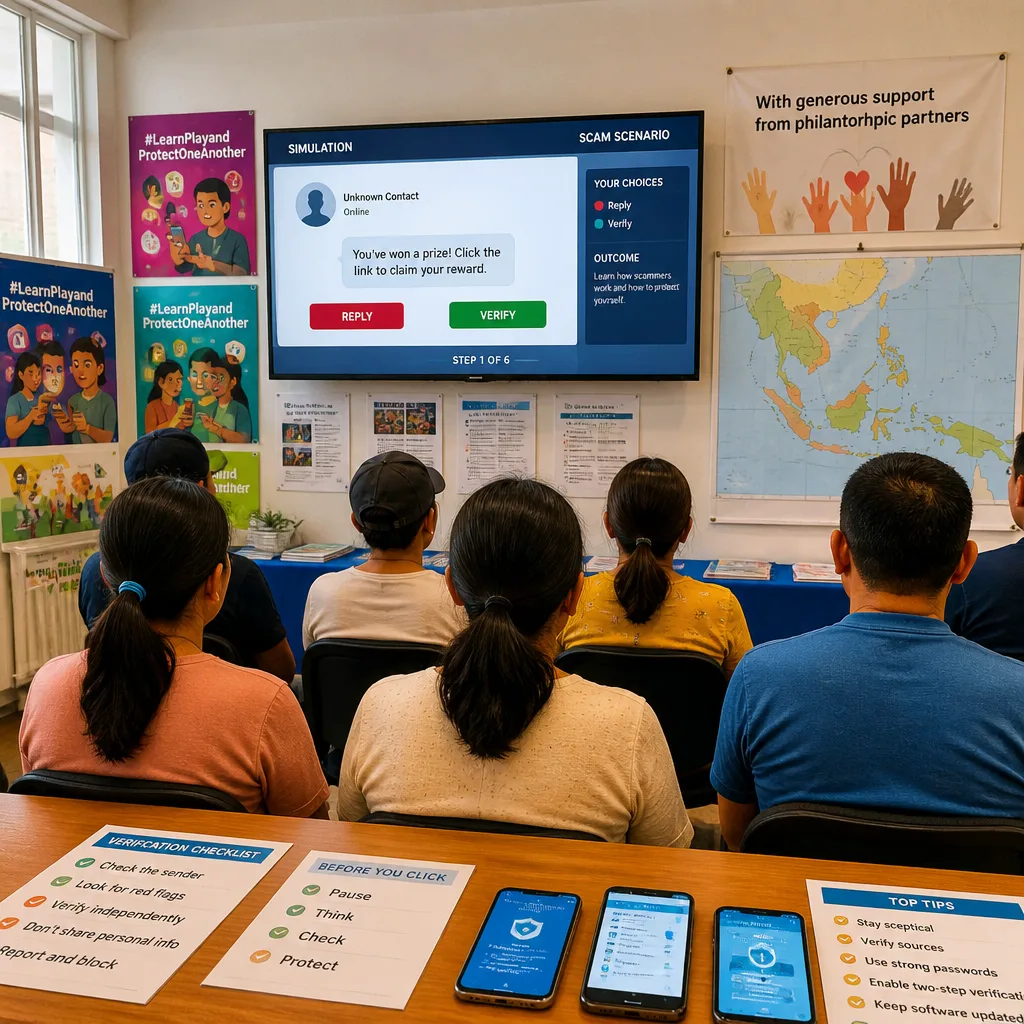
The foundation has launched Scam Ready ASEAN, a programme that uses gamified simulations and open learning resources to train civil servants and the wider public to respond to realistic scam scenarios. The initiative, supported by Google.org, seeks to build what its leaders call psychological defences — automatic habits that prompt people to pause and verify when they encounter suspicious requests.
The move comes against a stark backdrop: the Global Anti-Scam Alliance (GASA) estimates that Southeast Asia lost US$23.6 billion to scams in 2024. The ASEAN Foundation stresses that actual losses are likely higher because of significant under-reporting.
“A sophisticated scam rarely begins with a technical breach. It is not about cyberattacks. Scammers exploit human behaviour,”
That line, from the foundation’s executive director, encapsulates the programme’s rationale: while technical defences remain important, the decisive vulnerability is often human — specifically the absence of a moment to stop and check when targeted.
How the programme works
Scam Ready ASEAN departs from traditional training in two principal ways. First, it focuses on simulation rather than just knowledge transfer: learners encounter interactive scenarios that reflect common manipulation techniques. Second, it frames training as behavioural conditioning — repeated practice designed to turn verification into an automatic response.
The programme’s project manager has also launched an initiative called #LearnPlayandProtectOneAnother, which combines:
- open-access learning materials,
- gamified simulations tailored to different personas, and
- community engagement to promote ongoing practice and collective responsibility.
Programme leads say simulations mimic the social pressures that make scams effective, such as messages impersonating colleagues or managers — scenarios that traditional phishing-awareness modules can miss.
| Metric / Element | Detail |
|---|---|
| Estimated regional loss (2024) | US$23.6 billion (GASA estimate) |
| Approach | Gamified simulations, behavioural conditioning, community engagement |
| Support | Google.org |
Implications for education and public services
For the education sector, the campaign raises questions about how digital and civic curricula should equip young people with not just technical skills but resilient decision-making habits. In schools and universities, simulation-based exercises could reinforce routines of verification — for example, checking identities and seeking independent confirmation before sharing funds or details.
Within the civil service, the ASEAN Foundation argues that many employees already recognise basic red flags in emails. The challenge arises when a message appears to come from someone in authority or a trusted peer. Simulation can recreate that pressure and allow staff to practise safe responses without real-world cost.
Leaders of the programme compare scam simulations to vaccines in the way they prepare people’s responses to future threats: repeated, low-risk exposure to manipulative techniques builds a quicker, more automatic defensive reaction when a genuine attempt occurs. That framing underlines why the foundation has prioritised repeated practice and community-level reinforcement over one-off publicity campaigns.
As scams evolve in sophistication, the ASEAN Foundation’s approach highlights a broader shift in public education: equipping people to act differently under pressure, not merely to recognise danger.