
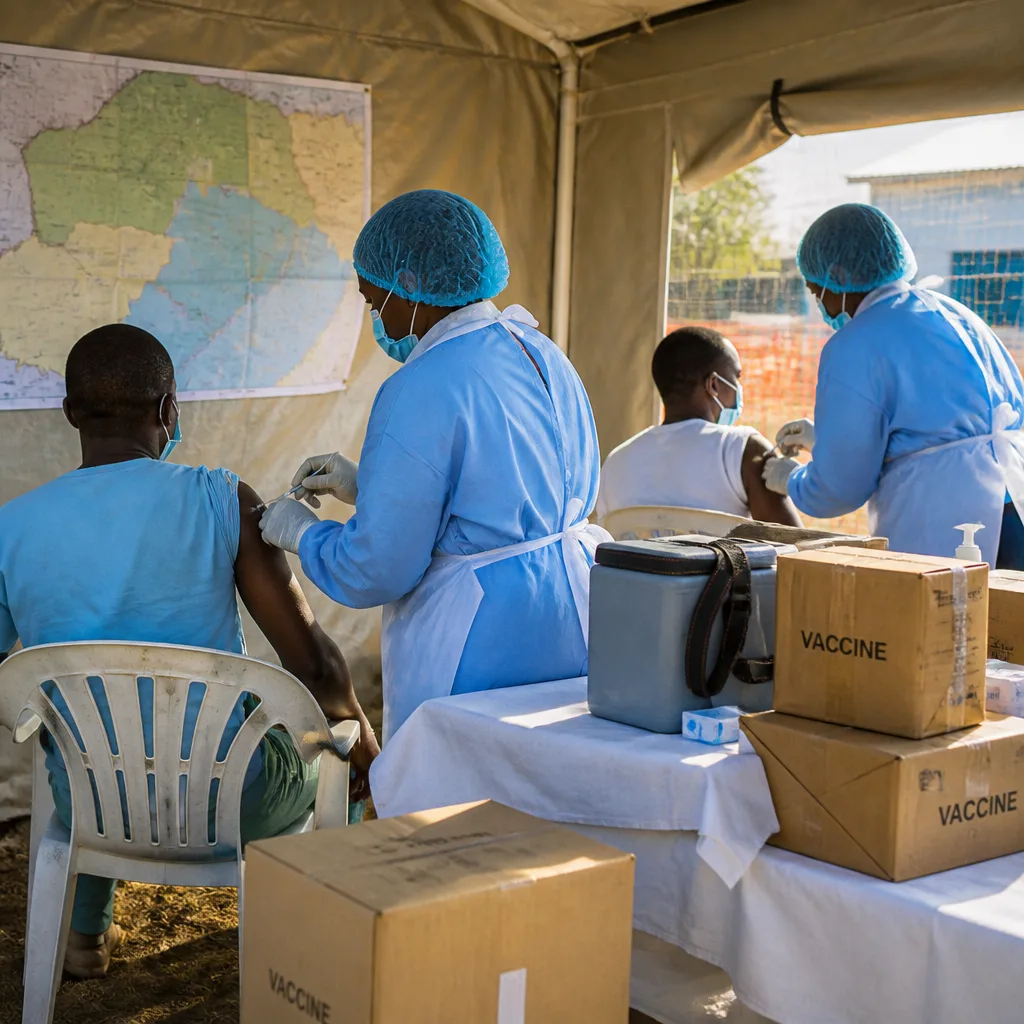
The Democratic Republic of Congo has launched a targeted vaccination campaign for health and other front‑line workers in the Ituri province, officials said, as the country grapples with what is already its deadliest recorded Ebola outbreak.
Vaccine use focused on those most exposed
Health teams began administering the Ervebo vaccine on Saturday in Bunia and Mongbwalu — areas identified as epicentres of transmission — prioritising staff directly involved in patient care and outbreak response.
"Our collective duty is to protect life. Launching this vaccination drive for front‑line staff in Ituri is not an arbitrary choice, as these workers are particularly exposed and deeply involved in the response,"
said Major General Gaby Kasongo Mulumba, the provincial military governor.
The campaign is expected to reach an estimated 20,000 front‑line workers across Ituri and neighbouring North Kivu over six to nine months, according to health authorities. The Ervebo vaccine was previously shown to be effective in outbreaks caused by a different and more common Ebola species; it is being used here on a prioritised basis while trials continue to develop and license a vaccine targeted at the current strain.
Scale and severity of the outbreak
Government figures reported on Saturday put the outbreak at 7,541 confirmed cases with 3,639 deaths, and 1,823 recoveries. Transmission is concentrated in Ituri province and the outbreak has been described by the World Health Organization as uncontrolled and expanding under highly challenging conditions.
| Measure | Number |
|---|---|
| Confirmed cases | 7,541 |
| Deaths | 3,639 |
| Recovered | 1,823 |
Authorities warn the epidemic is spreading in a context of insecurity, population displacement, a strike by health workers and intense movement of people, all of which complicate contact tracing, case isolation and vaccine delivery. The WHO has said the outbreak could exceed the scale of the 2014–2016 West Africa epidemic if control measures do not improve.
Why this vaccine and what it can do
Ervebo was developed and deployed in response to Ebola virus disease caused by the Zaire ebolavirus species and has demonstrated protective effects in earlier outbreaks of that strain. The current outbreak is caused by the Bundibugyo virus, for which there is no licensed vaccine or specific antiviral treatment yet. Clinical trials are under way to identify and licence vaccines tailored to the Bundibugyo virus, but results and regulatory approvals are pending.
Health workers on the ground said the decision to vaccinate was pragmatic. Dr Jeannot Elua, encountered by reporters at a Bunia health facility, described the vaccine as "beneficial" and said staff felt they had little choice but to accept immunisation because of their exposure.
"We healthcare workers don’t really have a choice: we are going to receive it,"
he said, adding that some colleagues had previously received the earlier vaccine and he had been vaccinated himself when it was mandatory.
Constraints and caution
Experts caution that using a vaccine developed for a different Ebola species is not equivalent to having a licensed product for Bundibugyo; cross‑protection can be incomplete and real‑world effectiveness against this strain is not established. In addition, insecurity and disruption to health services reduce the speed and coverage of vaccination drives. Clinical trials remain the accepted path to determine safety and efficacy for the specific virus circulating.
- Priority group: health and front‑line workers in Bunia and Mongbwalu.
- Campaign scale: around 20,000 workers targeted over six to nine months.
- Outbreak status: 7,541 confirmed cases and 3,639 deaths reported; WHO describes the epidemic as out of control.
The vaccination of front‑line staff is a pragmatic attempt to protect those most at risk while research continues. However, the broader public‑health challenge — stemming from violence, displacement and strained health systems — means that vaccination alone will not be sufficient to halt transmission unless accompanied by strengthened surveillance, security and community engagement.














