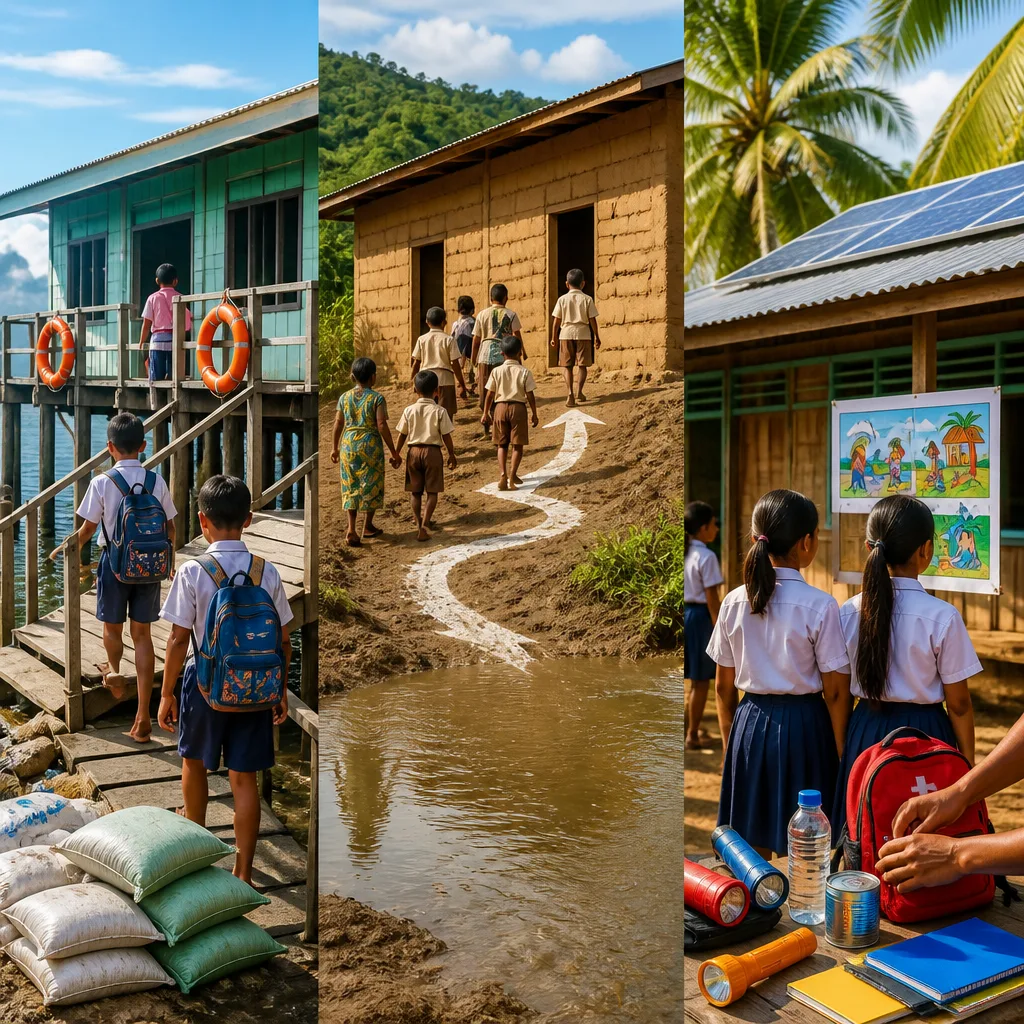
International climate finance is being channelled directly into education for the first time through complementary initiatives that combine grants and technical assistance to shore up school buildings, prepare pupils for hazards and strengthen systems in vulnerable countries.
Grants and guidance: two approaches
The Building the Climate Resilience of Children and Communities through the Education Sector (BRACE) project marks a notable development: it is the first education-focused programme to receive funding from the Green Climate Fund (GCF), having been agreed at COP28 in Dubai.
BRACE is financed principally by a US$32 million GCF grant alongside a US$8 million contribution from the Global Partnership for Education (GPE). Save the Children Australia is named as an implementation partner, with the project active in South Sudan, Tonga and Cambodia.
In parallel, the Climate Smart Education Systems Initiative (CSESI) operates as a technical assistance programme. Launched in March 2023, it carries GPE funding of US$21 million, including a US$5 million contribution from Japan. CSESI focuses on advice, capacity-building and inter-ministerial collaboration, including practical measures such as running safety drills with pupils ahead of floods.
Why education is now central to climate finance
Both initiatives arise from a growing recognition that natural hazards and climate change have direct impacts on schooling: damaged or unsafe infrastructure interrupts learning, while poorly prepared systems exacerbate educational losses after extreme weather.
BRACE seeks to bridge the climate and education financing streams, combining resources from both sectors to strengthen education systems and protect learning. The UNFCCC and GPE documents set out ambitions to make national and sub‑national education sectors more resilient; an early programme objective reads:
"the education sector at national and sub-national levels in targeted countries is more r"
That truncated sentence in the source underlines that these projects target system-wide resilience rather than piecemeal interventions.
What this means for schools and pupils
Practical actions funded or supported through these initiatives include retrofitting or rebuilding school infrastructure to withstand floods and storms, integrating disaster risk reduction into education planning and running drills so pupils and staff know how to respond in emergencies. Technical assistance helps ministries of education to coordinate with disaster and climate agencies — a commonplace challenge in many countries where responsibilities are fragmented.
- BRACE — large-scale grant funding aimed at tangible improvements in targeted countries’ education infrastructure and systems.
- CSESI — technical advice and capacity-building to help governments plan and implement climate-smart education reforms.
Funding snapshot
| Initiative | Primary funder(s) | Funding (US$) | Focus |
|---|---|---|---|
| BRACE | Green Climate Fund; GPE | 32,000,000; 8,000,000 | Resilience of education systems; implementation in South Sudan, Tonga, Cambodia |
| CSESI | GPE (incl. Japan) | 21,000,000 (incl. 5,000,000 from Japan) | Technical assistance, capacity-building, safety drills |
While the sums are modest by the scale of global education budgets, they are significant in signalling a shift in international priorities: climate funds are being deployed explicitly to keep children learning during and after climate shocks.
Implications and questions for policymakers
For education ministers and school leaders — in the UK and abroad — the initiatives underline several policy considerations. First, planning for climate risk must become integral to education sector strategies, not an add‑on. Second, ministries require technical support and cross‑departmental mechanisms to align building codes, early warning systems and school safety policies. Third, there is a need to ensure financing reaches the sites where children learn: community schools, temporary learning spaces and remote facilities often carry the highest risk and the least access to resources.
For donors and multilateral bodies, BRACE and CSESI offer models to replicate and scale: one bundles capital grants to upgrade infrastructure; the other provides technical know‑how to mainstream climate resilience in education planning. Together they advance the argument that protecting learning is an essential part of climate adaptation.
As climate-related school disruptions grow in frequency, the outcomes of these programmes will be watched closely by governments, education agencies and aid partners seeking to protect the education of millions of children in vulnerable settings.