
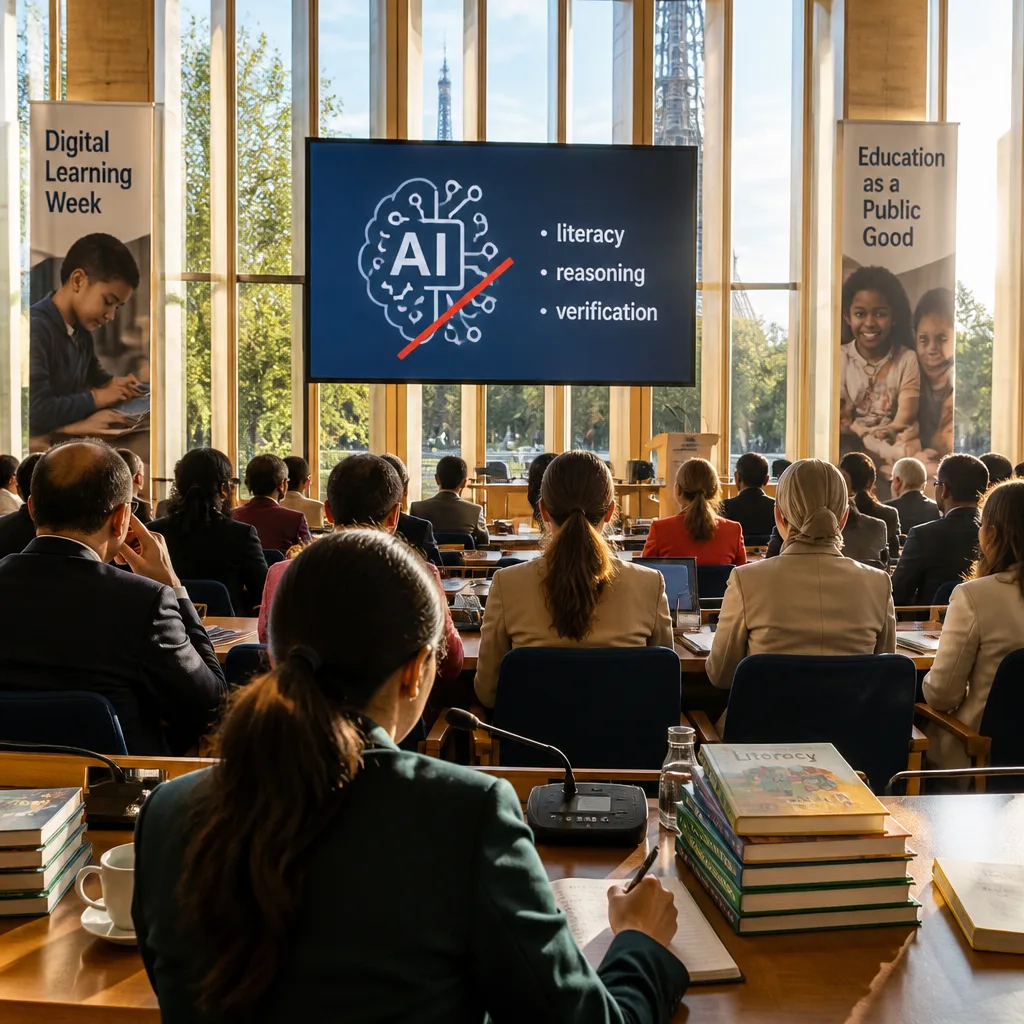
Bangladesh’s education minister has warned that governments should ensure children possess solid reading, reasoning and verification skills before embracing artificial intelligence across classrooms.
Ministers back human‑centred approach at Unesco event
Speaking at Unesco’s Digital Learning Week 2026 in Paris, the minister set out a clear caution: AI is becoming unavoidable, but its value for education should be judged by how it affects actual learning, teachers’ workloads, equity and safety, not by the scale of deployment.
More than 25 ministers and designated education representatives at the event adopted a joint statement committing to sustain education as a human right and a common good in the age of AI. Delegates explicitly pushed back against technological solutionism and sought to place public authority at the heart of decisions about educational technology.
Questions of control, cost and readiness
The minister’s intervention emphasised four areas ministers considered essential when evaluating AI in schools:
- Safety — ensuring children are protected when tools are used;
- Age appropriateness — deciding when pupils are ready to engage with AI;
- Procurement and cost of ownership — understanding long‑term financial and operational commitments; and
- AI sovereignty — questions over who controls data and systems.
These are framed, the minister argued, as matters of public policy and governance rather than solely technical issues. In practice, that means determining who decides a child’s readiness for AI, how student information is controlled and what conditions vendors must meet.
| Focus area | Policy question |
|---|---|
| Safety | How will pupils be protected from harm? |
| Age appropriateness | At what stage should children access AI tools? |
| Procurement & cost | What are the full financial and operational implications? |
| AI sovereignty | Who controls pupil data and decision‑making systems? |
Teachers must be central to decisions, minister says
The intervention argued that educators should have a central role in shaping pilots, procurement choices, evaluations and corrections. The minister warned against allowing automated systems to make personnel decisions such as recruitment, promotion or disciplinary action.
That position reflects growing international concern that rapid procurement and deployment of AI tools can inadvertently increase teachers’ workloads, entrench inequality or outsource accountability to opaque vendors. The minister urged policymakers to start by asking: what problem is the technology intended to solve, and what basic capabilities must be present for it to help?
Seen from the classroom, that question is a practical one. Many schools' immediate challenges remain fundamental: ensuring pupils can read fluently, reason carefully and verify information. Without those foundations, a sophisticated AI tutor may do little more than disguise learning gaps.
Implications for policy and procurement
For national education systems, the minister’s remarks underline several consequential policy considerations. Procurement processes will need to account for total cost of ownership, not simply licence fees. Data governance arrangements must be robust and publicly accountable. And professional development is required if teachers are to evaluate, adjust and integrate AI tools without being sidelined.
Ministers at the Unesco roundtable signalled a shift away from competing to be first with new technology, towards measuring success by outcomes for learners and fairness across communities. That does not reject technological innovation, but it reframes it as a means to educational aims rather than an end in itself.
The challenge for education ministers everywhere will be translating those principles into procurement rules, regulatory safeguards and classroom support systems — while making sure that the basics of literacy and critical thinking remain the priority.











