
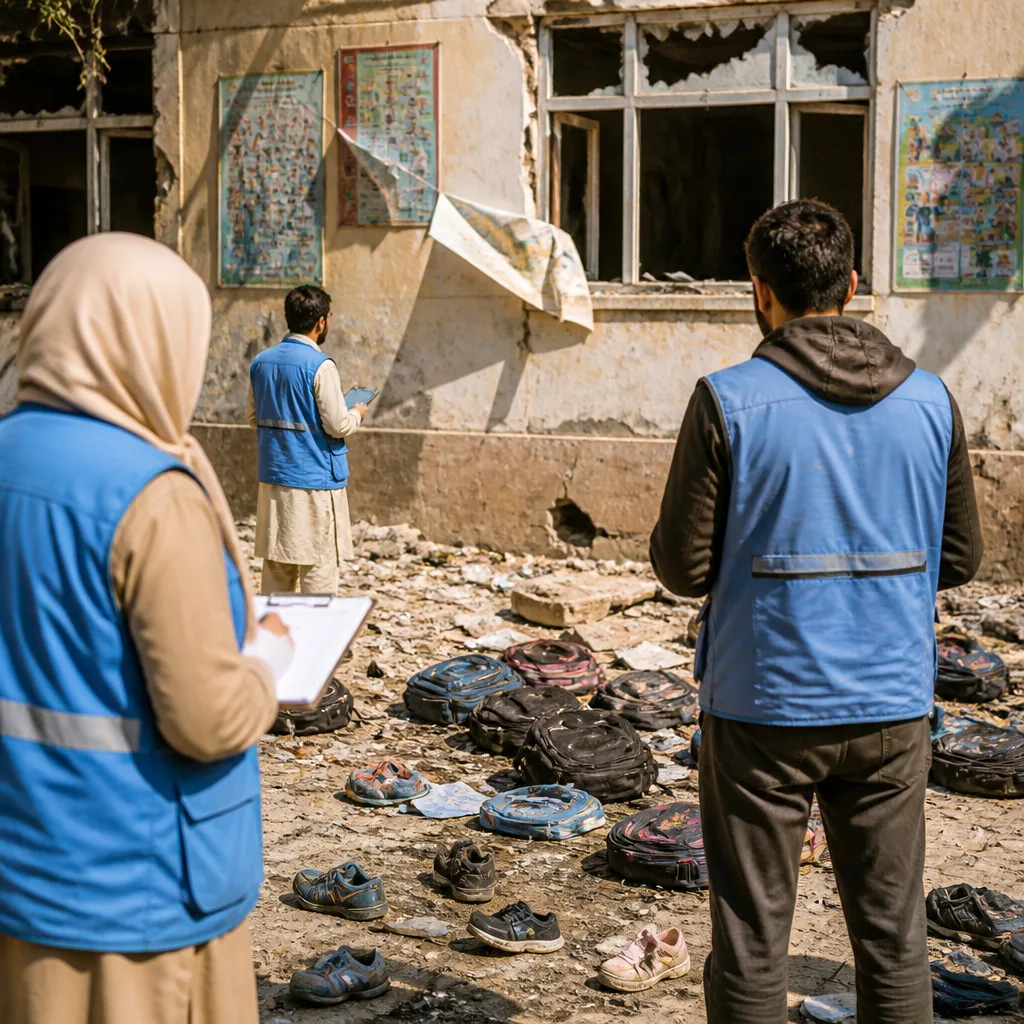
An explosion at an education centre in Kabul on Monday injured at least 42 children, United Nations investigators said, in an incident that has yet to be fully explained and that has prompted calls for an immediate, independent investigation.
What is known so far
The United Nations Assistance Mission in Afghanistan (UNAMA) reported the number and age range of the victims but gave few further details. The injured children were said to be between nine and 14 years old, and the figure of 42 was described as provisional — recorded as "at least" to reflect the possibility that additional victims might later be identified.
"At least 42 children between the ages of nine and 14 were injured."
Officials have not released information about where within or near the education centre the explosion occurred, what caused it, whether the facility was deliberately targeted, or what form of teaching was being provided. There has been no breakdown of the injuries by severity and no official statement about which medical facilities received the wounded, or how many remain in critical condition.
Unanswered questions and immediate priorities
Because key facts remain unknown, the incident is being treated by observers as a serious but still insufficiently explained explosion. UNAMA has urged an investigation to establish what happened, stressing that schools and education centres must be protected and kept safe.
- Cause: Not yet established — could be deliberate attack, an unexploded device or an accident.
- Location within centre: Unknown — authorities have not specified where the blast occurred.
- Type of education and attendance: No details released about the programme or the number of students present.
The absence of a claim of responsibility does not determine whether the explosion was deliberate. Investigators will need to examine physical evidence, witness testimonies and any available recordings before reaching reliable conclusions.
Wider context and implications for education
Afghanistan's education system has faced repeated disruptions and threats, including restrictions on girls' schooling and periodic attacks on learning facilities. In this context, incidents that injure children at educational sites carry wider resonance: they affect parental confidence in sending children to class, increase the emotional and physical barriers to attendance, and place additional strain on already stretched health and education services.
UNAMA expressed sympathy with the children and their families and underlined the need for clarifying the circumstances of the blast. Prompt, transparent findings will be essential both to provide accountability and to reassure communities about safety measures at schools and learning centres.
| Known detail | Information available |
|---|---|
| Number injured | At least 42 |
| Age range | 9–14 years |
| Cause of blast | Unknown / under investigation |
| Responsibility claimed | No claim reported |
For parents and educators in Afghanistan and internationally, the episode will heighten concerns about the fragility of school safety in conflict-affected settings. Until investigators publish findings, the scale, cause and precise circumstances of the explosion will remain open questions. Further official updates will be required to determine whether the blast resulted from a deliberate act, an unexploded ordnance or an accident, and to inform any urgent measures needed to protect children attending education centres.
The immediate priorities are medical care for the injured, transparent investigation of the incident and reassurance that learning spaces can be made secure for pupils and staff.











