
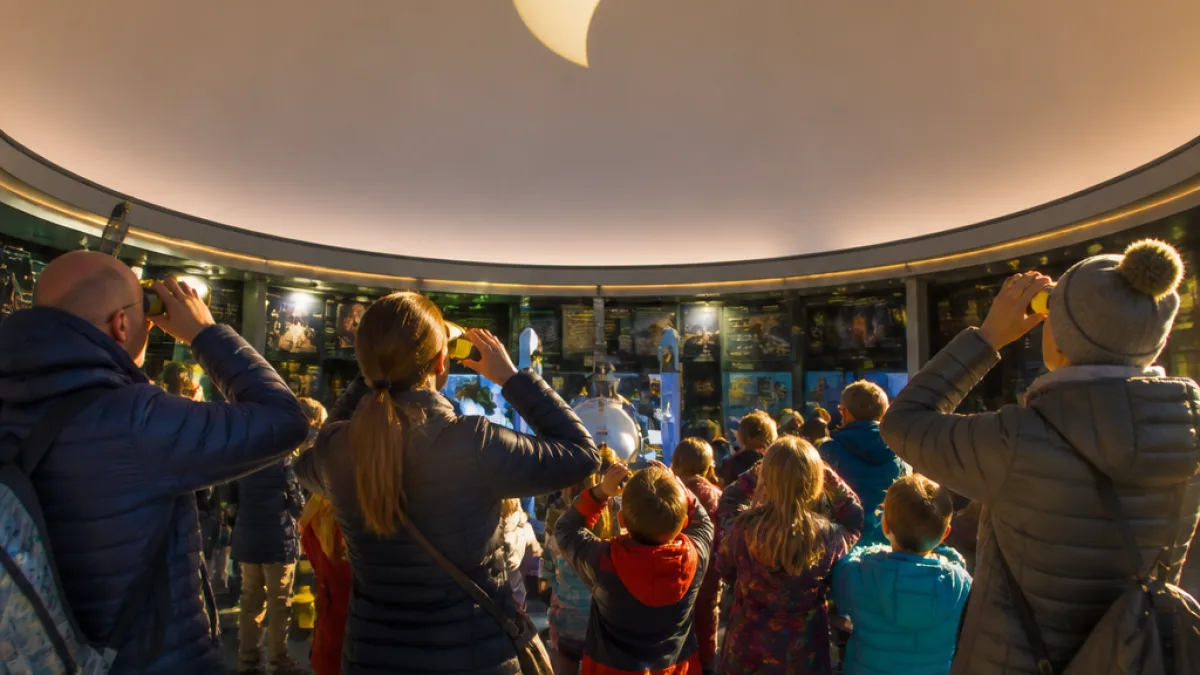
Public turnout high as Armagh prepares for a rare astronomical spectacle
Armagh’s Observatory and Planetarium was packed out on Wednesday as families and amateur astronomers gathered to watch a partial solar eclipse expected to obscure around 94–95% of the Sun across much of Northern Ireland.
Professor Michael Burton, director of Armagh Observatory and Planetarium, told visitors the event was a reminder of Earth’s place in the solar system and that the Moon would come between the Earth and the Sun, nearly matching the Sun’s angular size and consequently blocking most of its disc.
“We’re having one of these remarkable astronomical events… it’s going to just about block it all out,” Professor Burton said.
Experts described the eclipse as likely the deepest witnessed from the region since the total eclipse of August 1999, and said a similar spectacle will not be visible from here again until 2090. While some parts of the world will experience a total eclipse — including areas of Spain, Greenland and Iceland — residents of the west and south of the island of Ireland were expected to see up to 98% coverage, compared with roughly 94% in the east and north.
Local arrangements and outreach
Armagh Observatory joined sister institutions in the Republic — Dunsink in Dublin and Blackrock Castle in Cork — in organising public viewing events. The planetarium’s outreach team, including Dr Rok Nežič who conducts science communication and outreach at the observatory, took part in preparations to ensure visitors could see the eclipse safely and understand the science behind it.
- Public interest was high, with the planetarium reporting full capacity for its scheduled sessions.
- Organisers emphasised the importance of using proper eye protection while viewing to prevent eye damage.
- The eclipse was promoted as an opportunity to engage families and school groups in astronomy and science communication activities.
Professor Burton said eclipses have a particular resonance because they make people feel connected to larger cosmic processes. He noted that while this would not be a total eclipse for Armagh, the near-complete obscuration of the Sun is nevertheless an uncommon and striking phenomenon.
How the eclipse will look across the island
Observers across Ireland and Northern Ireland could expect differing levels of coverage depending on location. Local astronomers provided percentages to give the public a sense of what to expect:
| Area | Estimated Sun coverage |
|---|---|
| West & South of the island | 98% |
| East & North of the island (including Armagh) | 94–95% |
Planetarium staff used the event to reinforce safety messages. Direct viewing of the Sun without appropriate filters can cause irreversible eye injury; organisers advised the public to use certified eclipse glasses or indirect viewing methods.
The turnout at the Armagh venue reflects sustained local interest in astronomy. The observatory, which combines scientific research with public engagement, has become a focal point for such community-facing events. Staff said they hoped the eclipse would inspire visitors to learn more about the science of the Sun, Moon and Earth.
While the partial eclipse will darken the sky considerably in Armagh, it will not produce the full daytime darkness experienced along the path of totality seen in parts of Spain, Greenland and Iceland. Nonetheless, for many attendees at the planetarium the spectacle was described as a rare, communal moment that connects people to the cycles of the solar system.
Organisers encouraged anyone unable to attend live events to follow coverage from reputable scientific institutions and to observe safety guidance when attempting to view the eclipse from home.









