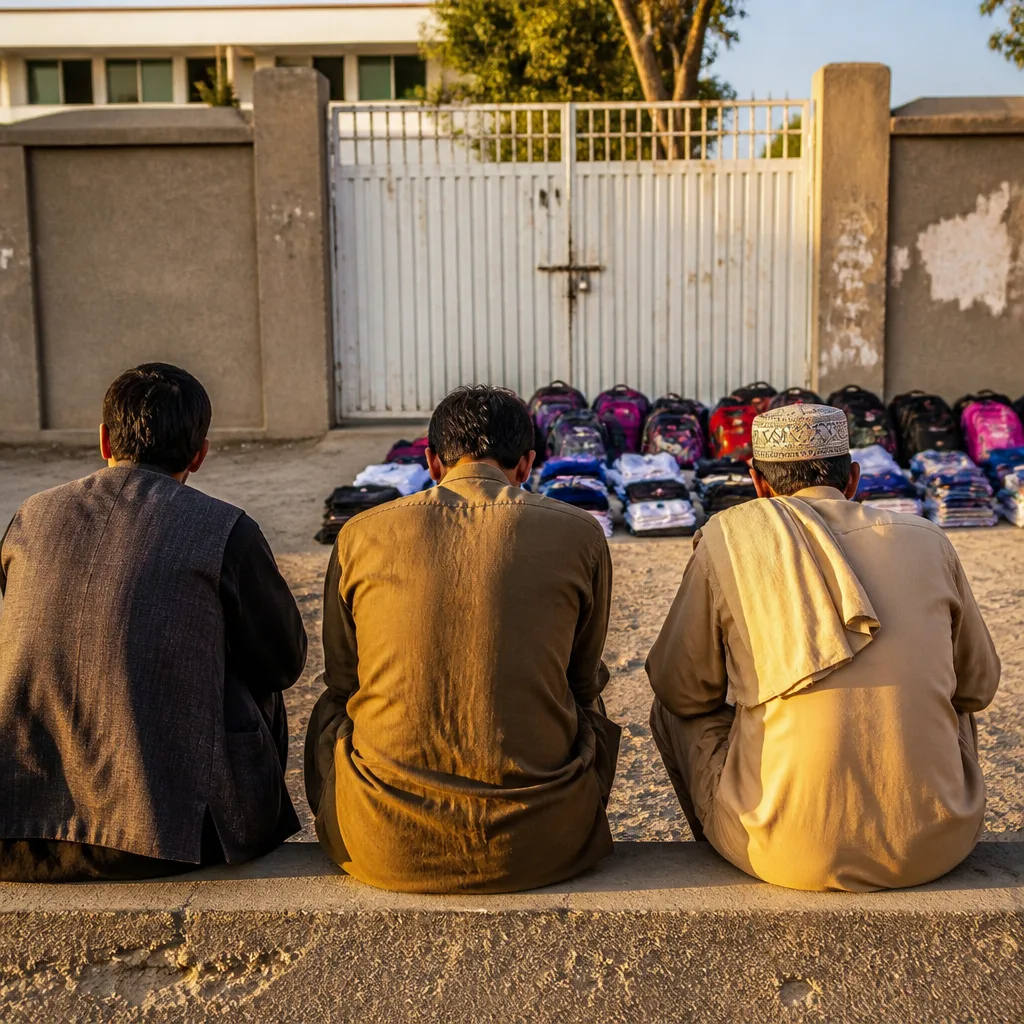
Fathers across Afghanistan are describing profound distress and helplessness after a Taliban decree that has barred girls from attending secondary school since March 2022, a policy that the United Nations says has directly affected at least one million girls.
Personal anguish and wider consequences
AFP interviews with fathers around the country reveal the emotional cost of the restrictions behind closed doors. Many of the men spoke of sleepless nights and mounting worry about how to support daughters who had been making good progress at primary level.
One engineer, whose wife had been employed as a secondary school mathematics professor before the ban, said he could not imagine a future in which his daughters would be left effectively unable to meet the demands of "the 21st century". He warned that stopping education at roughly the sixth-grade mark would leave young women severely disadvantaged.
“You will never find in the Qur’an that education is only for men,”
That reflection came from a devout father who told AFP he could not reconcile the ban with his understanding of Islam. Another interviewed man, who praised the Taliban for bringing security and reducing corruption, nonetheless said he could not "find any proper justification" for the measure.
Public opinion and protest
Surveys indicate the policy clashes with public sentiment among men: a UN poll last year found that nine out of ten men questioned considered secondary schooling for girls important, and nearly two thirds regarded it as pious for a father to support his daughter's education. The prohibition has also provoked public action; some men have been jailed after demonstrating against the restrictions.
Taliban officials have repeatedly described the ban as temporary, but more than four years on there has been no reversal. The authorities did not provide a response to AFP’s queries about the continuing ban.
What is known
The following facts are established from reporting and UN estimates:
- Girls were barred from attending secondary schools in March 2022.
- Universities were subsequently closed to young women later in 2022.
- The UN estimates that the policy has directly impacted at least one million girls.
| Measure | Date |
|---|---|
| Secondary schools closed to girls | March 2022 |
| Universities closed to young women | Later in 2022 |
| Estimated girls affected (UN) | At least 1,000,000 |
Classroom reality versus ideology
Fathers described daughters who were "bright and frustrated", unable to continue on a path that would previously have led to secondary qualifications, higher education and employment. One interviewee said that the family’s academic aspirations had been curtailed alongside the professional career of his wife, a former secondary school teacher.
The reactions recorded by AFP highlight a tension between local expectations and the ideological interpretation advanced by those in power. While officials maintain the prohibition is temporary, the longevity of the restrictions and the scale of the impact raise questions about the long-term social and economic consequences for Afghan women and girls.
For pupils, parents and educators, the ban is not only a present denial of opportunity but a potential determinant of life chances for an entire generation. As the fifth anniversary of the return of Taliban rule approaches, international agencies and Afghan families alike are watching for any shift that would restore access to secondary education for girls.
This article is based on reporting by AFP and UN estimates cited in that reporting; Taliban authorities did not respond to requests for comment.