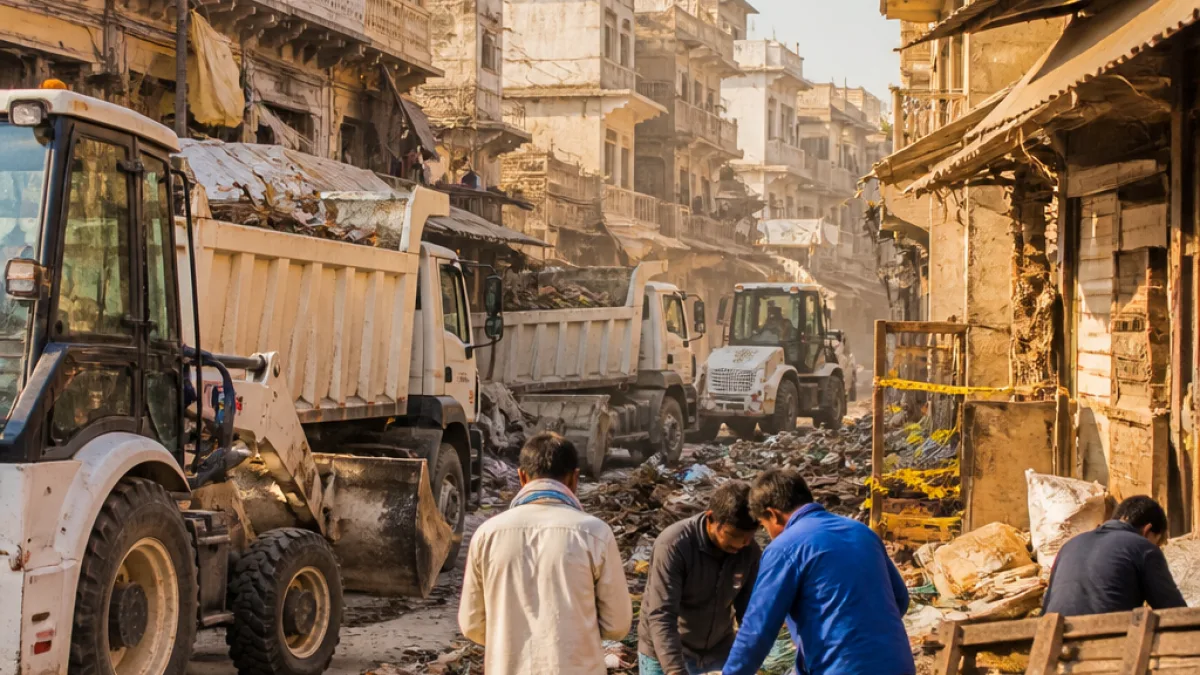
VARANASI: The Varanasi Development Authority (VDA) carried out a demolition drive in the Dal Mandi area, OdishaTV reported on Tuesday. The television channel’s social bulletin flagged the operation with a string of hashtags naming the locality and the authority.
What was reported
The only published coverage available at the time of filing came from OdishaTV, which posted a short item identifying the site as Dal Mandi and attributing the action to the VDA. The report did not provide details on the number of structures affected, the legal orders invoked, whether prior notices were served, or whether any arrests or detentions took place.
Immediate implications for residents and traders
Demolition drives in market neighbourhoods such as Dal Mandi typically affect local traders, hawkers and residents who depend on informal and semi-formal commercial activity. In the absence of detailed official statements on this operation, the immediate concerns that commonly arise include disruption to livelihoods, loss of stock for small traders, and short-term dislocation of customers and traffic flows.
- Livelihood impact: Traders operating in and around market yards can face sudden loss of premises and goods, particularly where structures are ad hoc or unauthorised.
- Traffic and access: Demolition activity often causes temporary road closures and diversion of traffic, affecting commuters and public transport.
- Civic services: Clearance operations can also affect waste collection, water supply points and sanitation arrangements in dense market areas.
VDA’s role and the wider context
The Varanasi Development Authority is the statutory agency responsible for planning and executing development schemes across the Varanasi metropolitan area. Its mandate includes enforcing building regulations, implementing planned layouts and undertaking anti-encroachment measures where authorities deem structures to be unauthorised or in violation of development plans. Media reports of demolition activity often reflect the tension between city development objectives and the realities of informal urban economies.
Without an official VDA release on this specific operation, public records such as notices, court orders or details of rehabilitation or compensation — if any — are not yet available in the public domain. That information is necessary to assess whether the action followed due process under relevant municipal and state laws.
What residents and stakeholders should look for next
For residents, traders and civic-watchers, the following pieces of information will be important to establish the legality and consequences of the drive:
| Information | Why it matters |
|---|---|
| Copy of demolition or anti-encroachment order | Shows legal basis and any timelines for compliance or appeal |
| Details of notices served | Indicates whether due process was followed prior to action |
| Record of property/stock losses and rehabilitation plans | Relevant to compensation and relief for affected persons |
OdishaTV flagged the operation in a short report identifying Dal Mandi and the VDA as parties involved.
Urban clearances and enforcement actions are a regular feature in fast-growing Indian cities. In Varanasi — a city that combines dense residential settlements, traditional markets and ongoing infrastructure projects — enforcement operations can have outsized effects on livelihoods and daily life. Clear public communication from the authority, documentation of legal steps and any measures to protect vulnerable traders will be key to managing the aftermath.
Local residents and stakeholders are advised to seek official information from VDA offices or through the VDA’s public notices to obtain authoritative details on the action and any recourse available. As of this report, the VDA has not issued a detailed public statement on the Dal Mandi operation beyond what was carried in the OdishaTV item.
Reporting note: This article is based on the televised report published by OdishaTV identifying a demolition drive by the Varanasi Development Authority in Dal Mandi. No additional independent confirmation was available in the public domain at the time of publication.