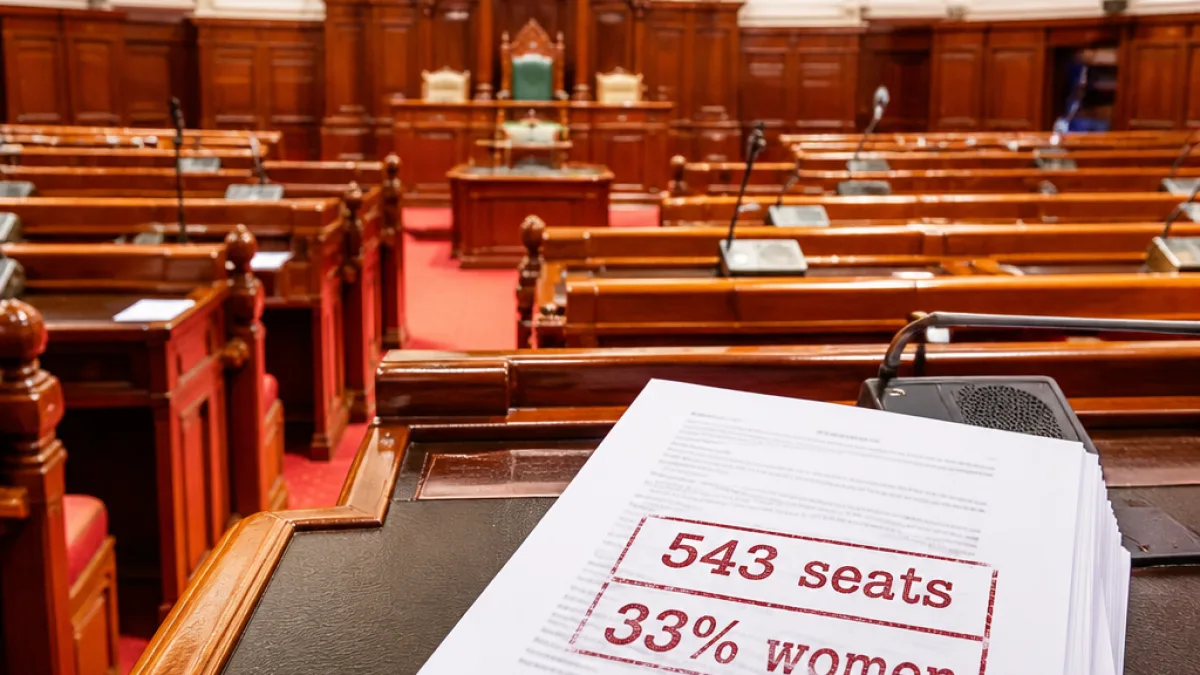
Chennai, 13 August: The Tamil Nadu Legislative Assembly on Wednesday adopted a resolution requesting the Union government to freeze the number of Lok Sabha seats at 543 and to provide for 33% reservation for women in legislative bodies on that basis.
Assembly stance and political alignments
The resolution, moved by the state administration led by the Tamilaga Vettri Kazhagam (TVK) under Chief Minister C Joseph Vijay, won support from the principal opposition Dravida Munnetra Kazhagam (DMK) and allies including Left parties and the Viduthalai Chiruthaigal Katchi (VCK). Parties that opposed the resolution included the Bharatiya Janata Party (BJP), All India Anna Dravida Munnetra Kazhagam (AIADMK), Pattali Makkal Katchi (PMK) and the Desiya Murpokku Dravida Kazhagam (DMDK).
The move comes against the backdrop of the Union government’s earlier attempt to amend the Constitution through the Constitutional (131st Amendment) Bill, 2026, which envisaged ending the five-decade freeze on delimitation, taking up a fresh exercise based on the 2011 census and increasing the number of Lok Sabha members substantially.
Why the Assembly wants a freeze
State leaders argued that a fresh delimitation based on older census figures would penalise southern states such as Tamil Nadu, which have managed to control population growth. The resolution urges that the total number of recognised Lok Sabha seats be held at 543 — the current operational figure for direct-elected seats in Parliament — and that any expansion or redistribution should not diminish the relative representation of states that performed better on demographic control.
"We request all honourable members of this assembly, across all party lines, to pass this resolution unanimously,"
The above appeal was made on the Assembly floor by Chief Minister C Joseph Vijay while moving the resolution.
Context: The 131st Amendment and the delimitation debate
In April 2026, the Union government introduced the Constitutional (131st Amendment) Bill, 2026, which sought to remove the 50-year freeze on delimitation, undertake a fresh exercise using the 2011 census and increase the Lok Sabha strength from 550 to 850, according to the Bill’s proposals. Parliamentary debate and voting on the measure stalled amid concerns about how the redistribution would be carried out; critics said the Bill lacked clarity on the method of allotting additional seats to states.
Opponents within and outside Parliament feared that a delimitation tied to the 2011 census — without compensatory mechanisms — could permanently reduce the representation of states that achieved lower population growth rates after the 1970s.
What the Assembly asked the Centre
- Freeze the number of Lok Sabha seats at 543.
- Ensure 33% reservation for women in legislative bodies based on the frozen strength.
- Reconsider any constitutional amendment that would alter state-wise representation without a clear, equitable mechanism.
Political reaction and implications
The Assembly’s resolution is intended as a formal expression of the state’s position to the Union government and Parliament. If the Centre revives or rephrases the 131st Amendment Bill or introduces a similar measure, the resolution signals that Tamil Nadu will press for safeguards to protect its parliamentary strength.
Supporters of the resolution argued that keeping the number of seats at 543 preserves current representation balance and provides a stable basis for implementing women’s reservation. Opponents countered during the Assembly debate that the nation’s democratic architecture requires regular review to reflect demographic changes and that a simple freeze may not address representational imbalances.
| Stance | Parties |
|---|---|
| Supported resolution | TVK (ruling), DMK, Left parties, VCK |
| Opposed resolution | BJP, AIADMK, PMK, DMDK |
The resolution does not have the force of law but represents the state legislature's formal request to the Centre. Any change to the number of Lok Sabha seats or the mechanism for delimitation requires parliamentary legislation and, in many cases, constitutional amendment procedures.
As the matter moves back to national debate, Tamil Nadu’s position is likely to figure in consultations between state and Union leaders, particularly if the Centre seeks the large numbers in Parliament required to pass a constitutional amendment. The Assembly’s demand for a simultaneous guarantee of women’s reservation underlines a push to secure gender representation while protecting state interests.
Reporting from Chennai.