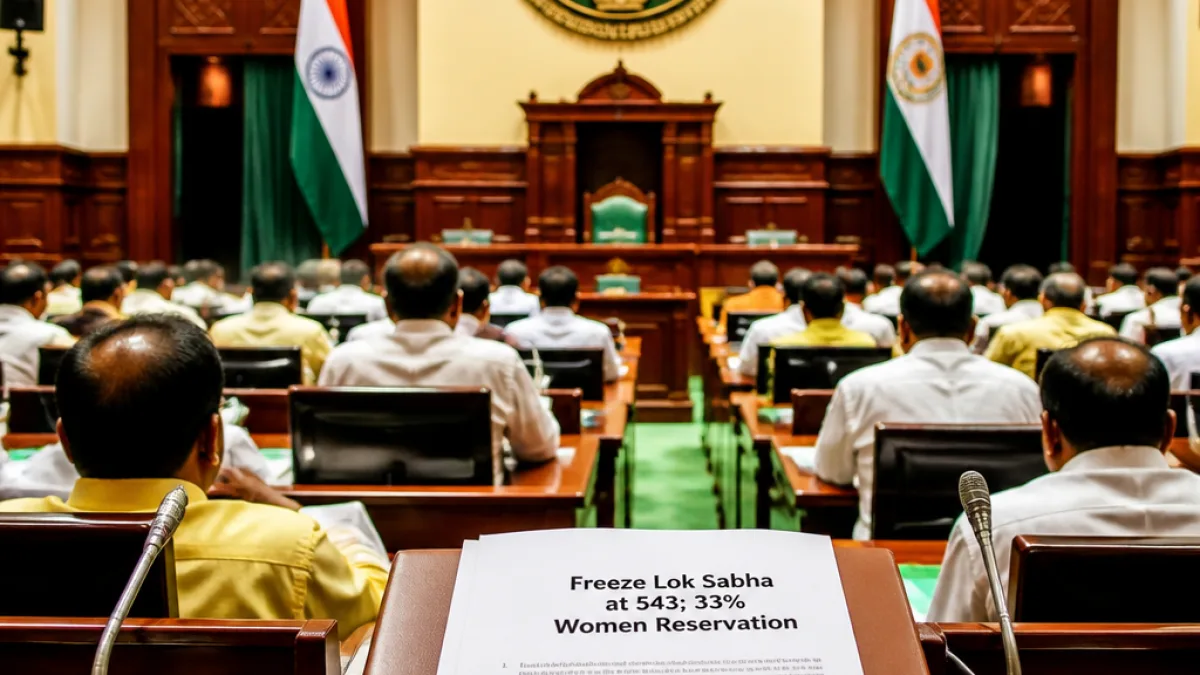
Chennai, Aug 12: The Tamil Nadu Legislative Assembly on Wednesday passed a resolution urging the Union government to freeze the total strength of the Lok Sabha at 543 seats, retain the present pattern of inter‑state allocation and implement 33% reservation for women in the 2029 general election on the basis of the existing constituencies.
Assembly motion and demands
Moving the resolution, Chief Minister C. Joseph Vijay framed the demand as a protection of southern states’ political representation and a measure to ensure timely implementation of women’s reservation that Parliament had approved in 2023. The resolution was adopted amid opposition from some parties in the House.
The text of the resolution sets out four core demands to the Centre:
- Retain the total number of Lok Sabha seats permanently at 543.
- Freeze inter‑state distribution of seats in the present proportions.
- Preserve the existing Lok Sabha–Rajya Sabha ratio of 2.2:1.
- Implement 33% reservation for women in the Lok Sabha in 2029 based on the current 543 constituencies and carry out subsequent Assembly elections without delay.
Rationale cited by the Chief Minister
Mr. Vijay told the Assembly that the resolution reflected concerns about women’s representation and about states that successfully pursued population control being penalised in a delimitation exercise. He highlighted Tamil Nadu’s history of notable women leaders from the Sangam era to the present day and stressed the importance of expanding political opportunities for women.
"Reservation for women is not a concession. It is a matter of social justice and a constitutional right," Mr. Vijay said.
The Chief Minister also drew attention to electoral participation, noting that voter turnout among women in the State was higher than among men. He pointed out that although the number of women MLAs had risen from 12 in the preceding Assembly to 23 in the current House, the percentage share had not seen a significant increase.
Context: constitutional amendments and bills
In 2023, Parliament enacted the 106th Constitutional Amendment Act providing for one‑third reservation of seats for women in the Lok Sabha and State Legislative Assemblies. The Act stipulated that it would come into effect after the decennial population census and any subsequent delimitation exercise.
More recently, the Union Government introduced the Constitution (131st Amendment) Bill, 2026, and a Delimitation Bill, 2026, with proposals to expand Lok Sabha strength and expedite women’s reservation. The 131st Amendment Bill was introduced in the Lok Sabha on April 16, 2026, but on April 17 it failed to secure the two‑thirds special majority required under the Constitution, according to parliamentary records cited in the House.
| Item | Position |
|---|---|
| Current Lok Sabha seats | 543 |
| Proposed expansion in 131st Bill | Up to 850 (as introduced) |
| Women’s reservation | 33% (106th Amendment Act, 2023) |
Political implications and southern states’ concern
The resolution underscores an argument frequently raised by several southern States: that population control success should not translate into loss of Parliamentary seats. By pressing for a permanent cap at 543, Tamil Nadu aims to lock in current representation and the inter‑State balance ahead of any future delimitation that would use fresh census figures.
Passage of the resolution sends a formal request to the Centre, but it does not have binding legal effect. Any change in the composition of the Lok Sabha or the framework for delimitation requires action at the Union level — either through a constitutional amendment, fresh legislation and, where applicable, the conduct of a new census and delimitation exercise.
Next steps and local impact
The State government has placed its four demands before the Union Government; it will now await a response from New Delhi. Should the Centre proceed with delimitation using newer census data, the political map and seat shares could be altered — a development Tamil Nadu’s resolution seeks to pre‑empt.
For voters and political parties in the State, the key practical outcome sought is the guaranteed implementation of women’s reservation in the 2029 general election on the present constituency map, which would determine candidate selection and party strategies in the run‑up to polls.
Official communiqués and Assembly records quoted in the House provide the basis for the resolution and Mr. Vijay’s statements. The State’s formal communication to the Centre is expected to be transmitted through the usual constitutional channels.
Selvan Murugesan