
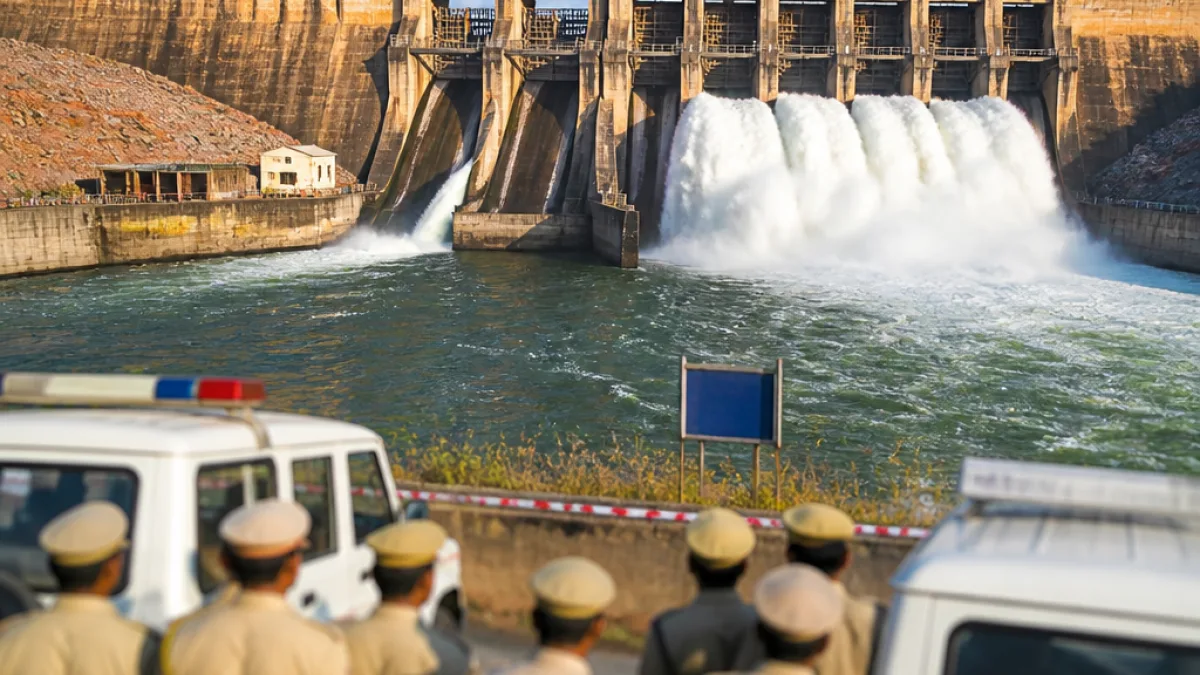
NAGARJUNA SAGAR (Nalgonda district): Tension erupted at the Nagarjuna Sagar reservoir on Wednesday after Andhra Pradesh irrigation personnel released water into the right canal without producing an order from the Krishna River Management Board (KRMB), Telangana officials said.
Immediate dispute over unauthorised release
Telangana irrigation staff, who manage the project, alleged that Andhra Pradesh officials entered the site and released about 2,000 cusecs into the right canal early in the day, citing drinking water requirements. When Telangana personnel sought the KRMB order authorising the release, the AP team reportedly could not produce a copy on the spot, prompting a confrontation.
According to Telangana irrigation sources, the Andhra Pradesh side told staff that roughly 10 TMCft would be made available for drinking water purposes. Telangana officers opposed the move in the absence of documented KRMB approval and tried to prevent the release, they said, adding that during the scuffle some Telangana officials were allegedly pushed and assaulted.
Telangana response and downstream releases
Following the release by Andhra Pradesh into the right canal, Telangana authorities opened the left canal, discharging about 500 cusecs to meet drinking water needs, officials said. Releases into both canals were continuing at the time of reporting.
Police personnel were posted at the project as a precautionary step and were monitoring the situation to avert any further clashes between officials from the two States.
Why the dispute matters
The episode highlights the sensitivity surrounding management of Nagarjuna Sagar, a major storage structure on the Krishna whose operational control rests with Telangana. The State maintains records of reservoir storage, inflows and releases for multiple uses including drinking water for Hyderabad and power generation.
Officials said the latest confrontation came days after a KRMB meeting convened at Jalasoudha in Hyderabad, where representatives of both States sought releases to meet drinking water demands. The three-member KRMB committee, comprising officials from the two States and the Union, had deferred a decision on the utilisation of water from the Srisailam/Nagarjuna Sagar system at that meeting, according to sources.
Practical implications for water management
Water released without clear inter-governmental consent raises questions about downstream allocations and monitoring of canal flows. The incident is likely to focus attention on:
- Verification mechanisms for KRMB orders at project sites;
- Protocols for inter-State teams operating at reservoirs under the control of one State;
- Security and official conduct when disagreements arise over releases.
Telangana irrigation records form the official ledger for storage and utilisation at Nagarjuna Sagar; any unilateral action by another State could complicate accounting for drinking water supply to urban centres and irrigation allocations downstream.
Data at a glance
| Item | Details |
|---|---|
| Release by Andhra Pradesh | ~2,000 cusecs into right canal |
| Claimed volume for drinking use | ~10 TMCft (as told by AP officials) |
| Release by Telangana | 500 cusecs into left canal |
| Authority in charge | Project management rests with Telangana; KRMB supervises inter-State allocations |
The exact KRMB position on the Wednesday releases was not made available at the site. Both sides had representation at a recent KRMB meeting in Hyderabad, where a decision on releases was postponed.
Political and administrative fallout
Water disputes between Telangana and Andhra Pradesh have recurred since the bifurcation of the erstwhile State, with reservoir operation, canal rights and drinking water security often at the centre of tensions. Incidents such as the one at Nagarjuna Sagar can strain administrative channels, requiring swift intervention by the KRMB or political leadership to prevent escalation.
Deployment of police at the project indicates authorities on both sides preferred to contain the situation rather than allow it to develop into a wider confrontation involving local communities or canal users.
How the KRMB responds — whether by issuing a retrospective order, calling an urgent meeting of the three-member committee, or directing a joint verification at the project — will determine whether this episode remains an operational skirmish or becomes a broader inter-State flashpoint.
Further updates are expected as the KRMB and the irrigation departments of both States clarify authorisations and workflows for canal releases from Nagarjuna Sagar.