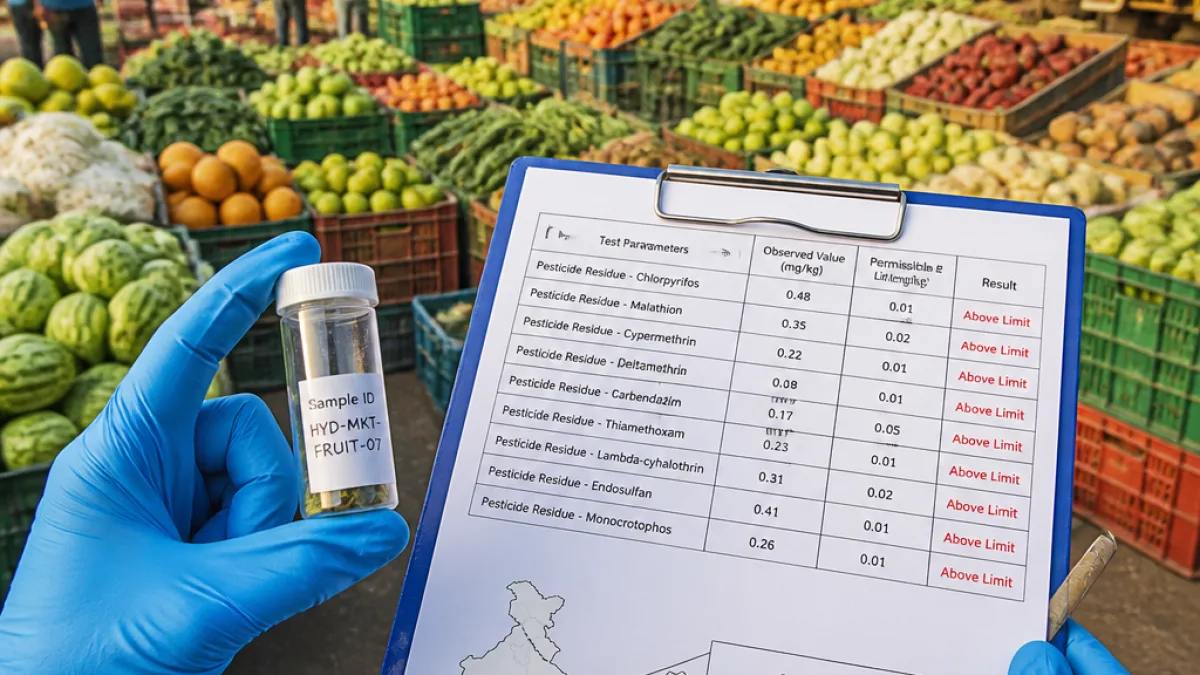
Hyderabad: Telangana recorded the largest number of fruit and vegetable samples with pesticide residues above permissible limits in India over the last three years, parliamentary data shows, raising concerns about citizen exposure to chemical residues in the food supply.
National monitoring figures
Data tabled in the Lok Sabha under the Monitoring of Pesticide Residues at National Level (MPRNL) project indicate that, of 8,198 samples tested from Telangana between 2023 and 2026, 486 samples — or 5.9% — exceeded the Maximum Residue Limits (MRLs) set by the Food Safety and Standards Authority of India (FSSAI). This was the highest number and rate reported among states in the period.
By comparison, the national breach rate stood at 3.1%, with 2,223 of 70,652 samples beyond prescribed limits. Other states with significant counts included Karnataka (334 of 9,176; 3.6%) and Maharashtra (260 of 5,295; 4.9%).
How Telangana compares on pesticide use
An ICAR Agricultural Development 2024 report cited in the parliamentary material shows Telangana's reported pesticide application is relatively high. In 2022–23 the state used 4,920 tonnes of technical‑grade pesticides — equivalent to 0.530 kg per hectare — compared with the national average of 0.277 kg per hectare. The ICAR figures provide context for the higher residue detections recorded under MPRNL testing.
| Metric | Telangana | All‑India |
|---|---|---|
| Samples tested (2023–26) | 8,198 | 70,652 |
| Samples above MRLs | 486 (5.9%) | 2,223 (3.1%) |
| Pesticide use (2022–23) | 4,920 tonnes (0.530 kg/ha) | — (0.277 kg/ha) |
Health risks and expert comment
Medical experts caution that chronic exposure to pesticide residues, particularly beyond regulatory limits, can carry long‑term health risks. Among the concerns raised are neurological effects, endocrine and reproductive disruptions, developmental issues in children and organ damage, depending on the chemical class, dose and duration of exposure.
“With growing concerns over cancer and other lifestyle and chronic diseases in Telangana, it is important to ensure that pesticides are manufactured, supplied and used strictly within prescribed limits. Long-term exposure to excessive pesticide residues can cause several health concerns, including neurological problems, hormonal and reproductive disorders, developmental problems in children, liver and kidney damage, and certain cancers, depending on the type of pesticide, dose and duration of exposure,” said Dr Mahesh Reddy, an emergency and critical care specialist.
Statewide variation and low‑violation regions
The monitoring exercise also highlighted states and union territories with minimal or no exceedances during the period. Odisha, Jharkhand and Chhattisgarh returned a 0% violation rate in the samples tested; Andaman and Nicobar Islands (0.09%), Assam (0.17%) and West Bengal (0.32%) reported very low proportions of exceedances.
- Telangana: 486 of 8,198 samples > MRLs (5.9%)
- Karnataka: 334 of 9,176 (3.6%)
- Maharashtra: 260 of 5,295 (4.9%)
- Country (overall): 2,223 of 70,652 (3.1%)
Implications for consumers and supply chain
The findings have implications across the farm‑to‑fork chain: from pesticide selection and application practices on farms to monitoring, testing and traceability in markets. For consumers, routine cooking and washing can reduce certain residues but may not remove systemic pesticides or residues that penetrate tissues. The FSSAI prescribes MRLs and mandates surveillance, while state agricultural and health departments are responsible for outreach on safe pesticide use and good agricultural practices.
Officials at the state level and local agricultural extension agencies were not quoted in the parliamentary data released. The tabling of MPRNL results in the Lok Sabha is aimed at enhancing transparency of residue monitoring; it also underscores the need for targeted interventions in states with higher detection rates.
What needs to follow
Public‑health experts and food‑safety stakeholders say a combination of measures is needed to bring residue levels down: stricter adherence to label directions and pre‑harvest intervals by farmers, training in integrated pest management, improved sampling and laboratory capacity, and consumer awareness on safe handling. Regular publication of monitoring results and state‑wise action plans would help focus resources where exceedances are highest.
The parliamentary figures provide a snapshot from the MPRNL testing window; continued monitoring and timely follow‑up by regulators and state agencies will determine whether residue levels fall in future rounds.
— Sridhar Reddy, Telangana correspondent