
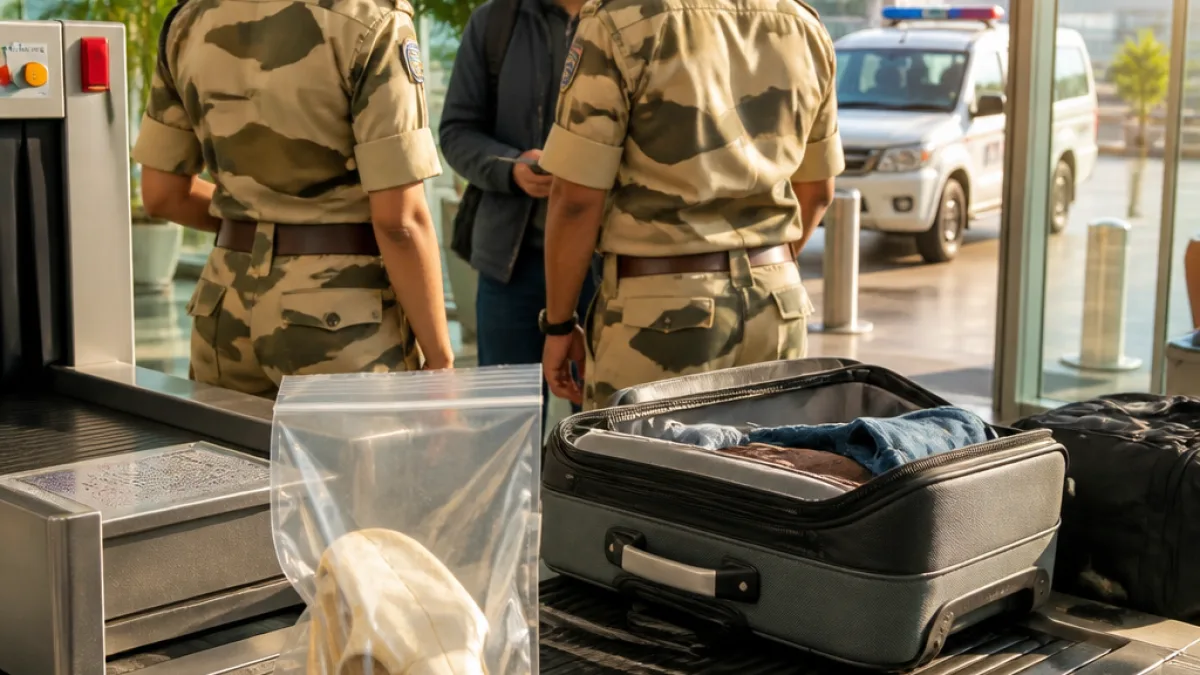
New Delhi: A skull, believed to be that of a monkey, was discovered concealed in a passenger's hand baggage during pre-embarkation security checks at Indira Gandhi International (IGI) Airport on August 10, officials said on Thursday.
Security screening led to discovery
Central Industrial Security Force (CISF) personnel performing routine screening at a departure concourse detected a suspicious object in the carry-on of a passenger scheduled to fly from New Delhi to Hyderabad. On closer inspection, the item was identified by the passenger as a monkey skull, the CISF said.
"Given the suspected wildlife connection, the passenger was handed over to the local police for further action under the Wildlife (Protection) Act, 1972," the CISF statement said.
Local police confirmed they have taken custody of the traveller and that the matter has been referred to the Wildlife Department to establish the object's identity and determine whether its carriage amounts to a statutory violation.
Legal and investigative steps under way
Police sources said the Wildlife Department's technical opinion is necessary to classify the item formally and advise on penalties, if any. Depending on the department's forensic and taxonomic assessment, the incident could trigger action under the Wildlife (Protection) Act, 1972, which governs possession and transport of prescribed wildlife articles and imposes penalties for contraventions.
No arrest has been reported so far; police added that further legal action will follow if the Wildlife Department's examination concludes that the item is of protected origin.
Airport and passenger details
Authorities said the incident occurred during standard pre-embarkation checks. The passenger was on a domestic flight manifest for Hyderabad. Officials did not disclose the traveler's name, age or other identifying details, citing the ongoing inquiry.
| Item | Detail |
|---|---|
| Date of detection | 10 August |
| Location | Indira Gandhi International Airport, New Delhi |
| Destination | Hyderabad |
| Security agency | CISF |
| Statute involved | Wildlife (Protection) Act, 1972 |
Context and implications
Airport screening routinely detects prohibited items, but discoveries with potential wildlife links carry additional legal and conservation implications. If the Wildlife Department confirms the object belongs to a protected species, the case could lead to prosecution under provisions that regulate possession, sale and transportation of animal parts. Penalties under the Wildlife (Protection) Act can include fines and imprisonment, depending on the species and the nature of the offence.
Beyond criminal liability, such incidents raise biosecurity and ethical concerns. Transport of animal remains in passenger baggage can pose public-health and conservation risks, prompting close coordination between security agencies, local police and wildlife authorities.
What authorities will examine
The Wildlife Department's assessment will typically consider:
- Taxonomic identification – whether the specimen belongs to a protected or Schedule-listed species.
- Origin and chain of custody – where and how the item was obtained.
- Intended use – whether the possession suggests personal possession, trade or other unlawful purpose.
Forensic examination and expert opinion may be required to reach conclusive findings, officials said.
Procedure for travellers
Officials reiterated that passengers should not carry animal parts or biological specimens without clear legal permissions and documentation. Items suspected to be wildlife derivatives should be declared and cleared through appropriate channels to avoid detention or prosecution.
The probe into the IGI Airport incident continues. Police and wildlife authorities are awaiting formal identification from the Wildlife Department before deciding on further charges or prosecution.
Reporting from the national capital.