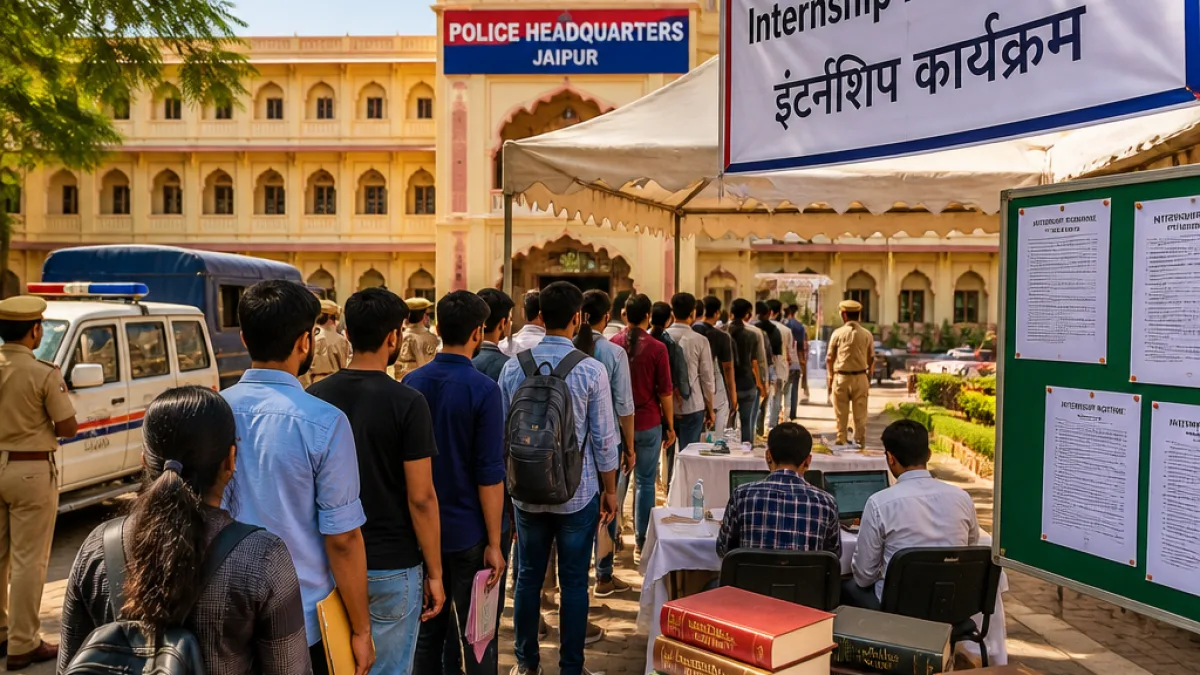
Jaipur: The Rajasthan Police on Wednesday launched a new internship scheme to give high-performing law students hands-on experience inside police units, an official statement said. The programme will admit students pursuing undergraduate, postgraduate and PhD legal courses from institutions in India and abroad for short-term, unpaid attachments with various wings of the force.
Scope and objective
According to the police headquarters, the initiative aims to familiarise young legal scholars with the workings of the criminal justice system and contemporary policing challenges. Selected interns will gain exposure to forensic science, cyber law and operational branches while contributing to policy analysis, data collection and research tasks, the statement added.
Who can apply and placement details
Eligibility is anchored on academic performance: applicants must have secured at least 60 per cent or equivalent marks in Class 12. The minimum engagement period is set at 45 days, with internships permitted to continue up to three months. The scheme is explicitly unpaid and will place students across both headquarters and field units.
| Aspect | Details |
|---|---|
| Eligible students | Law students (UG/PG/PhD) from Indian and foreign universities |
| Minimum qualification | At least 60% in Class 12 or equivalent |
| Duration | 45 days to 3 months |
| Stipend | Unpaid |
| Potential attachments | Crime Branch, Traffic, Cyber Crime, Legal Branch, Modernisation and other units |
Where interns will be placed
An order from Additional Director General of Police Bipin Kumar Pandey outlines that selected students will assist units including the Crime Branch, Traffic, Cyber Crime, Legal Branch and Modernisation divisions. The placements are intended to combine observational learning with concrete tasks such as legal research, data analysis and drafting reports for internal use.
Administration and intent
The faculty said the scheme was set following directions from Director General of Police Rajeev Kumar Sharma, who asked police headquarters to frame a structured opportunity for meritorious students. Officials described the programme as a bridge between classroom study and practical criminal justice work, rather than a pathway to recruitment.
- Practical exposure: Interns will observe and assist in investigations, cyber probes and forensic processes.
- Research support: Students will help with policy reviews, legal analysis and compiling data for departmental reports.
- Career utility: Experience is intended to inform future legal practice, academia or roles that intersect with law enforcement.
Implications for students and police
For law students, the scheme offers a rare vantage point into police procedures and inter-agency workflows that academic courses may not fully cover. For the police, tapping young legal talent can assist in areas requiring current academic rigour, such as cyber crime legislation, evidence management and legal drafting.
Officials emphasised that participation does not imply any automatic employment or candidature for police service; the attachments are educational and contributory in nature. The statement reiterated that selection will be on merit and suitability for the assigned units.
Practical notes for prospective applicants
Students interested in applying should monitor notifications from the police headquarters and their university placement cells for application windows and submission requirements. The statement did not list a portal or last date for applications, indicating further details would be released by the department in due course.
The programme follows a wider trend of law students seeking experiential learning with courts, legal aid cells and government agencies; the Rajasthan Police move formalises one such avenue within law enforcement itself.
Officials described the scheme in an official release; the file was processed from a syndicated wire feed.