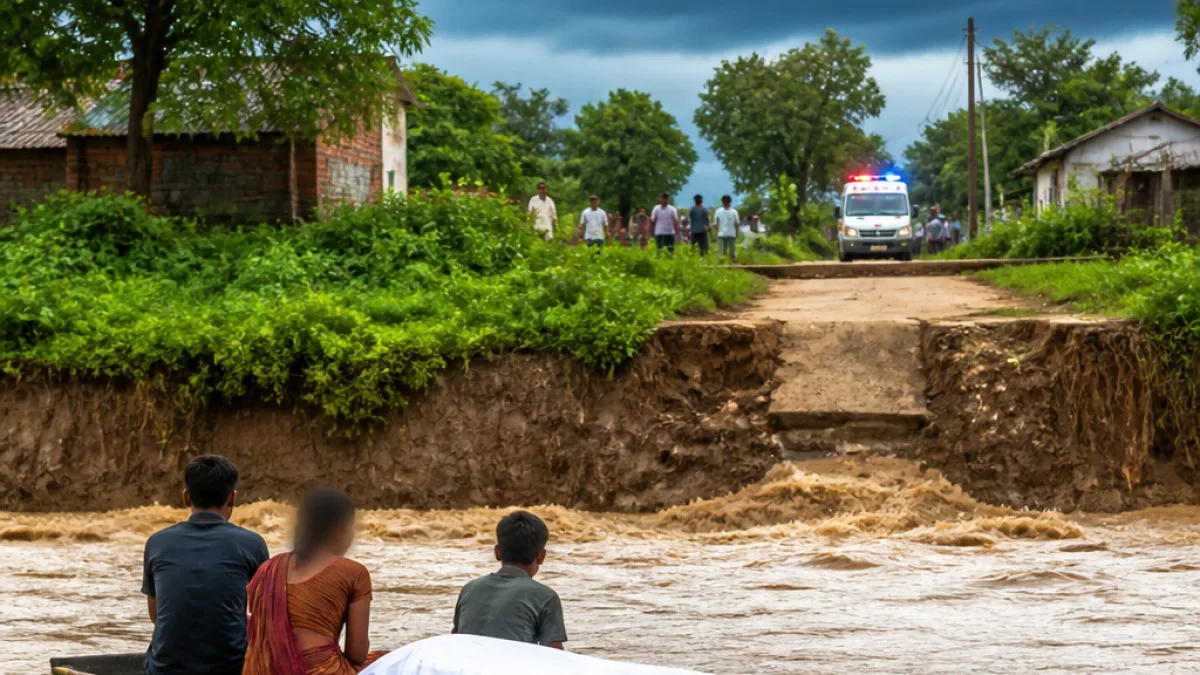
A pregnant woman died in the middle of the Kotri river in Chhattisgarh’s Kanker district after her family placed her on a wooden boat to reach a hospital when an ambulance was reportedly expected to take about an hour to arrive, residents said.
Sequence of events
The deceased has been identified as Sulata Jade, a resident of Kandari village. According to reports, a private doctor had diagnosed her with malaria on 16 August. Her condition reportedly deteriorated the next day and her family sought urgent medical care.
As per accounts from the locality, the family called for an ambulance but were told it would take approximately an hour to arrive. With Jade’s condition worsening, relatives arranged private transport to the riverbank and then placed her on a wooden boat to cross the Kotri river, which was swollen and flowing strongly following heavy rains. She died while the boat was in the middle of the river, residents reported.
Local reactions and concerns
Residents of Kandari and neighbouring villages expressed anger and distress at the incident. They pointed to the absence of a bridge over the Kotri river as a longstanding barrier to timely healthcare access, particularly during the monsoon when river flows rise and crossings become hazardous.
“The absence of a bridge and delays in ambulance services put lives at risk,” residents said, according to reports.
Locals also raised questions about the availability and deployment of emergency ambulance services in this remote area. The family’s decision to proceed by boat rather than wait for the ambulance appears to have been driven by an urgent perception of risk as the woman’s condition worsened.
Infrastructure and emergency response issues
The incident underscores two connected challenges: inadequate transport infrastructure in parts of rural Chhattisgarh, and limitations in timely emergency medical response for remote settlements. Where river crossings are necessary, lack of permanent bridges forces dependence on boats that are dangerous when rivers are in spate.
- Bridge deficit: Residents identified the lack of a bridge over the Kotri river as a major obstacle to accessing healthcare.
- Ambulance response time: Reportedly, the ambulance service informed the family it would take about an hour to reach them.
- Seasonal hazard: Heavy rains had swollen the river, increasing the hazard of crossing by small boats.
What is known and what is not
The reporting provides a basic timeline: diagnosis on 16 August, deterioration on 17 August, and the subsequent attempt to reach the hospital that ended with the woman’s death while crossing the river. The accounts cited are those of residents; there is no record in the reports of any official statement from health authorities, district administration or the ambulance service about the incident, response times or the availability of boats with safety equipment.
| Detail | Reported information |
|---|---|
| Name | Sulata Jade |
| Place | Kandari village, Kanker district |
| Illness | Diagnosed with malaria by a private doctor on 16 August |
| Mode of crossing | Wooden boat across the Kotri river |
| Ambulance response | Family reportedly informed ambulance would take about one hour |
Wider implications
The death in Kandari highlights persistent rural vulnerabilities in parts of Chhattisgarh: seasonal isolation due to rivers and inadequate permanent crossings, and gaps in emergency medical coverage. District collectors and the health department are typically responsible for coordinating disaster response and emergency medical services at the local level; such incidents often prompt calls for improved infrastructure and faster ambulance deployment.
Without official comment in the reporting, questions remain about whether any rescue or life-saving measures were attempted on the river, the dispatch protocols of the ambulance service that was contacted, and whether routine contingency arrangements exist for monsoon-period river crossings in the area.
What residents seek
Residents have urged construction of a bridge over the Kotri river to ensure uninterrupted access to healthcare and other essential services, particularly during the monsoon. They have also emphasised the need for reliable, prompt ambulance services in remote habitations.
The death is likely to renew local demands for infrastructure investment and better emergency care coordination in flood-prone rural pockets of the district.