State moves to boost local marigold cultivation ahead of festivals
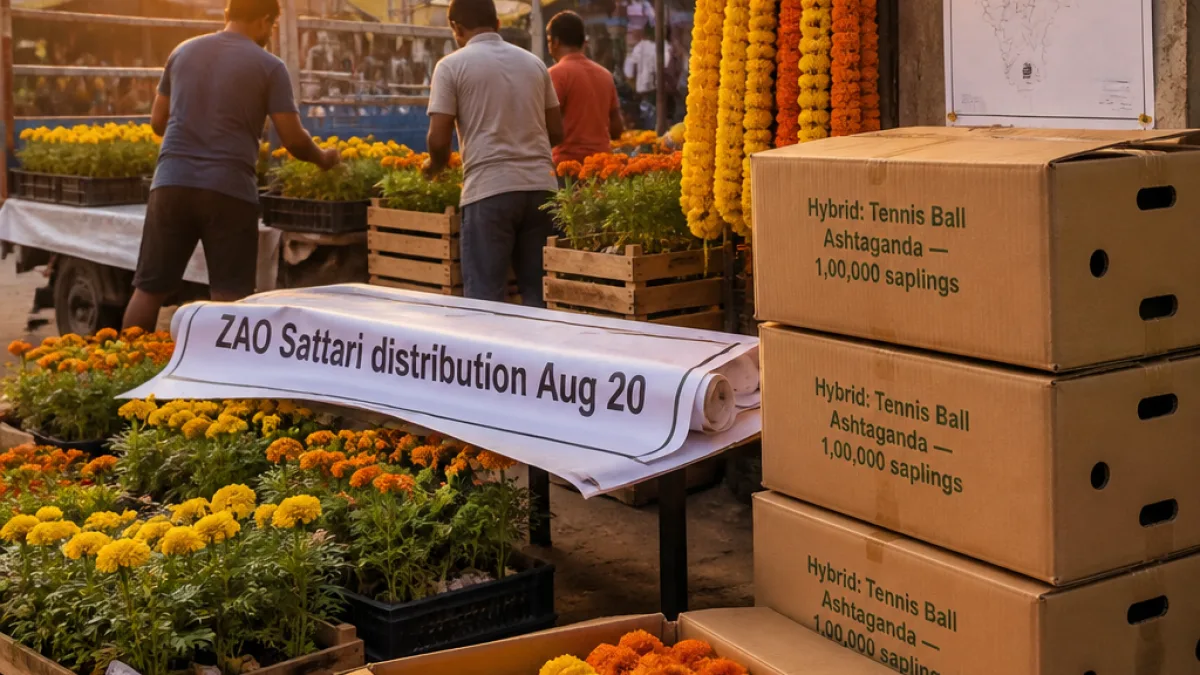
The Zonal Agriculture Office (ZAO) in Sattari is set to distribute 1,00,000 hybrid marigold saplings from August 20 under a state-sector scheme, aiming to expand cultivation in Valpoi and reduce Goa's reliance on flowers brought in from other states, officials said.
The initiative targets an increase in the marigold cultivation area in Valpoi from 5 hectares to 7 hectares in the current year. The sapling supply is intended to meet demand for the upcoming Dussehra and Diwali festivals, as the crop requires around three months to reach maturity, the office said.
"We are optimistic that the expansion programme will reduce Goa's dependence on marigold flowers sourced from outside the state. This year, nearly 90% of local festive flower requirements in Sattari could be met through locally grown marigolds, with complete self-sufficiency expected within the next two years if farmer participation continues to grow," said zonal agriculture officer Vishwanath Gawas.
Varieties, expected yields and sourcing
Farmers will receive two hybrid varieties of marigold: Tennis Ball (yellow) and Ashtaganda (orange). The saplings have been procured from nurseries in Kolhapur, Maharashtra. ZAO officials said hybrid varieties are chosen for their higher expected output, with production projected between 4 kg and 7.5 kg per plant under favourable conditions.
Officials framed the programme as both a supply-side intervention for festival-season markets and a measure to increase farm incomes by substituting imported flowers with locally produced marigolds.
Practical implications for Panaji markets and growers
- Supply stability: If cultivation expands as planned, traders and florists in Panaji and neighbouring talukas could see a larger locally produced supply of marigolds during key festival periods.
- Farmer opportunity: Participating growers in Valpoi and surrounding villages may gain an additional cropping option timed for demand peaks at Dussehra and Diwali.
- Import reduction: The scheme seeks to cut purchases of marigolds from other states; officials expect near-term relief for Sattari's local needs and full self-reliance within two years if uptake continues.
ZAO Sattari has not published a detailed cost-share or subsidy schedule in the statement released so far. The office said distribution will follow the state sector framework governing such programmes.
Data at a glance
| Item | Figure |
|---|---|
| Saplings to be distributed | 1,00,000 |
| Target increase in cultivation area (Valpoi) | 5 ha → 7 ha |
| Estimated yield per plant | 4 kg–7.5 kg |
| Target for local festive needs (Sattari) | ~90% this year; full self-sufficiency in 2 years |
Officials acknowledged that achieving projected yields will depend on agronomic conditions and farmer practices. They said the hybrids were selected to improve productivity but did not offer detailed agronomic advisories in the announcement. The saplings' three-month maturation period determines the timing for distribution ahead of festival demand.
For Panaji residents, the shift could translate into greater availability of locally grown marigolds and potential stabilisation of prices during festivals, provided the expansion meets targets. For growers, the scheme presents an opportunity to tap into seasonal flower markets that have historically relied on inter-state supply chains.
ZAO Sattari's statement did not quantify the programme's budget or indicate whether additional support—such as training, pest-management advice or market linkages—would accompany sapling distribution. Officials said the seedlings were sourced from Kolhapur nurseries and called for farmers to participate to realise the stated goal of reducing imports.
Further details on beneficiary selection, distribution centres and any follow-up extension services are expected to be released by the zonal office ahead of August 20.