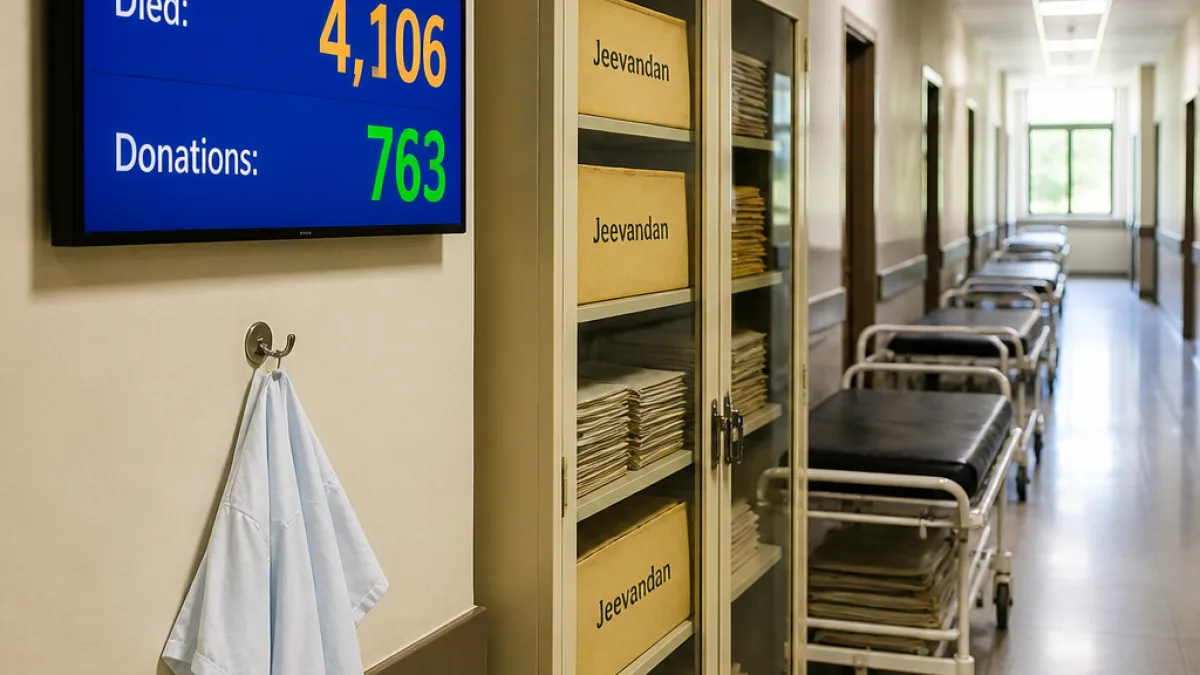
Hyderabad: Data from the state-run Jeevandan organ donation programme and media reports indicate that more than 4,100 patients in Telangana died while waiting for organ transplants between 2013 and 2026, exposing a wide gap between demand for organs and the number actually donated.
Registrations, outcomes and the shortfall
According to figures cited in a Times of India report and published Jeevandan records, a total of 19,386 patients were registered for organ transplantation in the 2013–2026 period. Of these, 4,106 patients died before receiving a transplant, while 5,307 underwent successful procedures. The remainder — about 9,413 people — were still awaiting transplants at the time the data was compiled.
Annual transplantation figures cited in media accounts suggest the state performs between 7,500 and 8,000 transplants a year, even though organ donations have remained below 1,000 annually. The highest number of donations recorded in a year was 763 in 2025.
Organs in demand and donated
The deaths among those on the waiting list were concentrated across a few critical organs. Jeevandan data shows the distribution of patients who died while awaiting transplantation as follows:
| Organ | Patients who died awaiting transplant (2013–2026) |
|---|---|
| Liver | 2,240 |
| Kidney | 1,537 |
| Lungs | 229 |
| Heart | 96 |
| Pancreas | 4 |
Over the same period, Jeevandan recorded donations of 1,724 kidneys, 1,724 livers, 506 lungs and 258 hearts. Those figures underline both the critical need for certain organs and the mismatch between availability and patient requirements.
Systemic issues and institutional contribution
Media reporting cited an official who pointed to an uneven contribution from healthcare providers, saying that only a handful of private hospitals regularly facilitate donations, while government hospitals contribute minimally. The report noted that this imbalance complicates equitable access to donor organs across the state.
"These five are the organs we need the most for transplants. However, it is tough to meet patients’ requirements since only four or five private hospitals in Telangana consistently contribute to organ donation. Government hospitals’ contribution is next to zero," an official was quoted by the Times of India.
Jeevandan is Telangana’s nodal body for organ donation coordination, responsible for registration, allocation and facilitating transplant logistics. The programme’s published data has become a reference point for policymakers and patient groups seeking to evaluate the effectiveness of organ procurement and allocation mechanisms.
Implications for patients and policy
The scale of mortality among those on the waiting list underlines several challenges: the need to increase public awareness about organ donation, expand hospital participation in donation processes, strengthen deceased-donor programmes in government hospitals and improve infrastructure for rapid retrieval and distribution of organs.
- Awareness and consent: Higher community awareness and donor registrations are essential to broaden the donor pool.
- Hospital participation: More government and district hospitals need systems and training to identify potential donors and to coordinate with Jeevandan.
- Equitable access: Strengthening allocation mechanisms to ensure organs reach patients based on medical need rather than institutional capability.
For patients and families, the waiting period for organs remains fraught with uncertainty. Patient registries such as Jeevandan provide transparency on numbers and outcomes but also highlight the urgency of scaling up donation and transplant capacity across Telangana, from Hyderabad to smaller districts.
Further action by health authorities, supported by both public hospitals and private centres, will be necessary if transplant mortality on the waiting list is to be reduced. The data should prompt policy discussions on incentivising donation, streamlining hospital participation and improving the supply chain for time-sensitive organ retrieval and transplant surgeries.
Reporting based on Jeevandan programme data and a Times of India report.