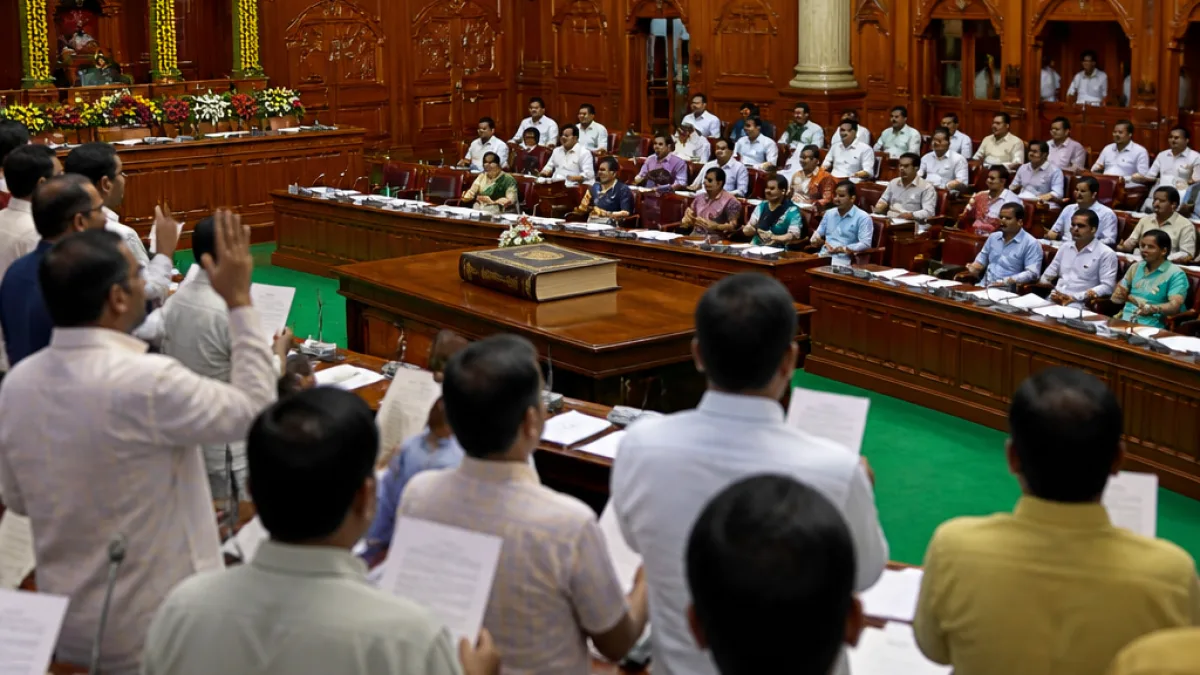
Bengaluru: A controversy over the rendition of Vande Mataram erupted in the Karnataka Legislature on Monday as Opposition members continued to sing the full version of the national song after the treasury benches limited the recital to two stanzas.
Standoff during special session
The incident occurred on the opening day of a three-day special session called to discuss implementation of the Kasturirangan report and the state's drought situation. After the treasury benches — led by the ruling Congress — and Assembly Speaker G S Patil concluded with two stanzas, BJP and JD(S) legislators persisted in singing the remainder of the song.
Several Opposition legislators, including Suresh Kumar, Sunil Kumar and B Y Vijayendra, recited the song from memory, while others used printed copies brought into the House.
Similar scene in the Legislative Council
A parallel scene played out in the Legislative Council where BJP and JD(S) members continued recitation after the treasury benches concluded the rendition following the first two paragraphs.
Background of the state order
The standoff follows a state government order issued on 8 September that limited the recital of Vande Mataram to two stanzas at state government functions and official ceremonies. The order came soon after the Centre enacted legislation related to the rendition of the song.
The restriction has been criticised by the BJP, which has repeatedly raised the issue in public forums and during recent engagements of party leaders with the state administration. Opposition members argued the two-stanza limit was inadequate and staged the protest inside both Houses on Monday.
Political reactions and context
Sources in the Assembly said ruling party members responded by proceeding to read the Preamble of the Constitution after the two-stanza rendition, while Opposition members continued singing. The episode quickly turned into a symbolic confrontation between the treasury and Opposition benches and became a key flashpoint on the first day of the special session.
- Event: First day of three-day special session (Kasturirangan report, drought).
- Order: Karnataka government order dated 8 September restricting official recitals to two stanzas.
- Reaction: BJP and JD(S) legislators sang the full song in protest; Congress and Speaker observed the two-stanza limit and read the Preamble.
Why the row matters
The episode highlights a broader political contest over cultural and symbolic issues that frequently surface in legislative proceedings. Restrictions on the rendition of a national song at official functions intersect with questions of ceremony, federal directives and political assertion, particularly ahead of discussions on sensitive matters such as environmental zoning under the Kasturirangan recommendations and the state’s drought response.
While the special session’s advertised agenda focuses on policy issues affecting large sections of the state — including farmers and forest-fringe communities in the Western Ghats zone identified under the Kasturirangan exercise — the Vande Mataram standoff dominated early proceedings and is likely to shape the tenor of debate during the three days.
Immediate implications
Legislative observers said the incident could set a confrontational tone for the remainder of the special session. Both Houses witnessed disciplined participation: some Opposition members used printed copies to ensure full rendition from the floor, while ruling members stuck to the state government instruction.
| Item | Position |
|---|---|
| State order (8 Sept) | Only two stanzas of Vande Mataram at official functions |
| Opposition | Sang full version in Assembly and Council |
| Ruling benches | Observed two-stanza limit; read Constitution Preamble |
As the special session continues, proceedings are expected to move to detailed discussions on the Kasturirangan recommendations and drought relief measures. The cultural flashpoint over Vande Mataram may persist as part of Opposition tactics to keep attention on the state order and its political implications.
Reporting from the Legislature indicates that both Houses resumed normal business after the exchanges, but the symbolic confrontation is likely to feature in subsequent headlines and party statements as the session progresses.