Traffic snarls as pilgrimage route reduces carriageway capacity
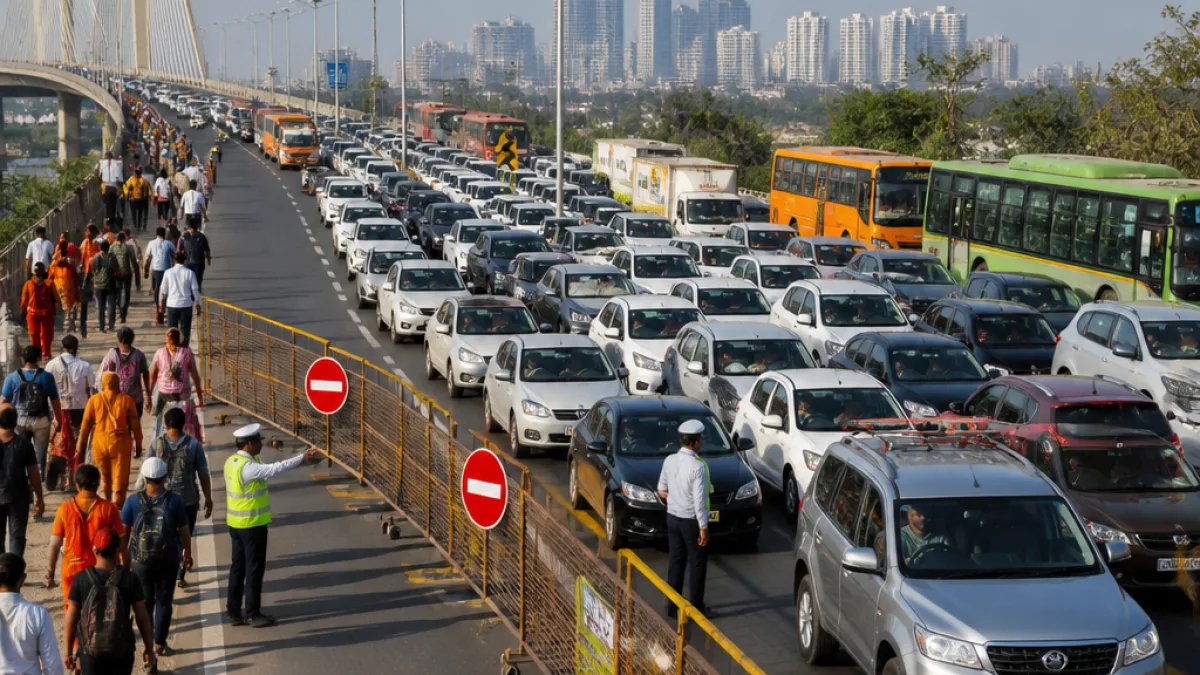
Parts of Noida experienced severe traffic congestion on Monday after authorities implemented diversions for the annual Kanwar Yatra, reducing carriageway capacity on key links and forcing commuters to travel at a crawl during morning peak hours. The diversions, which also affected adjoining Ghaziabad, are expected to remain in place till August 12, officials said.
On several stretches, delays stretched to nearly three hours as motorists were rerouted, particularly onto National Highway-9 (NH-9). In Ghaziabad, Google Maps showed no-entry signs on substantial portions of the Delhi-Meerut Road, GT Road and the Delhi-Meerut Expressway (DME), reflecting the movement of large numbers of Kanwariyas on foot.
“There is a space constraint due to diversions, so traffic snarls have ensued,” Additional Deputy Commissioner of Police (Traffic) Varun Kumar Singh said, adding that the Meerut-Ghaziabad carriageway of the DME is shut for now.
In Noida, traffic officers said roads connecting to the Chilla Border and the Kalindi Kunj bridge from Delhi witnessed heavy congestion during the morning and evening peak windows — between 8-10 am and 6-8 pm. At Kalindi Kunj, two of the four lanes of the bridge from Okhla Barrage towards the Okhla Bird Sanctuary were closed to facilitate the pilgrims’ movement. The 4-km route inside the city used by the Kanwariyas starts near Mayur Vihar, passes the Shani Temple and the Okhla Bird Sanctuary, and exits at Kalindi Kunj.
Where congestion concentrated
Traffic police said some vehicles were diverted via NH-9, which led to a heavy build-up from near Mehrauli till the Lal Kuan intersection on the Ghaziabad–Gautam Budh Nagar border. Although the police reported that traffic normalised on NH-9 after about one-and-a-half hours on Monday morning, pressure remained on alternative corridors because the Meerut–Ghaziabad carriageway of the DME continued to be closed.
- NH-9: Significant congestion in morning peak; some normalisation reported after 90 minutes.
- Kalindi Kunj bridge (Noida): Two of four lanes closed towards Okhla Bird Sanctuary to allow pilgrim movement.
- Delhi-Meerut Road / DME: Sections closed or showing no-entry; large foot movement from Haridwar reported.
| Route | Impact | Notes |
|---|---|---|
| NH-9 | Three-hour congestion reported | Vehicles rerouted; pressure eased after ~1.5 hours |
| Kalindi Kunj bridge (Noida) | 2 of 4 lanes closed (towards Okhla Bird Sanctuary) | Used by Kanwariyas on a 4-km city route |
| Delhi-Meerut Road / DME | Large sections marked no-entry | Meerut–Ghaziabad carriageway closed |
Traffic management officials said the volume of Kanwariyas arriving on foot from Haridwar has created a sustained demand for carriageway space. The additional deputy commissioner of police (traffic) noted that the pressure on NH-9 grew as vehicles were diverted from the DME and other primary corridors.
Commuters in Noida reported slow movement on access routes to the city, with drivers and passengers forced to add substantial time to their journeys. The Kalindi Kunj bridge, a vital link between Delhi and Noida, was identified by officials as one of the pinch points due to the lane closures and the proximity of the pilgrims' route.
Short-term disruption, safety and planning
Police said diversions are a temporary measure to ensure the safety and uninterrupted passage of the Kanwar Yatra, an annual pilgrimage that sees thousands walk to collect holy water. While authorities placed the diversions to manage foot traffic, the reduced vehicular capacity on arterial roads translated into longer travel times for daily commuters and commercial vehicles.
Motorists and public transport users were advised to expect delays on affected corridors through Tuesday as the pilgrimage draws to a close and to consider alternate routes or travel outside peak windows where possible.
Traffic officials maintained that they are monitoring the situation and will adjust diversions to ease congestion where feasible, but emphasised the trade-off between facilitating the religious procession and maintaining road capacity for vehicles.