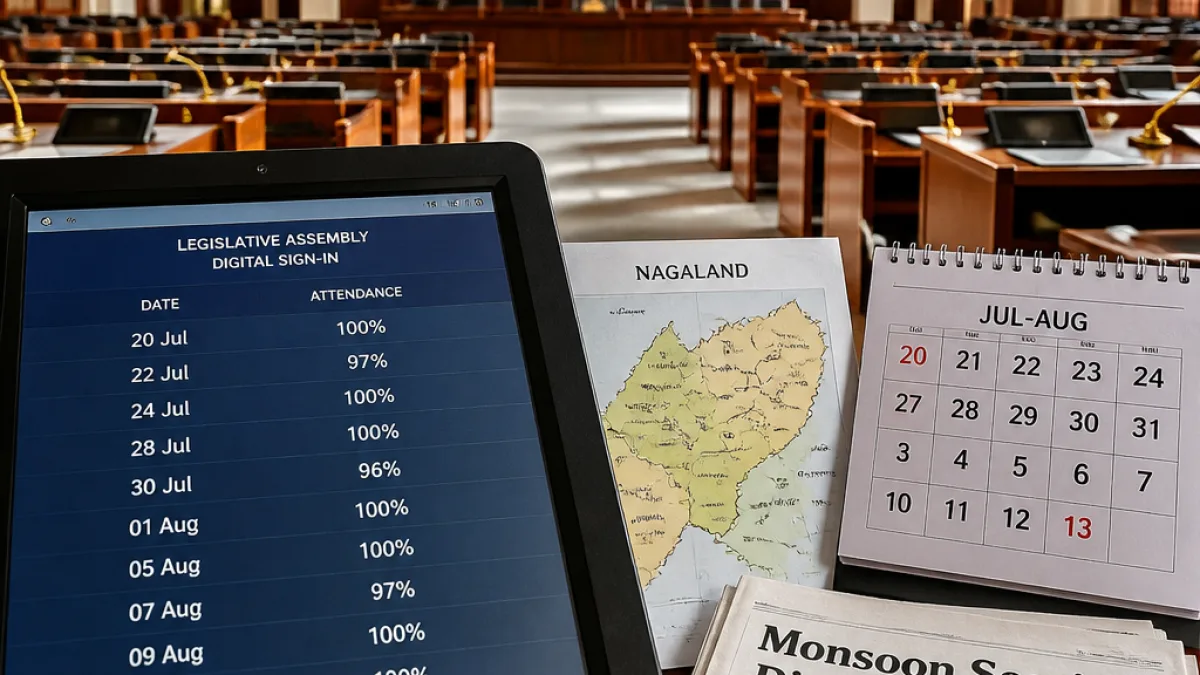
Dimapur: Nagaland’s two Members of Parliament registered generally strong attendance records during the Monsoon Session that ran from 20 July to 13 August, but their recorded participation in floor proceedings remained limited amid a session widely reported as disrupted and low in productivity.
Attendance figures and anomalies
Rajya Sabha MP S Phangnon Konyak was logged present for 16 of the 19 sitting days, an attendance rate of 84.2%, records show. The three days for which there was no sign‑in—4, 5 and 6 August—coincided with Konyak being in Nagaland, where she accompanied Union Health and Family Welfare Minister Jagat Prakash Nadda to landslide‑affected localities in Mon town on 5 August.
Lok Sabha MP S Supongmeren Jamir is recorded in one part of the reporting as having an attendance figure of 94.4%. However, the same attendance logs also indicate Jamir signed in on 22 of the 31 Lok Sabha sittings for the period, which corresponds to roughly 71%. The differing representations in public records are noted here without adjudication.
| MP | House | Sign‑ins | Recorded attendance |
|---|---|---|---|
| S Phangnon Konyak | Rajya Sabha | 16 of 19 | 84.2% |
| S Supongmeren Jamir | Lok Sabha | 22 of 31 | ~71% (alternate report: 94.4%) |
Participation on the floor
While sign‑in rates indicate physical presence in the Houses, actual floor engagement from both MPs was modest by the session’s standards. According to PRS Legislative Research, Konyak participated in four matters raised with permission. These interventions were not specific to Nagaland and covered issues across several sectors:
- Establishing residential skill development and employment centres for tribal youth in Tripura;
- A ‘One School‑One Playground’ campaign to protect playgrounds in government schools;
- Promotion of community solar projects on government vacant land and a ‘One District‑One Solar Town’ initiative;
- Guidelines for responsible use of artificial intelligence in school education.
On the concluding day of the Monsoon Session, 13 August, Konyak pressed the government on a Nagaland‑specific matter when she sought information on plans to establish Khelo India Centres in each district of Nagaland and on measures to provide regular coaching, sports science support and nutrition for rural athletes.
The public record for Jamir’s specific floor interventions during the Monsoon Session was not detailed in the material reviewed. The available reporting portrays overall parliamentary intervention from Nagaland’s MPs as limited, particularly in a session that was repeatedly interrupted and described as having low productivity.
Local engagements during the session
Notably, Konyak’s absence from the Rajya Sabha log on 4–6 August coincided with official activity in Nagaland. On 5 August she joined the Union Health Minister on a visit to inspect landslide‑affected areas in Mon town, including locations at Defence Colony and neighbouring Techa ward, according to the record. The presence of a Rajya Sabha member on site during a disaster assessment reflects an instance where constituency matters intersected with parliamentary obligations.
What the records show and what they do not
Attendance statistics document presence in the Chamber but do not capture other forms of parliamentary work such as constituency assistance, committee work, questions submitted but not taken up on the floor, or interventions posted in written form. In addition, the session’s disruptions—widely reported in national accounts—reduced the opportunity for sustained debate and constrained lawmakers’ capacity to secure time for questions and discussions.
Observers tracking legislative performance often point to a combination of attendance, questions asked, debates led and private member initiatives when assessing representation. For Nagaland’s MPs, the available data for this Monsoon Session shows reasonable sign‑in levels alongside relatively few permitted floor interventions, with one clear Nagaland‑specific query on sports infrastructure raised at the final sitting.
Further clarification on the discrepancy in Lok Sabha attendance figures for S Supongmeren Jamir would require direct access to the authoritative Lok Sabha attendance logs or a statement from the MP’s office; such documents were not part of the material reviewed for this report.