Shillong: Meghalaya Chief Minister Conrad K. Sangma on Saturday said the State’s economy has "more than doubled" since 2018, placing Meghalaya among the country’s fastest-growing states over the past five years, and outlined a development vision centred on natural resource protection, livelihoods and job creation.
Growth claim, development priorities
Speaking at the Independence Day function at the Polo Grounds in Shillong, Sangma credited improved roads, basic infrastructure, agriculture, healthcare, education, tourism and sports for the economic surge, and thanked Prime Minister Narendra Modi for the Centre’s support. He said the government has anchored its policy on three foundations: "protecting and preserving our land, empowering our people and upholding our culture."
The chief minister said Meghalaya had become the third fastest-growing state in India over the last five years. The claim was made as part of a broader address that highlighted conservation measures and farmer-focused initiatives designed to shift communities away from shifting cultivation (jhum) towards higher-value, long-gestation crops.
Conservation and farmer incentives
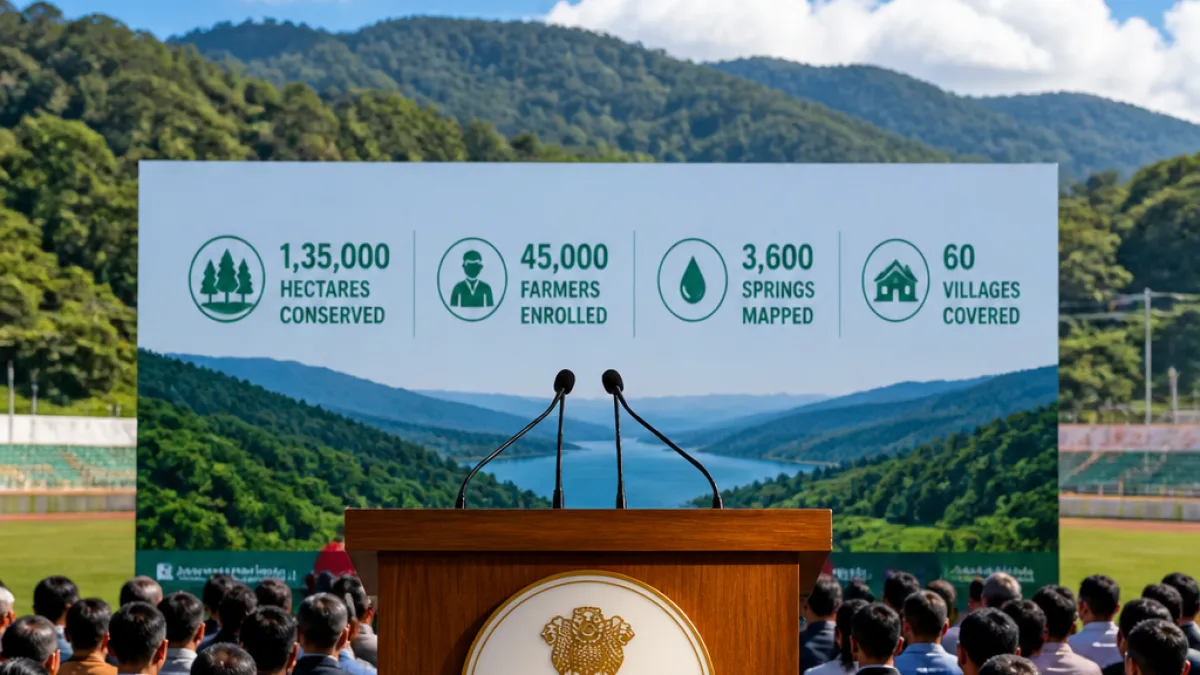
Sangma outlined several environment and agriculture measures introduced or expanded during his government’s tenure. He said the administration had brought 63,000 hectares of natural forest under conservation through the GREEN Meghalaya Plus programme, and that nearly 6,300 farmers receive annual payments for protecting forests.
"Give me an orchard, and I will stop the fire," Sangma recalled a farmer in Nokrek telling him, describing the remark as a catalyst for policies offering alternatives to jhum.
Under the CM FARM+ initiative, the chief minister said more than 25,000 farmers across all 12 districts are being provided with high-value, long-gestation crops. He also cited missions promoting Lakadong turmeric, organic farming, floriculture and ginger as part of efforts to transition farmers to remunerative cultivation.
Water and forest metrics
On water resources, Sangma said the government has mapped over 60,000 springs and is creating more than 500 large water-harvesting structures to bolster village water security.
| Measure | Figure |
|---|---|
| Forest area conserved (GREEN Meghalaya Plus) | 63,000 hectares |
| Farmers receiving annual forest protection payments | 6,300 |
| Farmers under CM FARM+ | 25,000+ |
| Springs mapped | 60,000+ |
| Large water-harvesting structures being created | 500+ |
| State forest cover | 76% |
Rationale and local impact
Sangma framed the programmes as responding to grassroots concerns, citing his visit to Nokrek in Garo Hills where a farmer affected by repeated burning of jhum land asked for an alternative rather than relief. That anecdote was used to justify initiatives aimed at creating orchards and long-term crops to reduce the cyclical practice of slash-and-burn cultivation.
Officials have increasingly highlighted the twin aims of environmental conservation and livelihood security. The chief minister’s emphasis on payments to forest-protecting farmers and efforts to map springs are measures aimed at integrating community stewardship with state programmes to secure both ecological assets and household incomes.
What remains unspecified
While Sangma announced headline figures and described several missions by name, the address did not include detailed breakdowns on budget allocations, timelines for scaling CM FARM+ across crop types, or independent verification of the economic-growth ranking. Such details would typically be provided in budget documents, state economic surveys or third-party assessments.
Questions that may be raised by analysts and stakeholders include the metrics used to calculate the claim that the economy "more than doubled" since 2018, the baseline figures, and the contribution of central schemes versus state-led investments to the growth rate.
Key programme highlights
- GREEN Meghalaya Plus: 63,000 hectares under conservation and payments to farmers protecting forests.
- CM FARM+: Over 25,000 farmers being transitioned to high-value, long-gestation crops.
- Water resource measures: 60,000+ springs mapped; 500+ large water-harvesting structures being created.
The chief minister’s Independence Day address reiterated the government’s commitment to marry conservation with economic opportunity, signalling that environmental protection and agricultural transformation will remain central to Meghalaya’s development agenda in the near term.