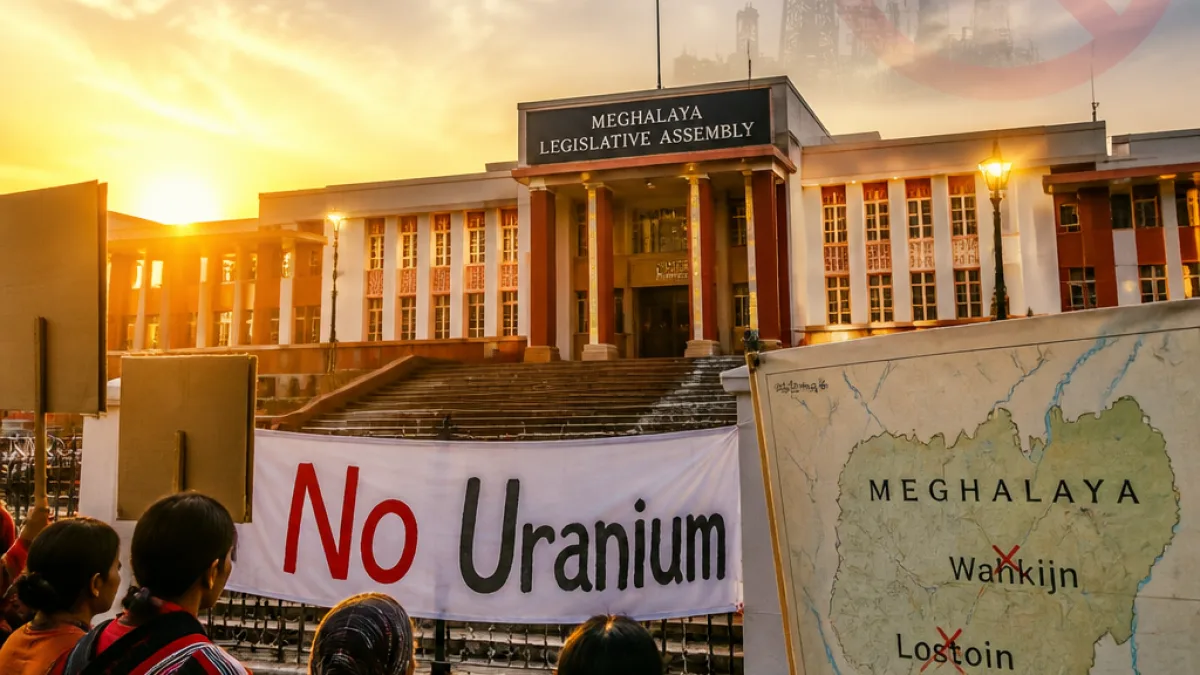
Shillong: The Meghalaya Assembly on Wednesday adopted a unanimous resolution prohibiting uranium mining and the establishment of any uranium ore-processing facility in the State, the House recorded. The motion, moved by Chief Minister Conrad K. Sangma and backed by all 60 MLAs, formalises the state government's opposition to uranium extraction in areas where deposits have been identified.
Assembly decision and next steps
The resolution directs the government to convey the legislature's position to the Centre and seeks respect for the sentiments of tribal communities in the State, the Chief Minister said after the House adopted the motion. The text of the resolution highlights concerns from communities in locations including Domiasiat, Wahkijn and Lostoin in West Khasi Hills district, where uranium occurrences have been reported.
"This is a historic and significant moment for the state," Chief Minister Conrad K. Sangma said, adding that the unanimous vote sends an "unequivocal message" that Meghalaya does not want uranium mining or a uranium ore-processing facility.
The government intends to formally communicate the Assembly's decision to the Union government, Mr Sangma added. The resolution was framed against the backdrop of long-running local opposition that has brought together traditional institutions, student bodies, civil society groups and residents of uranium-bearing areas.
Customary land rights and legal precedent
At the core of Meghalaya's stance is the State's distinctive land-holding system. Much of Meghalaya's territory is held under customary ownership — private, clan or community landholdings regulated by traditional institutions — a feature the Assembly said must be taken into account when determining the fate of natural resources.
The resolution specifically referred to the Supreme Court's 2019 judgment in State of Meghalaya vs All Dimasa Students Union, noting the ruling's recognition that, in the hill districts covered by the Sixth Schedule, private and community landowners have rights over both the surface and the sub-soil, including minerals, subject to statutory regulation. The judgment held that minerals beneath privately or community-owned land vest with those owners rather than automatically with the State.
By invoking that judgment, the Assembly underlined that any proposal for mining on customary lands cannot proceed without the authority of the legitimate landowners and the applicable legal procedures.
Local movement and historical context
The resolution gives legislative backing to a movement that has opposed uranium exploration and mining in the State for decades. The opposition gained prominence in the 1990s and was sustained in subsequent years by local leaders, community organisations and activists in affected areas.
Anti-uranium sentiment in Meghalaya has periodically halted or constrained exploratory work and remains a potent political and social factor, especially in the West Khasi Hills where community resistance has historically been strongest.
What the resolution seeks to achieve
- Formally record the State legislature's opposition to any uranium extraction and to the setting up of uranium ore-processing facilities within Meghalaya.
- Ensure that decisions on mineral development respect customary land rights under the Sixth Schedule framework.
- Direct the State government to communicate the Assembly's position to the Central government for consideration.
The resolution also appears timed to reinforce the local movement ahead of observances and anniversaries tied to anti-uranium protests in the State.
Implications for Centre–state relations and mineral policy
The Assembly's unanimous stance places the Meghalaya government on a clear collision course with any central plans to pursue uranium exploration, should authorities propose such projects without securing the consent of customary landowners. The invocation of the Supreme Court ruling may strengthen the State's legal position in future disputes over sub-soil rights on privately or communally held land.
How the Union government responds — whether through fresh consultation with State authorities and local institutions or by reaffirming central regulatory prerogatives — will be a decisive factor in whether the issue is resolved politically or moves into protracted legal contestation.
Regional and environmental considerations
Beyond questions of ownership and consent, uranium projects raise environmental and public-health concerns among communities and activists. The Assembly's resolution frames its opposition primarily in terms of customary rights and community sentiment; it also implicitly reflects the State's caution about the social and ecological impacts of radioactive mineral extraction and processing.
For now, the unanimous vote binds Meghalaya's political leadership to the position articulated in the House and signals to the Centre that proceeding without addressing local legal, customary and social concerns will face strong resistance.
| Item | Detail |
|---|---|
| Assembly strength | 60 members |
| Resolution moved by | Chief Minister Conrad K. Sangma |
| Areas cited | Domiasiat, Wahkijn, Lostoin (West Khasi Hills) |
| Legal reference | Supreme Court judgment: State of Meghalaya vs All Dimasa Students Union (2019) |













