Study finds Loni driving up Ghaziabad's air pollution readings
A recent study commissioned by the Ghaziabad Municipal Corporation (GMC) has found that the township of Loni registered considerably higher concentrations of fine and coarse particulate matter through 2025-26 compared with areas covered by GMC monitoring stations, prompting officials to recommend that Loni be evaluated separately and targeted for tailored pollution-control measures.
The report compared annual averages from four Continuous Ambient Air Quality Monitoring Stations (CAQMS) across the Ghaziabad urban area against the measurements from the Loni Nagar Palika. It found that Loni's average concentration of PM2.5 was 33% higher than the average of GMC-monitored locations, while PM10 levels were 18% higher. The township's recorded levels substantially exceeded national standards.
- Annual average PM2.5 in Loni (2025): 114.25 µg/m³
- Annual average PM2.5 elsewhere in GMC area (2025): 85.80 µg/m³
- Annual average PM10 in Loni (2025): 213.63 µg/m³
- Annual average PM10 elsewhere in GMC area (2025): 181.21 µg/m³
- India's National Ambient Air Quality Standards (annual limits): PM2.5 40 µg/m³, PM10 60 µg/m³
| Parameter | Loni (2025) | GMC average (other stations) | NAAQS annual limit |
|---|---|---|---|
| PM2.5 (µg/m³) | 114.25 | 85.80 | 40 |
| PM10 (µg/m³) | 213.63 | 181.21 | 60 |
Possible sources and recommendations
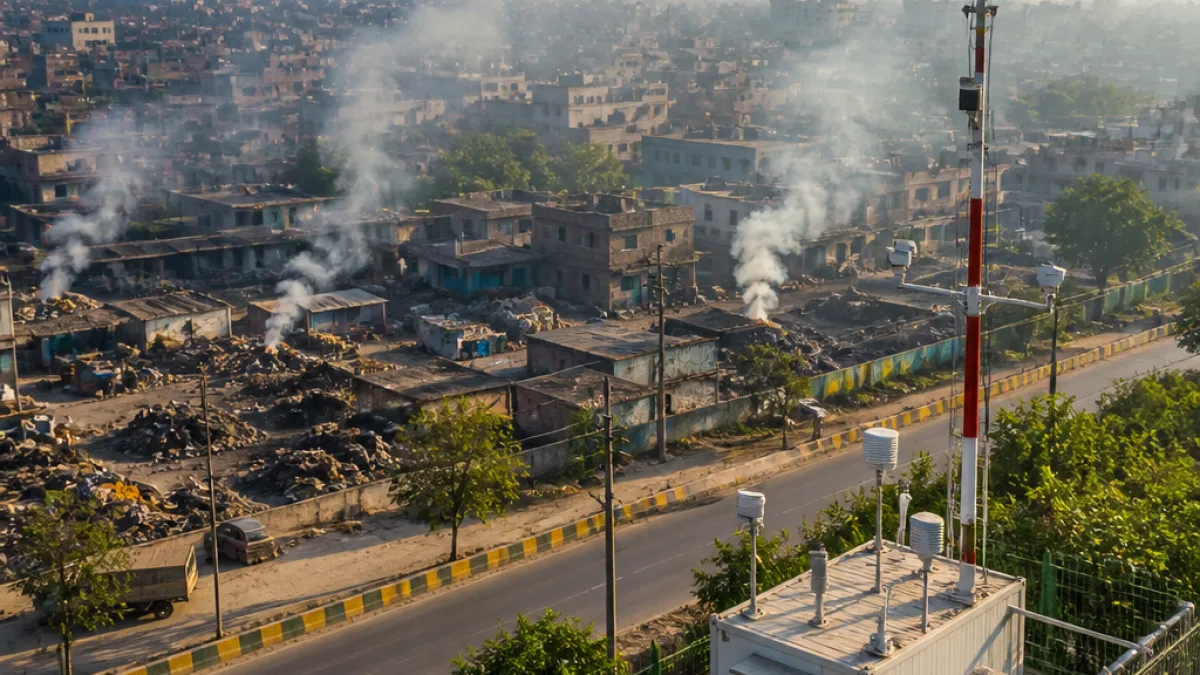
The study pointed to local activities that could be contributing to elevated particulate concentrations. It noted open burning of garbage in parts of Loni — including dense smoke and soot — and cited the presence of informal units involved in retrieving e-waste and metals as factors raised by environmental observers. Meteorological conditions were acknowledged as a compounding factor but not a comprehensive explanation for the sustained high readings, according to the report.
“It is not that it happens only during winter. It happens all year, but it was only that the problem of pollution aggravates during winter,”
The above observation was reported from environmentalist Sushil Raghav, who told reporters that illegal processing units handling e-waste and scrap metals operate across the township and materially worsen air quality throughout the year.
Based on the data, the GMC study recommended that air-quality performance for the Loni Nagar Palika be assessed independently from the rest of Ghaziabad and that targeted interventions be deployed in the township. Officials said separate evaluation would allow more accurate performance assessment and better design of mitigation measures.
International ranking and health stakes
Internationally, Loni featured in a Swiss air-quality platform's ranking released in April 2026: IQAir reported an average PM2.5 of 112.5 for Loni in the previous year, placing the township among the most polluted cities globally and reportedly about 22 times the World Health Organization's annual guideline for PM2.5, the study noted. The GMC report and observers highlighted the public health implications of sustained elevation in fine particulates, which are capable of penetrating deep into lungs and entering the bloodstream.
Respiratory and cardiovascular risks are associated with long-term exposure to high PM2.5 and PM10. Local authorities now face pressure to implement inspections of industrial and informal processing units, step up enforcement against open burning of waste, and expand monitoring coverage to better capture pollution sources within Loni.
GMC's call for separate evaluation reflects a wider administrative and technical challenge: devising enforcement and mitigation that match a locality's specific emission profile while coordinating with neighbouring jurisdictions to address cross-boundary pollution. For Loni residents, the study's findings underline an urgent need for visible action on waste management, enforcement against illegal processing activities and expansion of air-quality mitigation measures.