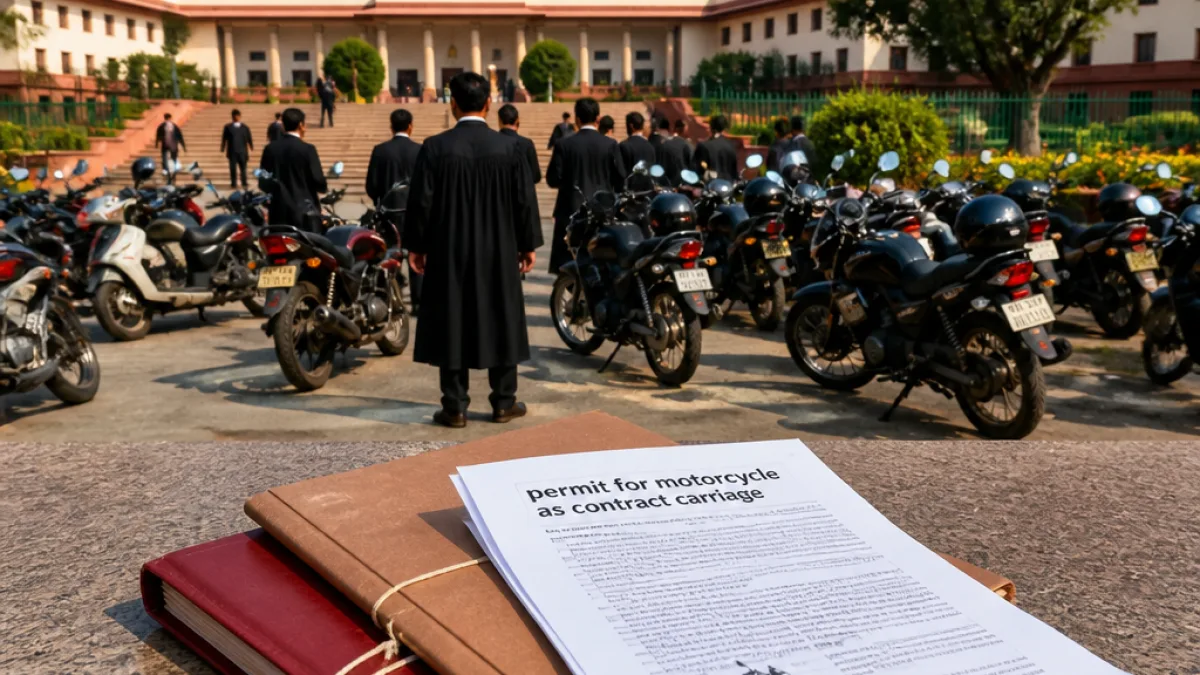
Bengaluru: The Karnataka government on Tuesday told the Supreme Court that motorcycles and two-wheelers cannot be treated as public transport vehicles, arguing that a Division Bench decision of the Karnataka High Court ignored safety, congestion and public-interest concerns when it directed authorities to consider permits for bike taxis.
State cites safety, congestion and limited utility
Appearing before a Bench headed by Justice Satish Chandra Sharma, the State, through advocate Sanchit Garga, submitted that restrictions on use of two-wheelers as taxis were reasonable, proportionate and necessary in the public interest. The matter was deferred for detailed consideration.
"The State has not imposed a blanket prohibition on the use of motorcycles for commercial purposes; rather, it has only restricted their use for carrying passengers," Karnataka told the apex court, adding that alternatives for motorcycle riders exist under the Karnataka Platform-Based Gig Workers (Social Security and Welfare) Act, 2025.
Karnataka argued the High Court's January 2026 Division Bench ruling, which set aside an April 2025 Single Bench order that earlier stayed bike taxi operations, effectively curtailed the discretionary powers of State and regional transport authorities. The Division Bench had found that taxi aggregators and individual motorcycle owners had a right to seek permits under the Motor Vehicles Act, 1988, and declared motorcycles to fall within the category of "transport vehicles." It directed authorities to positively consider applications for contract carriage permits for motorcycles.
State's counterpoint and statutory safeguards
The State maintained it had not prohibited commercial use of motorcycles outright and pointed to statutory welfare measures enacted last year. The Karnataka Platform-Based Gig Workers (Social Security and Welfare) Act, 2025 was cited as providing statutory protection and alternative avenues of livelihood for those dependent on two-wheelers.
In its submission, Karnataka emphasised concerns about the lower safety standards of motorcycles compared with four-wheeled vehicles and other forms of public transport, asserting that two-wheeler taxis raise the risk of higher accident fatalities and add to congestion on already crowded urban roads.
Legal timeline
The litigation over bike taxis has proceeded through multiple judicial stages, with contrasting directions creating regulatory uncertainty for operators and would-be gig workers.
| Order | Date | Direction |
|---|---|---|
| Single Bench order | April 2025 | Stopped bike taxi services pending framing of policy |
| Division Bench order | January 2026 | Set aside Single Bench order; directed consideration of contract-carriage permits for motorcycles |
| State's appeal to SC | August 11, 2026 | Challenge to Division Bench decision; matter adjourned |
Implications for commuters and gig workers
If the Division Bench view ultimately stands, aggregators and individual owners may obtain permits to carry passengers on two-wheelers, potentially creating a new category of urban transport in Bengaluru and other cities. The State warned that such an outcome could elevate accident risk and strain urban traffic management.
- Regulatory discretion: Karnataka says authorities must retain power to grant or refuse permits based on safety and local conditions.
- Worker welfare: State pointed to the 2025 gig-worker law as a statutory safety net for two-wheeler operators.
- Public safety: Government highlighted higher two-wheeler fatality rates and congestion as key concerns.
Legal experts say the case will require the Supreme Court to balance individual and commercial rights under the Motor Vehicles Act with the State's duty to ensure road safety and manage urban traffic. The outcome will be watched closely by ride-hailing platforms, gig workers, municipal bodies and commuters across Karnataka.
The court has yet to fix the next hearing date. Until then, the regulatory status of bike-taxi operations in Karnataka remains uncertain, with implications for policy framing, permit issuance and on-ground enforcement in Bengaluru and other urban centres.