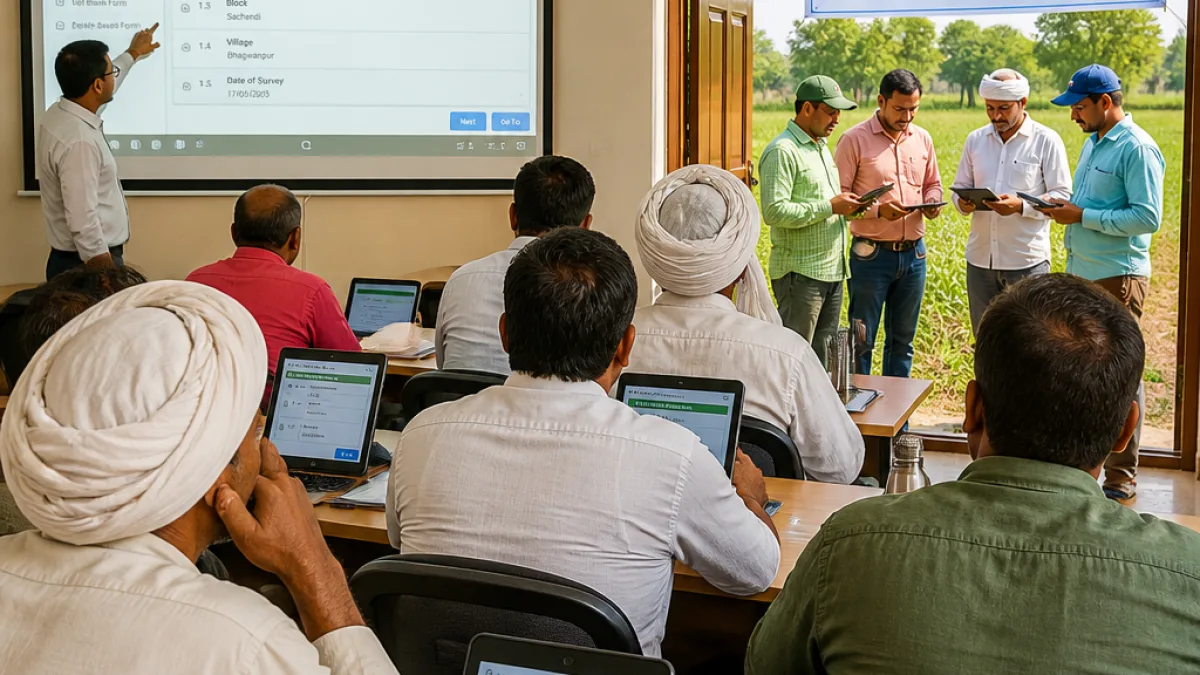
ICAR‑ATARI Kanpur finishes two‑day ODK training to strengthen farm data collection
Kanpur: The Agricultural Technology Application Research Institute (ICAR‑ATARI), Kanpur, concluded a two‑day hands‑on training programme on Landscape Diagnostic Survey (LDS) using the Open Data Kit (ODK) platform on 12 August, organisers said.
The event, held in collaboration with the International Food Policy Research Institute (IFPRI), the International Rice Research Institute (IRRI) and the International Maize and Wheat Improvement Centre (CIMMYT), brought together Subject Matter Specialists (SMSs) from six identified Krishi Vigyan Kendras (KVKs), extension personnel and farmers for practical field exercises in digital data collection.
- Practical exercises included questionnaire administration, data validation and quality assurance on the ODK platform.
- A field‑based survey component enabled SMSs to interact directly with farmers and capture real‑time field information.
- The programme also marked the inauguration of the MELIA/MEL Cell at ICAR‑ATARI, Kanpur and a plantation drive for Hariyali Amavasya.
According to the institute, the training was designed to build capacity ahead of a pilot implementation of the Landscape Diagnostic Survey in selected districts, and to familiarise extension staff with digital tools for systematic field diagnosis.
Dr R. R. Burman, Assistant Director General (Agricultural Extension), ICAR, New Delhi, emphasised the need to "further strengthen the research–extension–farmer linkage through data‑driven approaches."
Dr Raghwendra Singh, Director, ICAR‑ATARI, Kanpur, said the LDS will help translate field realities into research priorities. He said the survey "would systematically capture farmers’ field‑level realities, constraints and needs, enabling these insights to be translated into demand‑driven research priorities and extension programmes."
Focus on making extension evidence‑based
Organisers said the training gave participants hands‑on experience with all stages of digital survey work: from designing and uploading questionnaires on ODK to conducting interviews, collecting geo‑tagged observations and performing quality checks. The practical exposure aimed to strengthen preparedness for the pilot LDS rollout in selected districts and to promote a continuous feedback mechanism involving students and local stakeholders.
The inauguration of the Monitoring, Evaluation, Learning, Innovation and Analytics (MELIA/MEL) Cell at the institute underlined a wider push to institutionalise data‑driven extension services, organisers added. A plantation drive held on the second day marked Hariyali Amavasya and reflected ICAR‑ATARI’s emphasis on integrating environmental sustainability with agricultural research and extension.
| Item | Detail |
|---|---|
| Duration | Two days (concluded 12 August) |
| Organisers | ICAR‑ATARI Kanpur with IFPRI, IRRI, CIMMYT |
| Participants | SMSs from six identified KVKs, farmers, extension personnel |
| Key activities | ODK field exercises, MELIA/MEL Cell inauguration, plantation drive |
Officials highlighted that the LDS is intended to strengthen the "lab‑to‑land" approach by systematically documenting farmers’ constraints and needs so that research and extension can become more demand‑driven. The emphasis on capacity building for digital data collection comes as central and state agencies increasingly adopt evidence‑based planning tools to improve agricultural outcomes.
Participants were reportedly trained in data validation and quality assurance procedures to ensure reliable survey results during the upcoming pilot. ICAR officials said engaging students and local stakeholders in the process would help create a continuous feedback loop between farmers and researchers, improving adoption of appropriate technologies and interventions.
The specialised training in Kanpur represents a local step towards wider national efforts to use digital tools in agriculture, with the institute positioning itself as a nodal centre for training and pilot implementation of the Landscape Diagnostic Survey in nearby districts.