New Delhi: Uttar Pradesh's Compressed Bio-Gas (CBG) industry has attracted roughly ₹3,500 crore of investment and generated employment for about 25,000 people, the state's Agriculture Minister Surya Pratap Shahi said on Wednesday. He said around 20 plants are already operational and another 70–80 are expected to be built.
Expansion amid a larger green-energy push
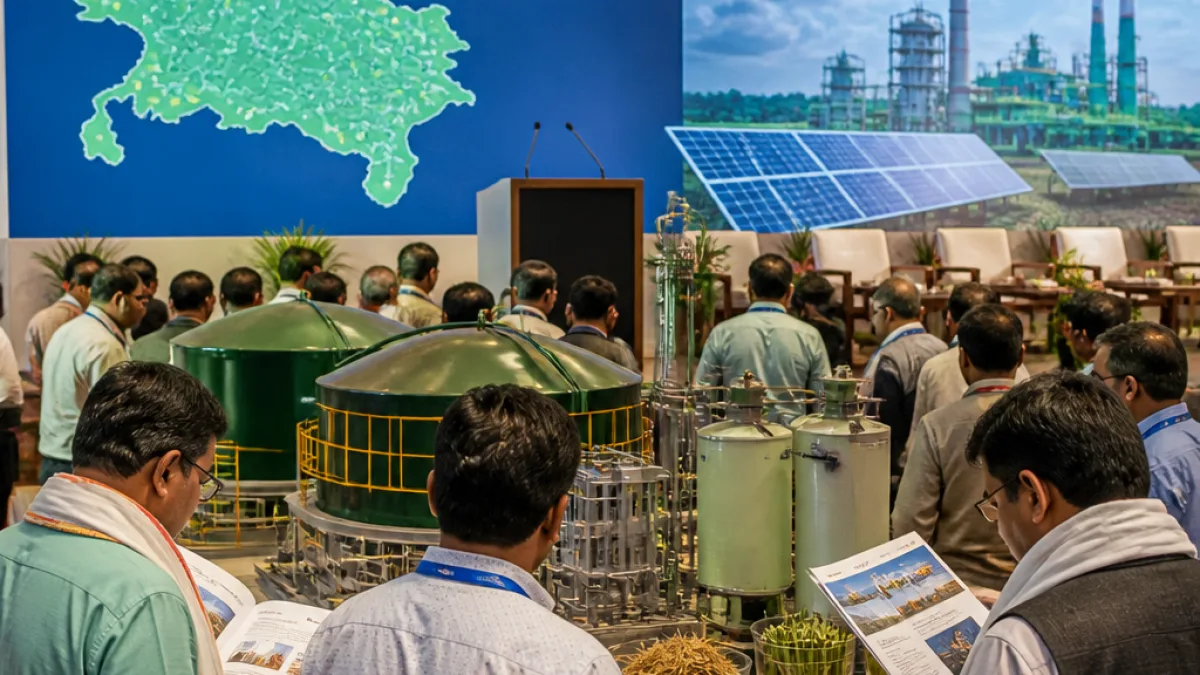
Shahi made the remarks on the sidelines of the second day of the India Bioenergy and Tech Expo and the 3rd International Conference and Exhibition on Bioenergy and Technologies in New Delhi. He said Uttar Pradesh had made "significant progress" in green energy in recent years and pointed to electricity generation and fuel production milestones.
According to the minister, the state has generated more than 5,000 MW of electricity through solar and other sources. He also said Uttar Pradesh is the top producer of both ethanol and CBG in the country, positioning the state as a growing hub for bioenergy.
"Around 20 plants are working and 70-80 more are going to be built. Up to ₹3,500 crores of investment has been made and 25,000 people have got employment through that," Shahi said.
Implications for farmers and soil health
Shahi emphasised the potential of bioenergy projects to boost farmers' incomes and improve agricultural land. He noted that by-products from CBG projects — particularly bio-fertilisers — could be effective in enhancing soil health and increasing the productivity of farmland.
"In order to increase the income of the farmers, this is a very important step," the minister said, adding that bio-fertilisers produced through such projects "will also be very effective and the land of the farmers will be able to be cultivated."
Feedstock availability and logistics remain a challenge
Despite the gains, Shahi acknowledged challenges in securing adequate feedstock for the CBG units. He said a system for collection needs to be developed and that while the government has taken steps in Uttar Pradesh, industry players will also have to engage more closely with farmers.
He added that in some cases the industry may have to pay appropriate prices to farmers for feedstock, indicating a potential market mechanism to ensure steady supply.
- Investment: ₹3,500 crore (approximately) attracted to UP CBG sector
- Employment: Around 25,000 people reported employed
- Operational plants: About 20 currently working; 70–80 more planned
- Electricity capacity: More than 5,000 MW generated from solar and other sources (statewide figure cited by minister)
Numbers at a glance
| Metric | Figure |
|---|---|
| Investment attracted | ₹3,500 crore |
| Jobs created | 25,000 |
| Operational CBG plants | ~20 |
| Planned plants | 70–80 |
| Solar and other generation | 5,000 MW+ |
Why CBG matters for UP
Compressed Bio-Gas is produced from agricultural residues, cattle dung and other organic waste and can be used as a transport fuel or for power generation. For Uttar Pradesh — India's most populous state with a significant agricultural base — expanding CBG production can serve multiple policy goals: diversify farmer incomes, provide cleaner fuel options, reduce open burning of crop residue, and generate local employment.
Shahi linked the sector's expansion with broader efforts in UP to scale renewable electricity and ethanol production, indicating an integrated approach to bioenergy. However, he cautioned that securing feedstock and establishing reliable collection systems are necessary to sustain growth.
Next steps and outlook
The minister said there is "still a lot of work to be done," signalling that the state government anticipates continued involvement with both industry and farming communities. He referred to Memoranda of Understanding (MoUs) that have been signed, though details on the specific agreements or signatories were not provided in his remarks.
As more plants move from planning to operation, attention will shift to feedstock logistics, price mechanisms for raw materials, environmental safeguards around plant operations, and the effective distribution of bio-fertilisers to farmers. The sector's trajectory will be closely watched by policymakers seeking to balance agricultural welfare, rural employment and clean-energy objectives.
— Abhishek Tripathi, Uttar Pradesh Correspondent