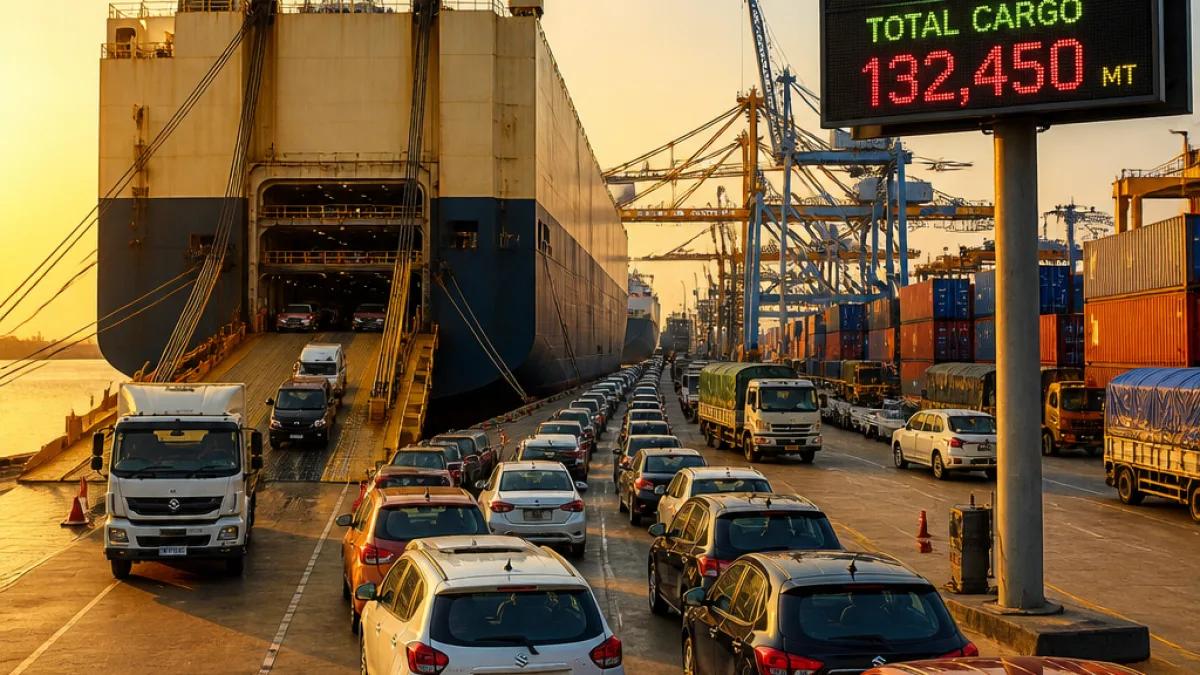
Gujarat Pipavav Port Limited reported a substantial year-on-year rise in consolidated profit for the quarter ended June 30, 2026, reflecting stronger container and Ro‑Ro activity that offset weakness in liquid bulk and rail‑linked volumes.
Key financials and cargo trends
Consolidated revenue for Q1 FY27 stood at approximately ₹332 crore, up from ₹250.44 crore in the same quarter of the previous year. Net profit increased about 42% to roughly ₹148 crore, compared with ₹104.32 crore in Q1 FY26, indicating improved operating leverage as the top line expanded.
The port’s container operations remained steady, with throughput of 1.68 lakh TEUs in the quarter, a modest rise from 1.64 lakh TEUs a year earlier. The most marked growth came from roll‑on/roll‑off (Ro‑Ro) cargo, which surged to 65,000 units in Q1 FY27 from 42,000 units in Q1 FY26 — an increase of 54.8%.
Mixed performance across bulk and rail segments
Not all segments contributed positively. Dry bulk volumes eased to 0.52 million tonnes from 0.55 million tonnes in the year‑ago period, while liquid bulk recorded a sharper decline to 0.22 million tonnes from 0.41 million tonnes. Rail logistics also moderated: the number of container trains handled fell to 346 from 447, and containers moved by rail dropped to 88,000 TEUs from 99,000 TEUs.
What the mix means for port economics
The quarter’s results underline a cargo mix shifting toward containerised and automobile traffic — areas that typically carry higher margin per unit compared with some bulk commodities. Strong Ro‑Ro growth and resilient container handling helped sustain profitability despite softening in liquid bulk and rail movement, signalling the port’s growing orientation to vehicle and container trade corridors.
Gujarat Pipavav operates under an exclusive concession with the Gujarat Maritime Board through September 2028 and handles a portfolio that includes container, dry bulk, liquid bulk and Ro‑Ro cargo. That concession framework, combined with cargo mix shifts, will inform the port’s revenue profile as it moves deeper into FY27.
- Revenue (Q1 FY27): ~₹332 crore (Q1 FY26: ₹250.44 crore)
- Net profit (Q1 FY27): ~₹148 crore (Q1 FY26: ₹104.32 crore)
- Container throughput: 1.68 lakh TEUs (Q1 FY26: 1.64 lakh TEUs)
- Ro‑Ro units: 65,000 (Q1 FY26: 42,000)
- Dry bulk: 0.52 mt (Q1 FY26: 0.55 mt)
- Liquid bulk: 0.22 mt (Q1 FY26: 0.41 mt)
- Container trains handled: 346 (Q1 FY26: 447); Rail TEUs: 88,000 (Q1 FY26: 99,000)
Quarterly metrics at a glance
| Metric | Q1 FY27 | Q1 FY26 |
|---|---|---|
| Consolidated revenue | ~₹332 crore | ₹250.44 crore |
| Net profit | ~₹148 crore | ₹104.32 crore |
| Container throughput | 1.68 lakh TEUs | 1.64 lakh TEUs |
| Ro‑Ro units | 65,000 | 42,000 |
| Dry bulk (mt) | 0.52 | 0.55 |
| Liquid bulk (mt) | 0.22 | 0.41 |
Implications for regional logistics and industry
Gujarat’s port network plays a central role in the state’s trade and industrial ecosystem. For automotive exporters and components manufacturers in and around the Saurashtra and Kutch regions, rising Ro‑Ro volumes at Gujarat Pipavav are a positive sign of demand and logistical throughput. Container growth, even if moderate, supports the state’s containerised trade lanes, including imports of industrial raw materials and exports of finished goods.
Conversely, the fall in liquid bulk throughput could reflect weaker imports for refining feedstock or lower throughput in petrochemical consignments; stakeholders in those sectors will monitor subsequent quarters to assess whether this is a short‑term blip or a structural change. The reduction in rail‑linked container movement may highlight modal shifts or capacity constraints that logistics planners must address to maintain hinterland connectivity.
Overall, the quarter’s results suggest the port has navigated mixed segmental trends to deliver improved earnings, driven by a favourable cargo mix and higher revenue. How these trends evolve over the remainder of FY27 will be watched closely by shippers, automobile exporters and logistics operators who rely on Gujarat’s maritime gateways.
Kiran Patel
Gujarat correspondent