State sets ambitious capacity goal with green-energy condition
The Gujarat government has formally notified the Viksit Gujarat Data Center Policy 2026–29, charting a course to attract hyperscale and AI‑optimised digital infrastructure while insisting that eligible facilities source a majority of their operational power from renewables. The policy targets 7.5 GW of hyperscale data‑centre capacity by 2029 and requires qualifying projects to obtain at least 51% of their electricity from renewable and green energy sources.
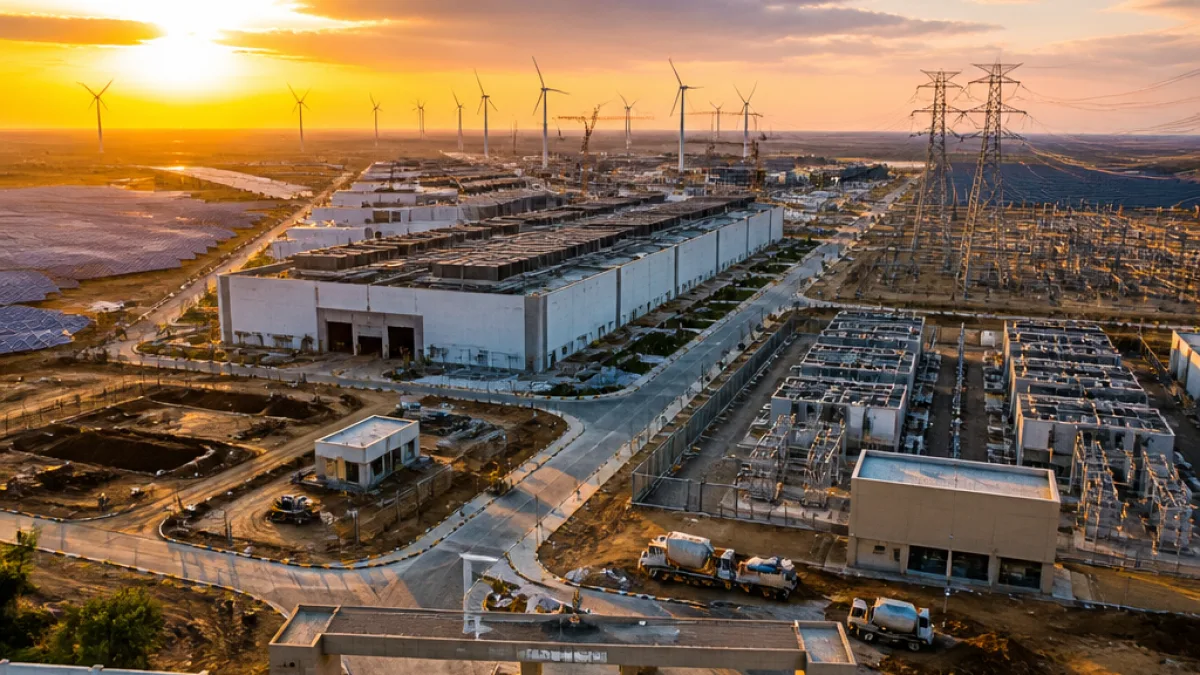
Officials have positioned the Dholera Special Investment Region as the principal node for this expansion, with additional financial infrastructure and connectivity advantages to be leveraged from GIFT City. The decision taps Gujarat’s existing strengths: nearly 74 GW of installed power capacity, a mature renewable ecosystem and dense optical‑fibre connectivity.
Fiscal incentives targeted at large, hyperscale projects
The policy is designed to favour large projects. Data centres with an approved installed IT load of 150 MW or above will be eligible for a package of fiscal incentives intended to lower upfront cost and operational risks for investors. Key support measures include:
- Capital subsidy of 2.5% on eligible fixed capital investment (EFCI) in the Dholera region.
- Interest subsidy of up to 4% for 10 years, with an annual cap of ₹25 crore.
- Power tariff subsidy of ₹1 per unit for a period of 20 years.
- Full exemption from stamp duty and registration fees on land lease or purchase.
- 100% reimbursement of electricity duty for 20 years.
- SGST reimbursement for plant and machinery, building infrastructure and eligible services.
The overall value of incentives is capped at 75% of eligible fixed capital investment, while annual disbursement will be limited to 5% of the total eligible amount.
Development support and operational facilitation
Beyond fiscal relief, the policy provides data‑centre specific development provisions intended to simplify construction and operations. These include enhanced floor space index (FSI), allowance for up to 70% ground coverage, flexibility in floor‑to‑ceiling heights and permission to place chillers on rooftops. The state will also support distribution licensing, facilitate dual power supply via independent feeders and enable open access for electricity procurement.
In recognition of the water intensity of large data centres, the policy contemplates facilitation of captive desalination plants. Capital assistance of up to 20% of expenditure, capped at ₹2 crore per million litres per day of capacity, is available for such facilities.
Implications for investors and the grid
By making a majority renewable sourcing a condition for eligibility, the state seeks to align the sector’s growth with decarbonisation goals while deflecting pressures on the thermal power mix. For investors, the renewable procurement condition will likely encourage long‑term power‑purchase agreements, onsite generation, or hybrid renewable‑plus‑storage solutions.
From the distribution and grid planning perspective, commitments on dual feeders and independent supply lines, if implemented at scale, will require coordination among state utilities, developers and power suppliers to manage load impacts and ensure reliability for both data centres and surrounding communities.
| Feature | Detail |
|---|---|
| Capacity target | 7.5 GW hyperscale by 2029 |
| Renewable mandate | 51% of operational electricity from renewable/green sources |
| Minimum eligible IT load | 150 MW |
| Capital subsidy (Dholera) | 2.5% on EFCI |
| Interest subsidy | Up to 4% for 10 years; annual cap ₹25 crore |
Local economic and employment expectations
Concentrating capacity at Dholera can stimulate ancillary demand for construction, mechanical, electrical and cooling infrastructure, while also supporting the renewable energy supply chain domestically. The linkages to GIFT City may facilitate financial structuring and attract global cloud and hyperscaler firms looking for favourable policy and ease of doing business.
However, the policy’s emphasis on large IT loads means smaller, regional data‑centre projects may not qualify for the fiscal package, which could influence where mid‑tier operators invest within or outside Gujarat.
Next steps and procedural notes
Project proponents seeking incentives will be evaluated against the policy’s eligibility criteria and approval processes established by the state. Annual caps on disbursement and an overall cap on incentive value mean that prioritisation and phasing of projects are likely, particularly if multiple large proposals materialise simultaneously.
The policy positions Gujarat to compete for hyperscale and AI‑aligned digital infrastructure investment in India, combining fiscal inducements with planning concessions and operational facilitation. Its ultimate success will hinge on implementation details—grid upgrades, renewable‑power availability and timely approvals—that determine whether the state can convert its stated ambition into commissioned capacity by 2029.
Gujarat correspondence by Kiran Patel.